So the Plan is Now in Place… and it’s Fucking Stupid

So the plan is now in place, and if it seems utterly cranky, then so much the better. While Clinicality Press will be publishing This Book is Fucking Stupid as a paperback later in the year, it will appear first on two different e-publishing platforms. The reasons for this are numerous, and not least of all financial. E-publishing is free and Clinicality have zero funds; any cash raised from the e-book editions will go directly into the production and marketing of the paperback. So far, so savvy. But here’s the rub: each edition will be different. This Book is Fucking Stupid is an incomplete project, and is designed as such, to be revised, expanded and reworked in order to exist beyond the prescribed confines of a ‘published novel’, wrapped up and clipped by the limitations of authorial and editorial constraints.

Bypassing the conventional process of republication by route of the first edition, revised edition, annotated edition, anniversary edition, scholarly edition, restored text, This Book is a continually evolving piece, it’s first e-publication intentionally abridged, with critical passages withheld for inclusion in the second, to be again expanded and subject to further supplements in the form of introductions, prefaces and a comprehensive index in the first print edition, which will also include further insertions that represent the critical and academic reception. These will all necessarily be engineered by the ‘author’, although each revision will represent a diminishment of the original author’s role and input, as his ‘own’ words and the story itself become diluted, accounting for a reducing proportion of the book’s total contents. The purpose of this exercise is to play out the way in which a text (d)evolves and changes complexion with each revision, translation, annotation, commentary. Even simple republications problematise the materiality of the text, with alternative pagination, typefaces, cover art, all contributing to a different reading experience between editions, a situation not resolved but in fact heightened by digital editions such as those designed for the Kindle, whereby the end user determines the format, the font size and thus the reading experience to a certain extent. Consciously or otherwise, readers respond to the physicality of a print edition of a text, ranging from the luxurious yet cumbersome large-format first edition hardback to the pocket-sized budget edition paperback on low-grade paper with the text in a small font, the lines packed tightly together. There’s a sense of the personal in a print edition, also, and it’s undeniable that one tends to feel and respond differently to a pristine first edition and a well-thumbed and rather battered trade paperback. These responses transcend the impositions of value and of commodity, yet these peripheral tangibles definitely colour the way readers engage with a text. Context is another extraneous factor; again, a scarce edition or clandestine publication provokes a different response from a mass-market edition that’s sold in the millions. The idea of a ‘restored’ edition or an ‘expanded’ edition connotes a sense of incompletion or correction, suggesting that previous editions were somehow ‘wrong’, that previous editors or publishers interfered with the writer’s work, either for the same of marketability, for social or political reasons, or simply because they had no respect, an overinflated ego or lacked any sense of competence.

Of course, history is full of revisions and ‘corrections’ – or perhaps more accurately, realignments, reconfigurations and reinterpretations, and this applies to not only literary history. The process of totalization, by which linear narrative and a continuum based on a sequence of events connected by cause and effect, is the very basis of the conception of history. Yet this almost universally accepted narrativisation is complete artifice, and linear sequentiality fails to account for simultaneity and disconnection. Nietszche was right: everything you believe to be true is a lie. To the point, there’s nothing that’s immutable, fixed, and to anchor a belief system on anything is simply an act of misguided (self)deception.  The revised edition, the expanded edition, the annotated edition, these are all examples not of an enhanced reader experience, but of exploitation, and usually created without the author’s consent and, more often than not, following the author’s death. This Book is different. It may still be exploitative, but at least it’s open and honest about the fact, and all of the insertions, amendments, deletions, are made with the author’s knowledge. It also exists to highlight the cynical nature of the conventional process, the life of the book. This Book collapses all of that, trashes it, burns it, razes it to the ground.
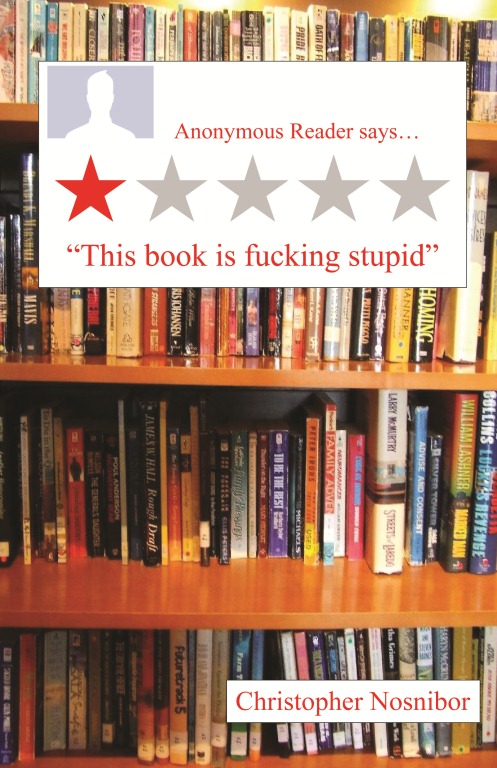
TBIFS Cover 2 copy

And if you’re loving my work, there’s more of the same (only different) at Christophernosnibor.co.uk

Christopher Nosnibor Banned from Social Network.. for Networking

Back in the MySpace days, when I was refusing to sign up to Facebook before peer pressure and a mass exodus meant I had to move in order to maintain my virtual profile and contact with many of the people who I’d met but who had since migrated, there used to be a running joke about Facebook that centred around the absurd premise of only networking with people you already know.

Having accumulated over 1,300 ‘friends’ (who probably are electric) since setting up my account, it’s probably fairly obvious that I’ve exchanged friend requests with a lot of people I’ve never met, never heard of and know nothing about. I do, however, tend to share a number of mutual friends with these ‘strangers’, more often than not on account of common interests and publishing.

Sometimes, I may not be actively seeking friends to add, but will fire off the odd friend request because, well, because Facebook tells me to. Granted, I’m entirely responsible for my own actions, but the feature whereby Facebook suggests friends is undeniably a less than subtle form of suggestion. Now, I’ll concede that it does list these suggestions under ‘people you may know’, but when you’ve got a significant number of mutual friends who move in the same circles, then you’re into ‘friend of a friend’ territory in a rapidly diminishing virtual world.

Still, to cut a short story shorter, it would seem that one of my requestees decided they didn’t know me and didn’t want to and told Facebook as much. Consequently, I received a notice informing me I was banned from sending any friend requests for a week, and furthermore, I was required to revisit the terms and conditions and tick a box on a declaration stating that I wouldn’t send friend requests to anyone I didn’t know, ever again. I was given the option to cancel all of my outstanding friend requests, or just those sent to users with whom I have ‘few’ friends in common, which was generous, but note the use of the word ‘few’ – not ‘no’. What qualifies as ‘few’? it’s all relative, surely. If a person only has 10 friends and five are mutual, it’s relatively many, but few in real terms. I know, I’m intentionally missing the point to an extent.

Moreover, it’s not that I don’t appreciate the irritation and antagonism serial spammers cause, or the threat to personal security the scamming spammers represent, but I nevertheless find this suspension approach absurd, because it’s not hard to distinguish between a human who’s a heavy user and a spambot.

Can you imagine the same scenario playing out in the real world: for example, delegates milling around at a conference not speaking to one another or introducing themselves to others? Shuffling up to the buffet and not speaking to someone because they don’t already know one another is hardly networking, is it? Or imagine a freshers’ week at university where no-one strikes up a conversation with someone just because they look interesting or they’re wearing a particular band T-shirt or whatever, because they don’t share an arbitrary number of common friends already. It’s unfeasible, and life simply isn’t like that. Social networking isn’t like inviting random strangers into your house just because they knock at your door: the clue’s in the name.

So is this an indicator that despite what Facebook claims to be, and despite the fact we’re supposedly living in a shrinking world with a wider society, what we’re actually doing is growing more insular, more fearful of ‘strangers’ and spending our time indoors not meeting new people, preferring instead to only associate in virtual life with people we know in real life? This would also suggest that social networking is, in fact, the precise opposite of what its name implies, and it would be more accurate to describe it as anti-social not-networking. Staying may well be the new going out, but forgive me for wanting to get out more while I’m staying in.


facebook-logo

Farcebook: absurd ‘guidelines’


And if you’re loving my work, This Books is Fucking Stupid is published on April 1st.

I’m in good company….

The following review is something I found on-line while working on my forthcoming novel., This Book is Fucking Stupid. It’s a review of Hemingway’s classic The Garden of Eden.


I give up.

This book is fucking stupid. There is no story at all. It’s all a bunch of sleeping and eating in France while nothing actually happens. Envy and sex. That’s it. A woman has a mental breakdown and Hemingway obviousy had some rampant sexual fantasies. Now that I know what happens… Catherine loses her mind because she’s jealous of David’s attention to writing…she’s a rich little psycho who wants to be showered in attention constantly. She gets increasingly jealous of his masculinity and she admires it so much that she keeps getting her fucking hair cut more and more and it says online that she even got tailored pants and picked up a chick with whom she had a lesbian affair with. Then she lets David sleep with her too. They’re like some sick happy triangle. Oh my god, really? That’s it? A whole fucking novel for that? My god, the first stage of her psychotic episode seriously took up like a third of the book. Maybe when this was written it was groundbreaking and mind bending so I could be looking at it with completely the wrong mindset and judgmental eyes. I just found it to be such a drag. For me, right now, in 2011 at least. I feel like that was such a waste of life, lol I’m sorry. Wow. Just WOW. Like I said it’s probably a lot more amazing in the context of the time. It took the dude fifteen years to finish. I read the summary on the book and thought it was boring, I should’ve just put it back on the shelf. I guess I wanted a taste of how it was written and how everything played out but I found a lot of babbling, broken scenes with a lot of pointless fluff, a lot of “and”s and a character I really dislike who talks too fucking much and needs counseling. I’m a little disappointed. I should just stick to Poe. There’s always a twist, and if there’s not it at least gets you thinking and stimulates the senses. And Emerson. God, this book made me feel so stir crazy. Crazy. Town. Let me out.


hemingway

Hemingway: Who are you calling stupid?


And if you’re loving my work, there’s more of the same (only different) at Christophernosnibor.co.uk
They were cunts in school and are still cunts now….

Job-hopping was, historically, considered to be a bad thing. A job was for life, and anyone who had a CV that consisted of an endless catalogue of short-term contracts was perceived as either being unable to stick at anything, or incapable of obtaining anything more than seasonal or temporary work – usually menial, low-grade employment that was undemanding and required minimal intellect or, worse still, the kind of person who made a habit of getting themselves sacked. Times have changed. Some people actually choose to flit between jobs and call it ‘freelancing’. Others have short-term work forced upon them, and it’s no longer simply the blue-collar types. Offices and ‘contact centres’ (call centres to those who live outside of the corporate environment) are bursting at the seams with temporary staff and staff on fixed-term contracts – to the extent that many large companies actually employ very few staff directly. While the hourly rate for a temp may be higher on paper, subtracting the cost of benefits such as staff pension and sick pay and it’s easy to see why companies do it, although the benefits are immeasurably in their favour over those of the employee. Many of these temporary staff are educated to degree level, yet are still unable to secure permanent contracts. Even in positions that require higher qualifications and levels of experience, the situation is the same: universities are employing teaching fellows on a basis of a semester at a time, for one or two hours of teaching a week.

Again, there is an immense disparity between the idea of job-hopping as a lifestyle choice and the common reality for those who find themselves forced into a life of what Ivor Southwood refers to in his book Non-Stop Inertia as ‘job precarity’. It isn’t fun. And yet recruitment agencies and those who enjoy the ‘freelancing’ lifestyle (usually the kind of people who get head-hunted and land a short-term contract of a year or two in highly-paid executive roles) all emphasise the empowering nature of the ‘freedom’ this approach to employment affords the individual. For those who lack the comfort of a financial buffer and the capacity to earn large sums in short periods of time, the uncertainty and lack of stability that arises from short-term employment contracts is is anything but liberating, and every bit as depressing as being stuck in the same dead-end job for a decade or more.

The endless quest for a new contract and the endless stream of rejections the endless applications elicit is just as soul-crushing as knowing that your life is slowly slipping by while you sit in the same office churning out the same meaningless shit each dull day. At least that unfulfilling rut pays the bills, ensures the rent gets paid and affords the kind of security that comes will a pension, sick pay and all the rest. As a job-hopping freelancer, you are not your own boss: you’re a slave to the quest for the next thing and the search for a new boss to fuck you and discard you along with all the short-term contract trash not worthy of a permanent contract.

Still, surely no employment can be as depressing as Friends Reunited, arguably the first social networking site – if re-establishing contact with people you already know qualifies as ‘networking’. More often than not, people lose contact for a reason: the friends who are worth keeping, you make the effort to maintain contact with, and the effort is mutual. If you want to feel old, look up your old schoolmates. Check out their photos and see how their youthful looks have faded as they’ve grown fat,old, bald and saggy. Read their profiles and see how happy they are with their pathetic lots as they plough through life unquestioningly, aspiring to nothing more than a fortnight in Spain to provide a change of scenery from the 9-5 which, though monotonous, is the pinnacle of their capabilities, and as they like their colleagues and are able to leave their 2.4 children with their parents or grandparents while they go for a few drinks down the pub on a Friday night, it’s no cause for complaint. The ‘successful’ ones are no better really: leaving behind their small-town roots and making for the big smoke after graduation, they’re rich, jet-setting and love their Autumn skiing trips, mini-breaks to Paris and Rome and will have seen the world long before they retire at 50, but none of this changes the fact that they were cunts in school and are still cunts now.

friends-reunited-08

Friends Reunited: keeping track of a bunch of cunts you never liked in the first place

The desire to rebuild bridges with people you were never friends with in the first place is simply a manifestation of the anxiety of ageing, the fear of losing one’s youth and all ties with it. Never mind that you hated school and were bullied mercilessly: you were young and had your whole life ahead of you. Rather than face the fact that you’re halfway through your time on the planet, it’s infinitely preferable to delude yourself that on reflection, school wasn’t that bad, in fact it was good fun. But however hard you work on kidding yourself, however much you force yourself and everyone to swallow the lie that you were cool in school, the bullying was just banter and that you didn’t spend those years lonely, depressed and yearning for something, anything, that would take you out of that hateful environment, every once in a while something will trigger a rush of recollection and it will all come screaming back at you. Sometimes, you can’t help but yield to those pangs of curiosity, when something random makes you remember a name, a face, an occasion and it drags you back like an undertow and you wonder what that person, those people are doing now. And before you know it, you’re trawling Friends Reunited or Facebook. You can’t help yourself, it’s a morbid fascination that makes you recoil in horror at that ageing face, that flabby beer gut, those sagging tits you lusted over when they were pert and teenage and hadn’t been ravaged by three screaming brats by three different fathers, none of whom is the current husband, hanging off them but you still go on through those family snaps, the pictures of the works nights out, the hen night for that slapper who laughed at you when you said ‘crotches’ when you meant ‘groynes’ in geography class. You can still hear that honking sound that ended with a snort and your blood boils with repressed anger even though it was almost a full fifteen years ago now. And that’s why you try not to think about it, because when the recollections resurface, the old wounds open up and you find yourself staring into the gaping gash straight into your fear-filled soul that’s been shrivelled by a decade of corporate dehumanisation. You need to snap out of it, now.


And if you’re loving my work, there’s more of the same (only different) at Christophernosnibor.co.uk