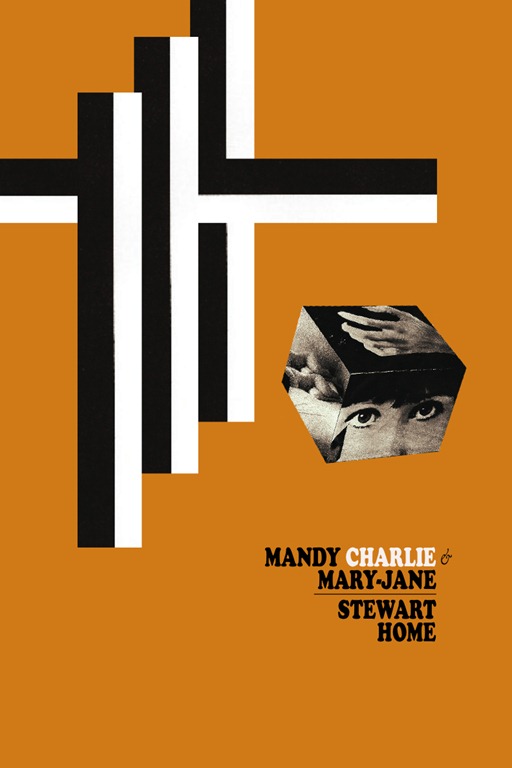
The one thing it’s possible to predict with the publication of any new Stewart Home book is Home’s unpredictability, and his latest book to be published, Mandy, Charlie and Mary Jane is a suitably unpredictable and audacious assault on cultural studies – and a broad range of targets, as it happens.
Although Home is by no means an author who adheres to the adage ‘write what you know’, he does freely admit to drawing on his immediate environment for source material, having presented journal-like reportage in Memphis Underground and based countless characters on thinly-veiled representations of figures in the art scene throughout his career.
It’s for this reason that Mandy, Charlie and Mary Jane contains lengthy lists of films, and on-line DVD purchases that look suspiciously like the sort the author himself would buy, along with lengthy reviews of exhibitions written in the style of Home’s blogs, and screes of dialogue on trains and in lecture theatres that appear to have been transcribed from real-life scenarios almost ver batim, or otherwise exist solely to facilitate the expounding of some theory.
I’ve always been one to appropriate dialogue myself, because creating dialogue that reads like it might have actually been spoken is difficult. Ironically, in my experience, and as if to prove the adage that truth is stranger than fiction, my lifted dialogue has been criticised for not being credible. In Home’s hands, the absurdity is heightened by the incongruity of context.
There’s also the issue of the 7/7 bombings and the way Home ties this in with the narrator’s delusional quest for some vague domination. This particular event – as Home explained in one of his blog posts – features in the book primarily because it was happening at the time the book was being written and some of the observations on the event are from the author’s own experience of being in London on that day. Yet its inclusion is one of the reasons it’s taken so long for Mandy, Charlie and Mary Jane to arrive in the public domain. Recent history, when absorbed within the context of a postmodern novel, is just too sensitive and problematic for most publishers. Of course, Home’s contentiousness is a part of his appeal, and his portrayal of academic life is as likely to cause a stir in certain quarters as the terror thread of the plot.
I’m not referring to the countless sexual antics with students – real or imagined – but the narrator’s criticisms the university system in the UK. Of course, highlighting the issues of the effects of tuition fees and the squeezing of academic resources in the name of profitability is all part of Home’s ongoing critique of capitalism. However, where Mandy, Charlie and Mary Jane differs from his earlier ‘skinhead’ books which were overtly and explicitly political, is in the way the issues are addressed. Instead of using his third-person characters as parodic ciphers delivering blunt sloganeering polemic and slabs text by Marx et al, the first-person narrator of Mandy, Charlie and Mary Jane offers more subtle yet even more scathing observations from the coal face, as it were.
Home slings in large chunks of review, criticism, critique and theory in trademark fashion (echoing previous works, notably 69 Things to Do With a Dead Princess). The narrator’s Marxist reading of Deep Throat is as amusing as it is audacious, and is, of course, classic Home. By establishing his narrator, John – or Charlie – Templeton as a cultural studies lecturer with a chronic drug habit, these skewed academic musings are fitting, and what’s more, in Templeton, Home is also able to play with and dismantle notions of fixed character – even the narrator doesn’t know who he is at times and frequently contradicts himself throughout the story. It may revisit the character shifts in his 1997 novel Come Before Christ and Murder Love, and draw the more absurd elements from Memphis Underground together with elements of Cunt, but then formula has always been an integral aspect of Home’s output, and it never worked to the detriment of the work of any genre author, or Ballard for that matter.
And so the resurfacing of phrases that have appeared variously and numerous times in his previous works is all part of the joke. It isn’t supposed to be subtle, and by now, the reader is supposed to be in on the gag which centres around the fact that Home’s built a career on declaring himself a rampant plagiarist (and notorious / celebrated self-promoter) and now we see him appropriating from himself quite liberally.
Noting in one of his blogs that Mandy, Charlie and Mary Jane, like its predecessor Blood Rites of the Bourgeoisie was written – at least in part – while installed as a university writer in residence, it’s therefore unsurprising to find Home use the campus as his novel’s primary setting. Equally unsurprising, Home’s choice of location, the City University of Newcastle upon Tyne facilitates the use of its acronym repeatedly throughout the text, adding the type of shock value Home is notorious for before immediately debasing it through endless repetition – which in Home’s eyes renders it all the funnier, in accordance with his recurrent citation of Bergson’s theory that suggests repetition is the basis of all humour. No doubt by the end of the book and the thousandth repetition of CUNT, Home had split his sides and jizzed himself to a husk at his own wit and genius. And rightly so: it was certainly my instinctive reaction. Because as one of the few authors to take postmodernism to a new level and turn its self-celebrating, self-collapsing theoretical existence back in on itself, Mandy, Charlie and Mary Jane sees Home remain several steps ahead of the game (even taking into account the fact that this book was written five years ago).
It’s not just the narrator who loses the plot as the book progresses, and what begins in a relatively grounded realist setting (d)evolves into surreal flight of fancy. The ending is, of course, a complete joke, but also – even despite Home’s previous flights into the surreal – a surprise that’s likely to leave you shaking your head. I’d argue that you don’t really read Home’s novels for their plots, however, so much as the explosion of ideas, and on that level, Mandy, Charlie and Mary Jane certainly doesn’t disappoint, and, equally importantly, it’s perverse, it’s funny and, put simply, a cracking read.
And if you’re loving my work, there’s more of the same (only different) at Christophernosnibor.co.uk
 Christopher's Headspace