Criticising the Critics Criticising the Critics: An Exercise in Infinite Reflexivity and Getting Hip

So I recently stumbled upon a piece that was ostensibly a review of a gig I’d attended and reviewed, but with the secondary purpose of dismantling my review.

The writer, one Patrick Lee attacked my write-up from a number of well-considered angles, but it seems that the primarily provocation, to which he took particular exception, was my observation regarding the number of trendy hipster bozos in attendance (in fairness, relatively small) and the fact they talked incessantly (thus more than compensating for their number in terms of volume and level of irritation caused).

What I actually said, in the middle of a glowing review of all 4 acts performing that night, was, “Granted, a band as hot as White Firs are going to attract more than their fare share of hipster hangers-on, and the duffel-coat wearing popped-collar brigade are out in full force tonight, standing right at the front talking loudly and posturing hard. Forget ‘em. it’s all about the music…”

His response – suggesting he didn’t read the entire piece – was to get uppity about the duffel coat diss (I’d add that I was wearing a fleece under a jacket under a leather coat, because it was cold and I need the pockets to carry my pad / camera / beer / ego, but of course, I like to be inconspicuous at gigs and so not only to I keep out of the way but I keep my trap shut) and to defend talking throughout Bull’s set (I wouldn’t know if he jabbered on through the headliners’ set because I moved to get away from the hipster bozos who’d been standing directly in front of me).

He begins by saying ‘I think I might have been (depending on the time of the paragraph taking place) one of the “hipster hangers-on”, and whereas I am, I think, borderline complimented by this, I do take exception to the duffel-coat criticism, wanting to take the chance here to express admiration both for the duffel coat itself, and for those daring enough to wear it inside at a gig as “hot” as the one The White Firs produced.’

I’d also note here that neither of the places which have published Patrick’s piece (in Vibe as ‘Notice the form, or, Looking up at music culture from the underground’ and One&Other under the more descriptive and succinct title ‘Review: White Firs at Nichely Does It’) include links or even proper credits to my own original review which appeared at Whisperin’ and Hollerin’ and this, it has to be said, is poor form. But what’s considered good etiquette clearly isn’t a part of his agenda and may not even feature in his cognisance.

More pertinently, only a narcissist of the highest order would find any way of converting my criticism into a commentary, and then to admit to a) being one of the ‘characters’ so depicted b) being complimented (borderline or otherwise) transcends narcissistic egotism and borders on sociopathy. But then, such is the arrogance of the hipster. Pretentious, moi? I’m so cool, of course he’s writing about me… At this point, Patrick turns my criticism around a full 180 degrees to reveal that in fact, it is I who is in the wrong for being so misguided as to complain about their incessant chatter, writing,

‘to criticise those voicing an opinion during bands like Bull and The White Firs would be an error. Daring to pursue, tackle, render lifeless and then begin a post-mortem on this error is, as noted, daring, as splitting open an ugly error of such bizarre and complex proportions is likely to result in being covered in surgical smelling entrails; but, dragged here as we have been, we might as well cover ourselves in the grizzly innards of the thing, and hopefully be left cathartically and metaphorically cleansed by the end. A crucial question has been left unasked by the typical, cliché-ridden reviewer of music: What do The White Firs do?’

What do White Firs do? I think I covered that, actually, because I make a point of providing objective reviews that actually say what bands sound like and what they ‘do’ on whatever level people who’ve not heard the band may be interested in knowing about. Again, this furthers my theory that Patrick’s protracted exposition was a knee-jerk reaction to the second paragraph, and he was so incensed and overwhelmed he was compelled to spill his effusive verbiage instantaneously without taking the time to read on.

I feel a degree of empathy here. I too sometimes struggle to contain the urge to splurge when it comes to committing words to the (virtual) page, although I do think it’s poor form to dismantle a piece of writing without having read all of it. There’s a grave danger of appearing reactionary and ill-informed, after all. More importantly, my piece doesn’t have any pretence of being anything other than a review. It’s a short article, not a feature. I produce over 400 reviews a year. There isn’t the time to pick apart every fibre of every band’s being, and nor would I wish to even if there were. I don’t care what White Firs ‘do’ in terms of their being some kind of mega-influential cultural phenomenon. Not yet, anyway.

So when I wrote that ‘During their blistering set that ratcheted up both the volume and intensity of the night, they proved themselves to be in a different class altogether. With a rock-solid rhythm section (drummer Jack Holdstock occupied the stool for now-defunct but hotly-tipped garage noisemongers The Federals) providing the pulsating heart of the sound and the essential foundations for the fuzzed-out guitar attacks, they’ve got the swaggering Stooges sound absolutely nailed,’ I think I gave a few hints about what they ‘do’.

In fairness, hipster wordsmith Patrick Lee is writing with a different purpose. His angle, while writing on music and culture, in this piece, is to consider the nature of music reviewing, and there are many who believe that reviewing is a frankly pointless exercise. Fair enough, but in my experience both as a reader and writer of reviews, I’ve found that people come to respect the opinions of certain reviewers, and discover a lot of new bands they otherwise wouldn’t have because of the acts those reviewers provide exposure to.

It’s notable that a number of people have complained that they’ve never heard of any of the bands I review. As far as I’m concerned, that’s precisely the purpose of my reviews. Everyone already has an opinion on U2, Radiohead, Madonna, Coldplay, the household names and acts they have heard of, and there’ll be no short of coverage of their latest album in everything from The Guardian to the NME via The Sun and Q, not to mention every last website you might care to look. I find it much more gratifying – and culturally useful – to put word out about unknown and lesser known bands. And it’s for this reason I place such emphasis on description. Again, by way of example, another excerpt from my review of White Firs.

Danny Barton’s vocals have a nonchalant drawl about them, but still carry a melody and delivery some tidy pop hooks. Meanwhile, brother James churns out thumping basslines as cool as you like, while occasionally throwing in some shouty backing vocals. For all the overdriven noise blasting from the amps and the PA, it’s clear they’ve got a keen ear for a tune, their appreciation of Big Star shining through the squall of feedback.’

I’d also add that I tend to keep my style simple and direct, not because I’m incapable of flourish-filled purple prose, but because, well, who needs it? I love seven-line sentences and paragraphs that extend beyond three pages more than most of my work reveals, but by the same token, I do make every effort not to produce slabs of text so sense with descriptors as to lose even the most articulate of readers – an my own meaning – before the first semicolon. Postmodern society’s alienating enough without needlessly alienating the bulk of any potential readership before you’ve even said anything. Moreover, a good reviewer knows that their job is to convey what’s exciting about the band – and it’s all about the bands, not pushing my own agenda of convincing a publisher that they should indulge my literary aspirations by signing me up for a five-book deal which will see me rubbing shoulders with Martin Amis and Salman Rushdie and other heavyweight purveyors of literary fiction. Again, Lee’s reference points – Hemingway and Brett Easton Ellis – are telling in that they’re suitably literary (by which I mean they’re worthy namedrops for anyone with a casual interest in 20th Century literature) but reveal the author to be lacking in real knowledge of the field (Stewart Home makes for a much more pertinent and credible alternative to Ellis, and Lee could do far worse than acquaint himself with the exploratory prose of my own recent anti-novel, This Book is Fucking Stupid, if only to demonstrate just how firmly he’s got his finger on the pulse of the literary zeitgeist).

I’m practically bawling into my beer when I read his incisive summation of Bull, which pisses all over my my ‘tepid, cliche-ridden’ descriptions (being a typical music reviewer, I’m completely incapable of moving beyond such abysmal prose, while yearning to achieve flourishes comparable to his Paul Morley-esque circumlocution, brimming with esoteric verbosity dressed in endless frills. So when Mr Lee writes of ‘splitting open an ugly error of such bizarre and complex proportions’, it’s worth remembering the context. He’s writing about talking at a gig. And what’s more, he’s trying to defend it by pointing out that he was only saying good things about the bands. Good, clever things, too, unlike my simplistic, witless cliché things – which I at least had the decency to keep to myself until I’d left the venue. Put simply, Lee is making a pathetic and utterly misguided attempt to excuse the inexcusable and defend the indefensible by means of absurdly overinflated and exhausting prolix.

Of course, it all amounts to no more than pleonastic posturing. Fair enough. But please, next time you’re watching bands play, just shut the fuck up.

 

hipster1

A hipster at a gig, minus duffel coat. He’s so cool he’s hot and doesn’t need any tepid descriptions, dude.


Patrick Lee is a graduate from Goldsmiths College, University of London. He has written for Mint Magazine, International Relations, The Vibe and continues to write and edit fiction for Shabby Doll House. He enjoys music and film, and reading contemporary fiction, non-fiction and philosophy.

His profile pic features him, with a chick – thus illustrating his popularity and appeal to the opposite sex – with a paper or polystyrene beaker held in his mouth. What a bozo.


Christopher Nosnibor is a writing machine. He doesn’t feel the need to justify his existence by including his superior educational background in his biography and has written for more publications than her can be bothered to list.

He doesn’t have a profile picture, so no-one can identify him and beat the crap out of him when he’s dished out one of his more critical music reviews.


And if you’re loving my work, there’s more of the same (only different) at Christophernosnibor.co.uk


A Total Groove: Record Store Day 2013

Record Store Day has become an insanely big deal, and while it’s something of a double-edged sword for both stores and collectors alike – a debate I don’t feel the need to cover here – the fact is that I like RSD, and I’m certainly not alone.

While I have, in recent years, spend a lot less in record stores than I used to – partly because the opportunity isn’t there, partly because I simply don’t have the disposable income I once did and partly because I get sent a lot of music to review that I would have historically paid for – I do still put money into independent record stores whenever I can. I do so not out of a sense of dutiful charitability born out of sympathy (although there may be an element of that), but because they’re the places that tend to stock the stuff that I want.

Of course, larger independent stores still usually carry more stock than smaller ones, and have more buying power when it comes to things like Record Store Day. For this reason, I could have easily been tempted to make the trip to Leeds, raid Jumbo and Crash and return home with an armful of vinyl from my ‘wants’ list plus another armful of stuff to flog on at three times the price, thus covering my own expenditure, plus train fare and even potentially leaving me with a near profit.

Instead, I stayed local and hit The Inkwell. Why? In recognition of the fact that it’s a great little boutique shop. In recognition of the fact it’s my local record store, the one I drop into and invariably leave with something cool whenever I have any spare funds. In recognition of the fact that it has a community vibe. And in recognition of the fact that Paul, the owner, asked his customers for suggestions, recommendations and requests for items to order from the RSD release list. That’s a cool thing to do. Not having the budget to get a rack full of everything, it made sense. Moreover, look after the regular customers, and they’ll look after you.

I arrived for opening, and left happy with a clutch of singles, including a copy of the Twilight Sad 7” I’d recommended (one of only 500 numbered copies) and The Fall’s single.

In the afternoon, I went back to check out the two live acts who were playing: the ubiquitous and prodigious Mark Wynn, and purveyors of tinnitus-inducing garagey grunge, …And The Hangnails. Again, although scheduled as part of the RSD goings-on, The Inkwell hosts shows from time to time, either for the launch of local bands’ releases or just because, which is another reason stores like this (not that there are many stores quite like this) deserve support.

Mark and I exchanged goods: I traded him a hot-off-the-press print copy of This Book is Fucking Stupid for a copy of his new vinyl pressing, Social Situations, a split release with The Sorry Kisses. He proceeded to deliver one of his marvellously idiosyncratic performances, interspersing songs of social observation and gloriously off-kilter anecdotes with banterous ramblings that are awkwardly hilarious and hilariously awkward.

…And the Hangnails weren’t as loud as I might have expected and were nowhere near as loud as Swans the other week, but for a room with a standing capacity of 20 or so, the powerhouse 2-piece were pretty fucking loud. The shop got extremely warm and I began to worry the vinyl might melt (although by this time, only four or five RSD exclusive releases remained). Some kids looked uncomfortable and left, probably because they couldn’t hack anything as gritty and authentically rock ‘n’ roll as Hangnails (they’re certainly not White Stripes or The Black Keys), but the rest who stuck around really dug it. …And rightly so.

This, ladies and gentlemen, is rock ‘n’ roll. And this is what Record Store Day is really about.


DSCF3612

…And the Hangnails crank it up to ten and a half in a confined space


Check out The Inkwell here.

Check out …And The Hangnails here.

Check out mark Wynn here.

And if you’re loving my work, there’s more of the same (only different) at Christophernosnibr.co.uk

Redressing the Balance: This Book Isn’t Nearly as Stupid as the Title Suggests… Or Is It?

For all of the claims made by myself and my publisher for the audacious anti-literary bent that drives my latest novel, This Book is Fucking Stupid, the fact that the core thread – the story itself – is essentially a straightforward piece of contemporary literary fiction is something that’s been very much underplayed.

As the paperback edition is out today, I thought it would be an idea to post an excerpt from one of the more conventional narrative passages, if only to prove to the world that as a writer I am capable of ‘normal’ things like plot and character development (after a fashion) and not only about text that function on a theoretical level…. Ok, well I half mean it…


from This Book is Fucking Stupid


It was just another day at the office, the same as any other. Ben sat at his desk. He had spent the last three hours trying desperately to compile his latest report based on a series of site visits to out-of-town shopping developments ahead of Friday’s deadline, but it was proving nigh on impossible. For a start, the buildings were in a poor state of repair: his surveys had uncovered a number of significant structural flaws which were bad news all round. The trouble was, he found these modern prefabricated monstrosities composed of concrete and corrugated iron the most uninspiring of all buildings to assess, and while he had most of the information he required to hand, some of his notes were a little patchy regarding some of the sites, as he had been tired, bored and hungover while conducting the surveys. That said, he didn’t really find buildings in themselves all that inspiring. Surveying hadn’t been a calling for him, but then, for whom is surveying a calling, a passion? Surveying was a job, which required an even and pragmatic approach to factual data and a grasp of figures and certain scientific concepts regarding the deterioration of concrete, the weakening of iron girders, the flammability of certain materials and so on.
    The appreciation of architecture was not a prerequisite for becoming a government inspector of commercial property. Yes, a civil servant. But the modern out-of-town retail park developments were still the worst: once you had seen one, you had seen them all. But feeling tired and grotty made any report on such buildings even more wearisome, and with a tight deadline looming, even more troublesome to a man who was not a big fan of typing long reports, preferring, if possible, to keep communications down to brief notes and bullet-points. Equally troublesome, his phones – landline and mobile – kept ringing, interfering with his train of thought. No sooner had he regained his flow and begun formulating a coherent sentence detailing the defects in the roofing structures or damp coursing than another call would demand his attention and haul him away from the job at hand for just long enough for him to forget exactly what it was he had been about to write next.
    Ben sat and rubbed his eyes with his thumb and forefinger. His skin felt rough and dry, his eyes sensitive and watery. He had been staring at the screen for what felt like hours. How long it had really been, he was uncertain. The text was beginning to drift before his eyes as he read it again and again. The text was beginning to drift before his eyes as he read it again and again. He was exhausted, and this was reflected in his sallow appearance. He had spent the last week and a half driving long-distance between the sites he was surveying for this report – Wednesday last, Southampton, Thursday last Birmingham, Friday last Nottingham, followed by Bath on Monday, Stoke on Tuesday, Newcastle on Wednesday and Norwich this morning – before returning to the office with a sheaf of scribbled notes, digital camera shots, notes recorded on a Dictaphone while on the tops of various buildings, muffled and inaudible due to high winds blasting across the mic as he had mumbled tiredly and unenthusiastically about various joists and joints. He rubbed his eyes again and returned his bleary eyes to the screen. He rubbed his eyes again and returned his bleary pupils to the screen. He needed a break. Needed to clear his head, to regain his focus. Yes, he had a deadline looming, but he’d never make it like this, he simply couldn’t focus his mind.
    The Foo Fighters’ track ‘The Best of You’ rattled from his pocket for the umpteenth time that day. He loved that song – it rocked – but he was beginning to tire of its polyphonic yet stunted ring-tone version intruding into his life every five minutes. He was also weary of his works mobile. Why they wouldn’t upgrade to something more contemporary and functional like an iPhone or a Blackberry, he had no idea.
    It wasn’t that Ben was a he fan of the iPhone, although he did rather like its multimedia functionality, and its now classic design. He liked its dimensions, a cozy yet suitably chunky 115.5mm x 62.1mm 12.3 and comforting 133g weight. He also had an appreciation for its TFT capacitive touchscreen, even if its sleek surface, with its with its scratch-resistant oleophobic coating, became a slick of greasy thumb-prints within seconds, even while in the pocket, and these obscured the screen, despite its presenting a respectable 320×480 pixel 3.5” view at a density of 165 pixels per inch. Similarly, the Blackberry was a classic example of contemporary design. The Curve 8900 had real appeal. Despite the rather fiddly QWERTY keypad, it was practically a mobile office that would fit in the pocket, and with its 256MB ROM memory, 250ppi display, albeit at a smaller 2.5” – a whole inch smaller than that of the iPhone – its 65K colours made it suitable for checking out pics emailed from different sites while on the move, and then there was the card slot with a reader that could handle an SD card of up to 32GB. It also had the better camera. Still, neither the iPhone nor the Blackberry had a battery life worth writing home about, while the clunky piece of Nokia crap work had provided him with only needed charging once a week.
    He checked the name on the incoming call. It was Ruth, his ‘better half.’ They had been together almost eight years now – long enough for him to have known almost instinctively that it would have been her ringing.
    “Hi, Ru,” he said, half sighing, half croaking, his voice cracked with fatigue.
    “Hey,” she chirruped back.
    A slight pause – as was customary. He never liked to jump in and ask why she was phoning this time – it sounded tetchy, and she was the sensitive type – but she never came straight out with anything either, hence the waggledance of telephonic etiquette each time they spoke, even after all this time. Particularly after all this time: it had become habit, and he knew it. He knew not, however, of a way to break it, or even if there was any point in doing so – or even if he wanted to do so. It was harmless, but did take seconds out of his busy day. Seconds that could have been spent on other matters. He fought this involuntary irritation that he felt – that he had been feeling for the past few weeks, or possibly longer, he’s not been paying that much attention as he’d had a lot going on – and reminded himself that Ruth didn’t actually do anything to annoy him and that his tiredness was simply making him irrationally irritable. It wasn’t his fault he was tired and stressed. It wasn’t her fault he was tired and stressed. He just was.
    “Hey,” he echoed back, as he commonly did. It bought time, breathing space, signalled to her that he was listening, like a call-and-response of ‘Copy,’ ‘Roger.’
    “I was just wondering what time you’d be home for tea tonight,” she said in her usual even, gentle tone.
    He sighed and rubbed his tired, itchy eyes again. Ruth liked her routine. Daily, she called around 3.30 or 4pm to enquire when he’d be home, although he was rarely able to give a specific answer. There were invariably deadlines to be met, which frequently entailed working later than anticipated, however he budgeted his time, however hard he worked, and however closely he worked to the premise that however long one anticipates something taking, double it and add ten per cent to get a more accurate estimate. Then there was the matter of the drive home. On a good day – or a weekend – it would be a 40-minute drive. But on a weekday, during the rush two hours, it could be anything up to an hour and a half, and that was provided there were no accidents, freak storms or other unusual circumstances which may extend the journey time still further. Ben enjoyed driving, but did not enjoy being stuck in slow-moving traffic for hours on end on the same stretches of rode night after night. Open country roads with the windows down, the wind in his hair, shades on and the stereo up loud and his foot the the floor, that was his idea of driving. It was to liberating, that sense of freedom, the idea he could go anywhere he wanted, and fast. It was the precise opposite of being hemmed in between the mushroom walls of the office in which he worked, with its Jacobs Twist Axminster carpet in a fetching shade of blue-grey by the name of Fen and regimented rows of desks, each with identical Dell base units and monitors, accompanied by ergonomic keyboards and mice and standard-issue high-backed office chairs without arms.
    “I dunno,” he replied after a pause. “I’ve got a lot on at the moment.” “Ok, do you think you’ll be home before eight-ahuh?” she asked, her voice rising at the end and a small not-quite-laugh following the last syllable. He pictured her, smiling as she did, her nose wrinkled a little and her eyes half-closed, an endearing expression which he had been fond of from the outset when they had met some seven years ago. How time flew! He had been in his early twenties then, and having recently relocated following the securing of a decent job in Sheffield, Ben had been on the brink of embarkation on his career proper.
    “I don’t know,” he reiterated. “I hope so, but I wouldn’t like to say for definite.”
    “Ok, well I thought we might have chops tonight and they grill in no time, so I shall wait until you get in before starting the tea.”
    “Fine.”
    “Call me when you’re leaving work?”
    “Sure.”
    “Ok, I’ll speak to you later, bye.”
    “Yeah, bye.”
He couldn’t help it, he knew he sounded ‘off.’ The simple fact was that he had been feeling decidedly fractious lately, and it was difficult to pinpoint the exact reasons why. And because he didn’t know, he felt he couldn’t really talk about it with Ruth – what was there to say? It was his problem, and he didn’t want to push it onto her. She had her own things going on, namely the fact that she would soon be unemployed – again. After a succession of unappealing and unsatisfactory temporary jobs, mostly in big corporate offices, the type of place she hated – so many people, so many awful people, the sort she’d not have given a moment of her time to through choice – she had landed herself a fantastic job on a medieval library archiving project. Only now the project was almost done and the funding had run dry and so her contract was to be terminated in a couple of weeks. Ruth’s unemployment, or otherwise low wages did place a strain on things for them financially. Again, Ben never liked to make an issue of it, because to do so would be unfair. He accepted, and in some ways, thrived on fulfilling his role as the dominant male, the breadwinner. He’d always been ambitious, and while he’d never been certain as to what career he wished to pursue, he’d always been ambitious to earn. A good income, a nice house, a fast car…. It’s what every man wants, and it had always been his dream to live the life, to work hard and to reap the rewards, and to spend those rewards in such a way that everyone who saw him knew it, that he was a successful person.
    But right now he didn’t feel successful, and he was struggling to put his finger on exactly what the root of his niggling discontent was. But he had realised that he was not content, and despite his reasonable income – £42K pa plus car plus mobile phone, etc., was a fair salary, he knew that, although after tax there was little benefit, he felt, to earning £42K over earning £25K. He knew he wasn’t like those he left behind in school, those whose profiles he had read on Friends Reunited….

One Star


And if you’re loving my work, please buy a book. This Book is available in print from Clinicality Press and as an e-book through Amazon.co.uk and Amazon.com.

Fuckwits, Freaks and the Failed Future Generations

The phrase “Now I’ve seen it all” tends to imply incredulity toward a bizarre experience or witnessing some event and suggest that from hereon in, nothing in life could possibly surprise the speaker. Personally, I’ve witnessed some pretty weird behaviour and read about even stranger things and consider myself to be pretty unflappable, if not impervious. I like it like that: as a writer, I prefer to maintain the position of observer rather than participant and am, as William S. Burroughs claimed, a recording instrument:

There is only one thing a writer can write about: what is in front of his senses at the moment of writing… I am a recording instrument… I do not presume to impose “story” “plot” “continuity”… Insofar as I succeed in Direct recording of certain areas of psychic process I may have limited function… I am not an entertainer.

By no means do I consider my self to have seen it all, though, as I was reminded when walking home the other afternoon. A couple was walking down the street in my direction having just ended a conversation with a householder. As the door closed, the woman of the couple – who was probably in her late 50s and wearing a purple anorak – turned to another pedestrian, a woman, who was walking just a few feet ahead of me and within earshot.

“Excuse me,” she said.

The pedestrian stopped. The woman in the anorak raised an object held in her hands and began asking if the pedestrian knew of anywhere…

“I don’t, no,” was the reply. “A park, maybe?”

“But don’t you have a garden or something? I’ve been going down the street and no-one has a garden.”

The houses in the area, row upon row of 2-up, 2-down terraced properties built circa 1890-1910, have small back yards. There isn’t a garden to be found, probably in the entire postcode.

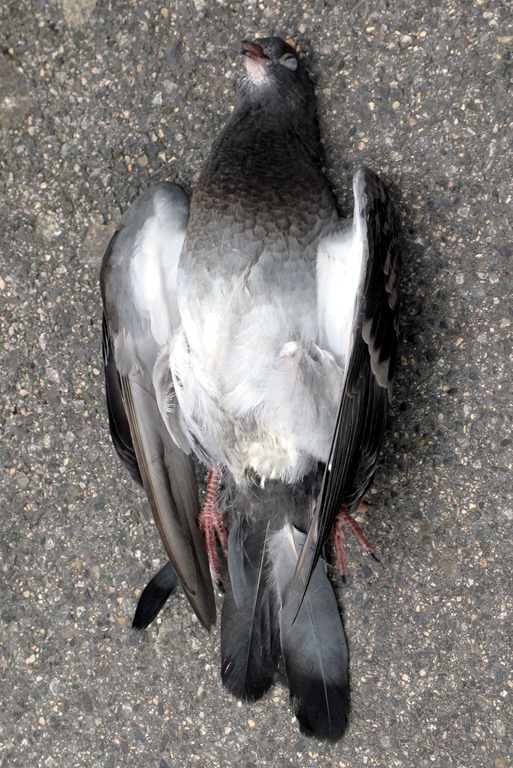
As I passed, I was able to observe the nature of the object the woman in the anorak was holding: a dead pigeon.

This little episode doesn’t have a defined ending, a punchline or a moral. It does, however, demonstrate the differences between the behaviours that are considered socially acceptable or ‘normal’ and those which are not. At least, you might think it does, but I’ve long maintained that social ‘norms’ are little more than a system constructed with the function of inducing mass alienation rather than conformity.

Over the weekend, I spent a lot of time visiting a local hospital. In itself, it was largely unremarkable and there’s no story to be extracted from the experience, with brief exchanges with hospital staff providing only the most cursory punctuation to endless hours of dead time spent waiting for something to happen, or not. But I did find myself, time and again, being reminded of my belief that the most overtly ‘normal’ people are the strangest of all, not least of all because while trying so desperately and unquestioningly to be inconspicuous in their conformity – to the extent that they will condemn others who display traits and behaviours which fail to correspond with their own – they overlook their own ticks and quirks, and even assimilate them into their definitions of ‘normal.’

So, because it’s a hospital, venturing off-ward in pyjamas and dressing gown is normal and acceptable behaviour. Fine, the context counts for a lot but then there are people who venture to the corner shop or make the school run in the same attire and see nothing remotely strange about it. And then again, there are those who venture off-ward or to the shop or on the school run in a onesie and see nothing remotely strange about that, either. Let’s be clear about this: a onesie is a babygrow in an adult size. Yet we now, unfathomably, have ‘wear your onesie to work’ days, and so on. These onesie-wearers are the same overgrown children who are into Harry Potter alongside 50 Shades and yet simultaneously declare kinks like infantilism ‘perverse’.

The hospital corridors aren’t only home to 20-stone onesie-wearers, though. They also contain a microcosm of our (sick) society. And the children’s ward proved particularly depressing. One of a pair of middle-aged women, on leaving, said, “I’ll be back.” Then she chuckled, and added “Eh, I sound like Rambo!” Making wildly inaccurate and ill-informed references to popular culture is ok. Everyone knows what you mean and no-one’s going to correct you. I am, of course, assuming she was referencing the Terminator films, and not Rimbaud.

As the hours dragged by, I found myself growing increasingly frustrated, not by the children, but the parents. Take, for example, the kid aged 7 who spent an afternoon watching pre-school shows including Waybuloo and building a tower of Megablocks, to the immense praise of his rugby fan toff of a father, while repeatedly pulling the clip for his monitor off his hand. The child didn’t appear to be backwards, but simply babied by his parents.

“The person who gave me this cough coughed in my face!” the child moaned during an hour-long sob-session. Kids are cruel, for sure, but that’s all the more reason not to raise your child a stunted sap.

Another mother gave her three year old a wash and nappy change approximately every hour and a half. He couldn’t keep his sensor on either.

Neither set of parents had the nouse to turn off the alarm while the clips were repositioned, meaning the ward was a cacophony of beebs and wails while the medical staff were rushed off their feet attending to children who were simply incapable of remaining still and whose parents were too dumb to figure out what needed to be done.

Then there was the three year old whose overtly middle-class parents sporting shawls and scarves her) and navy velvet blazers with brown shoes (him) gave her an Extra Strong Mint.

“That’s not too spicy for you is it, honey?” they both asked her repeatedly. For about half an hour.

“No,” replied the child each time.

“But you complain that toothpaste’s too spicy, sausage! Here, have some Kit-Kat. It’s a chocolate Kit-Kat (as opposed to those other Kit-Kats that don’t feature chocolate in the ingredients.. oh, wait)… careful, it’s melting because it’s warm! Now you’ve got chocolate on your fingers… let me lick it off so you don’t get it on the bedsheets.”

And so we have in the making one more mollycoddled moron who’ll be mocked mercilessly (and rightly so) by her peers when she refers to mints as ‘spicy’ and so on and so forth.

We may once have been a nation of shopkeepers, but increasingly we’re a nation of fuckwits. I’m as guilty as the next grumpy old cunt when it comes to complaining about the youth of today, but the sad fact is they haven’t got the best starting point. It isn’t a question of class or education, either: the parents here were clearly middle-class, educated people who simply hadn’t a grain of common sense or self-awareness. They simply hadn’t a clue, and they’re largely representative of the broader society, and proof positive that age doesn’t bring wisdom, but simply creates a population of ageing idiots.


Dead_pigeon_IMG_1284

A dead pigeon in need of a decent burial or a cozy onesie


And if you’re loving my work, there’s more of the same (only different) at Christophernosnibor.co.uk
Reviewed: ‘Mandy, Charlie and Mary Jane’ by Stewart Home (Penny Ante Editions, 2013)

The one thing it’s possible to predict with the publication of any new Stewart Home book is Home’s unpredictability, and his latest book to be published, Mandy, Charlie and Mary Jane is a suitably unpredictable and audacious assault on cultural studies – and a broad range of targets, as it happens.

Although Home is by no means an author who adheres to the adage ‘write what you know’, he does freely admit to drawing on his immediate environment for source material, having presented journal-like reportage in Memphis Underground and based countless characters on thinly-veiled representations of figures in the art scene throughout his career.

It’s for this reason that Mandy, Charlie and Mary Jane contains lengthy lists of films, and on-line DVD purchases that look suspiciously like the sort the author himself would buy, along with lengthy reviews of exhibitions written in the style of Home’s blogs, and screes of dialogue on trains and in lecture theatres that appear to have been transcribed from real-life scenarios almost ver batim, or otherwise exist solely to facilitate the expounding of some theory.

I’ve always been one to appropriate dialogue myself, because creating dialogue that reads like it might have actually been spoken is difficult. Ironically, in my experience, and as if to prove the adage that truth is stranger than fiction, my lifted dialogue has been criticised for not being credible. In Home’s hands, the absurdity is heightened by the incongruity of context.

There’s also the issue of the 7/7 bombings and the way Home ties this in with the narrator’s delusional quest for some vague domination. This particular event – as Home explained in one of his blog posts – features in the book primarily because it was happening at the time the book was being written and some of the observations on the event are from the author’s own experience of being in London on that day. Yet its inclusion is one of the reasons it’s taken so long for Mandy, Charlie and Mary Jane to arrive in the public domain. Recent history, when absorbed within the context of a postmodern novel, is just too sensitive and problematic for most publishers. Of course, Home’s contentiousness is a part of his appeal, and his portrayal of academic life is as likely to cause a stir in certain quarters as the terror thread of the plot.

I’m not referring to the countless sexual antics with students – real or imagined – but the narrator’s criticisms the university system in the UK. Of course, highlighting the issues of the effects of tuition fees and the squeezing of academic resources in the name of profitability is all part of Home’s ongoing critique of capitalism. However, where Mandy, Charlie and Mary Jane differs from his earlier ‘skinhead’ books which were overtly and explicitly political, is in the way the issues are addressed. Instead of using his third-person characters as parodic ciphers delivering blunt sloganeering polemic and slabs text by Marx et al, the first-person narrator of Mandy, Charlie and Mary Jane offers more subtle yet even more scathing observations from the coal face, as it were.

Home slings in large chunks of review, criticism, critique and theory in trademark fashion (echoing previous works, notably 69 Things to Do With a Dead Princess). The narrator’s Marxist reading of Deep Throat is as amusing as it is audacious, and is, of course, classic Home. By establishing his narrator, John – or Charlie – Templeton as a cultural studies lecturer with a chronic drug habit, these skewed academic musings are fitting, and what’s more, in Templeton, Home is also able to play with and dismantle notions of fixed character – even the narrator doesn’t know who he is at times and frequently contradicts himself throughout the story. It may revisit the character shifts in his 1997 novel Come Before Christ and Murder Love, and draw the more absurd elements from Memphis Underground together with elements of Cunt, but then formula has always been an integral aspect of Home’s output, and it never worked to the detriment of the work of any genre author, or Ballard for that matter.

And so the resurfacing of phrases that have appeared variously and numerous times in his previous works is all part of the joke. It isn’t supposed to be subtle, and by now, the reader is supposed to be in on the gag which centres around the fact that Home’s built a career on declaring himself a rampant plagiarist (and notorious / celebrated self-promoter) and now we see him appropriating from himself quite liberally.

Noting in one of his blogs that Mandy, Charlie and Mary Jane, like its predecessor Blood Rites of the Bourgeoisie was written – at least in part – while installed as a university writer in residence, it’s therefore unsurprising to find Home use the campus as his novel’s primary setting. Equally unsurprising, Home’s choice of location, the City University of Newcastle upon Tyne facilitates the use of its acronym repeatedly throughout the text, adding the type of shock value Home is notorious for before immediately debasing it through endless repetition – which in Home’s eyes renders it all the funnier, in accordance with his recurrent citation of Bergson’s theory that suggests repetition is the basis of all humour. No doubt by the end of the book and the thousandth repetition of CUNT, Home had split his sides and jizzed himself to a husk at his own wit and genius. And rightly so: it was certainly my instinctive reaction. Because as one of the few authors to take postmodernism to a new level and turn its self-celebrating, self-collapsing theoretical existence back in on itself, Mandy, Charlie and Mary Jane sees Home remain several steps ahead of the game (even taking into account the fact that this book was written five years ago).

It’s not just the narrator who loses the plot as the book progresses, and what begins in a relatively grounded realist setting (d)evolves into surreal flight of fancy. The ending is, of course, a complete joke, but also – even despite Home’s previous flights into the surreal – a surprise that’s likely to leave you shaking your head. I’d argue that you don’t really read Home’s novels for their plots, however, so much as the explosion of ideas, and on that level, Mandy, Charlie and Mary Jane certainly doesn’t disappoint, and, equally importantly, it’s perverse, it’s funny and, put simply, a cracking read.


mandycharliemaryjanejpg


And if you’re loving my work, there’s more of the same (only different) at Christophernosnibor.co.uk

Paul McKenna, Gnostic Bastard – The Power of Persuasion and the Great Hypnotic Con

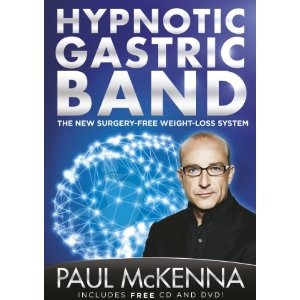
Since the new year, there’s been a large poster on the bus shelter where I catch the bus to work each morning advertising Paul McKenna’s latest book, Hypnotic Gastric Band. The first time I saw this poster, bleary-eyed at 7:45 on January 7th, I misread the title looming out of the darkness at me as Gnostic Bastard. Having made this rather curious error, I’ve since had to force myself not to read it as such each subsequent morning. In order to do so, I’ve found myself staring long and hard at the hoarding, and each time with growing consternation.

The poster itself is fairly bland: a large image of McKenna’s book, with the title and subtitle (‘The New Surgery-Free Weight-Loss System’) at the top, and at the bottom, the deal-clinching information that there’s a ‘free CD and DVD’ with the book. This is the same text that appears on the book cover itself, meaning the same words appear twice on the poster. Since repetition is the most basic but often effective form of brainwashing, I can’t help but wonder if this isn’t some form of brainwash to make people go out and buy the book – beyond the overt premise of the poster being an advertisement and therefore designed for that explicit purpose, I mean.

The book’s cover itself is interesting. On the face of it, it looks like any other crappy mass-market self-help book. The typeface is plain and bold, clean white lines on a darker background. It says ‘empowerment’. McKenna’s face stares out of the cover. But whereas most self-help gurus wear an expression that shows tranquillity, assurance, confidence, trustworthiness, in a way that say ‘I understand your problems and your pain. I’ve been there. I’ve turned my life around and I can help you to do the same. Have faith. I’m not going to lie to you or fob you off. I’m happy with my life now, and with my help, you can be too’, McKenna’s gaze is focused on… you, of course. He’s looking into your eyes, into your very soul. It’s not a calm look of inner peace. He’s lasering straight into your brain.

You’re so engaged in eye contact with Paul that you don’t really notice that nebulous cloud of lights, a little like a cut-out-and keep magazine rendering of an astronomer’s chart, over his shoulder. It’s a little fainter than McKenna’s image and the strong text above and below.

Within this two-dimensional representation of a multi-faceted polygon, fainter still, is a pale blue sac with tubing above and below – a representation of a stomach, no less, with something resembling a belt pulled tight like a noose just above the top of the bulbous mid-section. This, of course, is a gastric band. Because you need to visualise that band, drawing tight around your intestine, restricting your capacity for food. You’re not hungry, you’re full, and if you eat any more that band will draw so tight and constrict your internal organ that you’ll die.

The image itself is curious and compelling in equal measure. On the one hand it’s quite obvious what its purpose is, there on the cover of the book. On the other, it’s rather weird. I mean, in short that it looks odd. Compositionally, representationally. A sanitised, pseudo-scientific representation of a bulging pouch of muscle in the lower reaches of the intestine in the middle of something not dissimilar from an architectural sketch of the done from The Crystal Maze. What is it saying, and precisely to whom is it speaking when it issues forth those enigmatic utterances?

The kind of people who don’t really consider what they’re consuming to the extent that they may require a gastric band are the kind of people who struggle to associate images of life-threatening obesity, enlarged organs and stupendous amounts of fat when they’re shown on television with their own ruined bodies. But this image on the cover… As I stand, waiting for my bus to arrive, music injected into my ears through my in-ear phones attached to my MP3 player, I find myself mesmerised and wondering as I’m drawn into the billboard, is the gastric band itself hypnotic?

Never mind how the ‘system’ works (note, it’s not a ‘diet’ – largely because any food intake is a diet and we’re looking specifically weight-loss diets here, but more to the point, ‘weight-loss system’ is a perfect example of pseudo-scientific meaninglessness), I find myself totally absorbed by the image. And then I remember it’s all utter bollocks. If it was as easy as all that for the people this book is aimed at to exercise mind over matter to lose weight or otherwise remain at a size that’s considered healthy by the medical profession, then there’d be no need for the book, with or without the ‘free’ CD and DVD. And while only an idiot would believe that the CD and DVD are actually ‘free’ rather than incorporated within the purchase price (CD and DVD cost pennies and the cost of producing a book that’s a mere 144 pages in length (at least in the quantity of print run this is indubitably produced in) is negligible against the RRP of £12.99 which is approximately 9p per page), equally, only a complete cretin would buy into this crap. Let’s face it, The Hypnotic Gastric Band is another way to shift responsibility from the lazy and the weak-willed: which plus-sizer wouldn’t want the results of a weight loss diet without actually dieting? When it comes to mind over matter and the power of persuasion, the only trick here is getting desperate and gullible chubbers to part with their cash. But it’s a massive market (in all senses), which probably explains why the book’s sitting comfortably in Amazon’s top 10 right now….


Hypnotic Gastric Band

Paul McKenna: Gnostic bastard or con artist?


And if you’re loving my work, there’s more of the same (only different) at Christophernosnibor.co.uk
Nutjobs, Pissheads and Pains in the Ass

I don’t know what it is about me that seems to draw the crazies. I certainly don’t go looking for them, but they spring out of the woodwork and in an instant decide that I’m the kind of person who wants to converse with random strangers. In actual fact, little could be further from the truth. I’m a fast walker and I habitually avoid eye contact with people in the street. Wearing tinted glasses makes this easier, I find. More often than not, I have earphones in, too, just to create more of a barrier between myself and the world. But where the crazies – and drunks – are concerned, this exterior seems to send the opposite message. Or perhaps they’re just oblivious.

So I was walking back home after watching The Yawns play at The Basement. It was a little after eleven. I was more or less sober, having only consumed three and a bit pints (it would have been four, but while trying to photograph the band, I’d managed to spill the majority of my last pint, much to my extreme annoyance), but feeling buoyant because it had been a good show, and I’d had the chance to catch a few words with Joe Coates (the man behind Please Please You, and the majority of decent gigs in York), and Mark Wynn, cool music scene people I don’t see nearly often enough. I had just parted company with my mate Big Sam, the Balaclava Boy, and had not yet plugged myself into my MP3 player to create my hermetic space. I was, however, wearing a black Thinsulate hat pulled low to the bridge of my nose and felt pretty sealed off.

I’d clocked a guy leaving Sainsbury’s with a carrier bag as I crossed the road, and had seen him remove a bottle of wine from the bag, crack the cap off and take a long slug from the bottle. I thought nothing of it, and wasn’t concerned by the fact I’d probably have to overtake him. Up ahead a way, he stopped to roll a cigarette, and it was at this point I came to pass him.

“’Scuse me, mate.”

I should’ve walked on by and feigned deafness. But I’ve tried that before, and been harangued all the way down the street for ignoring such people. I figured he was going to ask me for a light. It happens a lot. I simply explain I don’t have a lighter because I quit smoking and that’s that. So I stopped and looked at the guy.

“Do you like heavy metal?”

Shit.

“I hope you don’t think I’m, like, stereotyping or making assumptions, but I thought you looked a bit alternative and like you’d be into different stuff like heavy metal. I hope you’re not offended or anything.”

“Not at all. It’s not my first choice of music,” I professed, “but I like some metal.”

“Yeah? Like Sepultura an’ that?”

“Not so much,” I replied.

“No? What then?”

My ears weren’t only ringing from the gig – I’d left the house in a hurry and irritatingly forgotten my earplugs – but from the clutch of upcoming Southern Lord releases Lauren at Rarely Unable had recently put my way and that I’d spent the afternoon getting my lugs round. These were still fresh – and loud – in my mind and represent, to me, the only kind of metal worth listening to. The really heavy, abrasive stuff. The nasty, gnarly stuff, the full-throated sonic annihilation of grindcore and crust is far more my bag than the overblown fretwankery of the ‘big’ metal acts. I attempted to explain this to him, although as succinctly and as accessibly as possible.

“So, like Slayer an’ that?”

“Not really,” I said. This really wasn’t going anywhere and I rather hoped my less than leading response would leave the conversation as extinguished as his poorly-rolled ciggy.

“No-one listens to metal,” he moaned. “I mean, I don’t want to blow my own trumpet, but I’m a shit-hot guitarist. You probably think I’m just a drunk wanker, and I am drunk, but I can play all the songs. Metallica, Iron Maiden. I’m 40 years old and I’ve been playing guitar for 20 years but I just can’t find a band to play in. Do you know where I could go to find other people who are into metal who’d want to be in a band with me? Do you play?”

“Nah. I play guitar a bit and can move a bar chord around in time but it’s pretty basic. I gave up on playing music and now I write about it instead.”

“What do you mean?”

“I’m a music writer.”

“Like a journalist?”

“Yes. I review stuff. CDs and live music. And I can tell you that a lot of people do listen to metal. It’s a huge market.”

“Yeah but I can’t find anyone. There’s nothing I’ve ever found that I can’t play. I can do all the solos, even. But no-one’s interested. It’s all DJ this and fucking MC that and… you know what I mean? You’re not a DJ are you?”

“Hell no. I’m a writer.” The guy was beginning to get on my wick and I was pleased to arrive at my turn-off from the main road. “I’m off down here,” I said.

“Me too.”

Shit.

“I know you’re probably thinking I’m some drunk twat, and I am drunk, but don’t worry, I live round here, I’m not trying to stalk you or follow you home or anything. I am a bit drunk, but I’m a decent bloke, y’know, and I know I’m a good guitar player. I mean that. I don’t like going up to people and saying ‘I’m a shit-hit guitar player, though.”

“Maybe you should. If you’re serious, you need to get out there.” I believed he wasn’t going to stalk me or follow me home, and I doubted he was about to turn and knife me, kick me head in or smash the now half-empty wine bottle over my head, but figured it was still wiser to humour him – because he was clearly a drunk twat – than risk it by tying to shake him in an obvious fashion.

“Is that what you’d do?”

“Yes.”

“And you’re a DJ?” There was a broad hint of incredulity in his voice.

“No, a writer.” There was a broad hint of weariness in mine.

“So how does that work?”

“I get sent music and I review it. I go to see bands play and I review them.”

“Where? Who do you write for?”

“Various websites.”

“Websites, eh? And you’re a journalist? But you don’t know where I can go to meet people who’d give me a chance? How do I find people that are into metal? I’m a fucking awesome guitar player – and I’m not just saying that, and it’s not just because I’m drunk – although I am drunk – I can play everything and I love metal. Satriani, you name it.”

“Maybe you could go and see some bands playing. Talk to them. they’ll know other musicians, people in bands who are looking for a guitarist.”

“And they’ll be into metal? I mean, I’ve got a band in theory – like me, and a bassist and a keyboard player but we don’t need a fucking keyboard player.”

“No, that’s a bit 80s hair rock, I’d have thought.”

“Yeh, exactly.”

And so it went on in this way until we reached a junction where our routes diverged, much to my relief.

“It’s been good to meet you,” he said. “Thanks for listening. A lot of people wouldn’t have done.”

“That’s the kind of guy I am.”

“You’re a good guy. What did you say your name was?”

“Thanks. I’m Chris.”

“Right, yeah. I’m Steve. And you’re really a DJ?”


drunk-guy

Some drunk bloke I found on the Internet


And if you’re loving my work, there’s more of the same (only different) at Christophernosnibor.co.uk

Smooth Salsa and Jizzy Jazz: The Great Corporate Crap Giveaway

I recently lent a friend of mine, who works for a large financial organisation, a handful of CDs. When he returned them, there was an extra disc. it’s not unusual: he often lends me music. On this occasion, said disc was housed in a gaudy digipak decorated with segments of primary colours and it was still in its shrinkwrap. A gift? Or an accident? No. Entitled ‘A World of Discovery’, the album was a compilation that promised ‘a journey through the world of jazz, soul, funk and blues’, and it had been ‘specially compiled’ for another financial firm by Jazz FM. The bastard! He’d offloaded this piece of corporate crap on me, knowing full well how much I despise jazz, soul, funk and corporate crap because he didn’t want it. And who could blame him?

There’s something that makes this kind of corporate crap particularly abhorrent. Sure, I get the idea of a ‘global’ corporation doling out promotional gubbins that reflects and encapsulates the spirit of their ‘brand’ (or what they hope is the way their brand is perceived), and a compilation of music from around the globe says ‘multinational’, ‘global’ and ‘inclusive’, and music supposedly transcends all borders of nation (the fact I think this is utter bollocks is something for another time). But it’s about as credible an image of global culture and a celebration of diversity as a Benetton ad. United colours? One world together in music? One world under the cosh of capitalism pretending to be friendly would be closer to the mark. Does anyone actually buy this idea? Do the creators even think that this is the face of finance, or are they laughing up their expensive suit sleeves and steaming up their Rolex watches?

There’s another thing, too. I appreciate that some would accuse me of being narrow-minded musically at loathing jazz, soul and funk, and while I’d strongly disagree, the point is that I do loathe jazz, soul and funk and I’m certainly not alone or even in a minority. I daresay that in attempting to associate themselves with the artists concerned (I’m assuming the artists all gave their consent and were paid handsomely for selling their music and souls in such a way), the company in question think they’re being ‘hip’ and presenting a ‘cool’ image to potential clients and partners. But in producing and distributing a compilation such as this, they’re making a huge assumption regarding people’s musical tastes. Either that, or they’re hoping to dictate people’s musical tastes, in which case they should be sponsoring something on MTV or Radio 2. But Jazz FM? What does that say about the company, really?

Sidestepping that question and letting it serve as a rhetorical device, I’ll admit that I haven’t actually played the CD at this point. But then, do I really need to hear the ‘old school raw soul quality of Australia’s Electric Empire on their number ‘Baby Your Lovin’’, or ‘Let me Show Ya (Funkhaus Sessions)’ by Jazzanova of Germany?

Against my better judgement, I bung the disc in the player. It’s fucking hideous and sounbds exactly the the way you’d expect it to. A flicker of flamenco, a splash of salsa, with the horrible drum machine backing favoured by the Peruvian pan flute bands that play on the high streets. Laid-back Latina grooves smoothed to slick perfection transports the listener to a forgettable restaurant where the wallpaper, food and music all melted into one beige blur not even worthy of a smiley snap for Facebook. The ‘United Kingdom’, incidentally, is represented Escala, with their multinational smash, ‘Feeling Good’. Er, yes, quite. Escala, the ‘Britain’s Got Talent’ finalists covering Nina Simone. What in? Well, in keeping with the jazzy jizz of the rest of the material here, stringy sonic spunk.

In a time of recession, I do understand that companies need to find new promotional angles, and even when times are tight, it’s necessary to speculate to accumulate. But surely that’s all the more reason to ensure that promotion is effective – and cost effective. Even if the clowns who cooked up this cack-handed codswallop campaign genuinely believe that most people do like jazz, soul, funk and blues, what do they expect the recipients of these discs to do with them? Play them on an evening or at dinner parties to show how sophisticated they are, while subconsciously deciding they ought to do business with the company who gave them out? But as we’ve established, not everyone likes jazz, soul, funk and blues – so then what do you do it you’re the recipient of one of these dodgy discs? Landfill seems horribly wasteful. There’s the local charity shop, but who would buy it and would you want to be seen donating it? And while CDs make great coasters, it’s not everyone’s style. Which means the best option is to pass it on to your mate who happens to write music reviews and ranty blogs about pointless causes of irritation.


yikescds

A substantial stack of crappy unwanted CDs, not unlike the one in my house.


And if you’re loving my work, there’s more of the same (only different) at Christophernosnibor.co.uk

2012: A Year in Books

This is not a ‘best books of 2012’ list, and I have neither the time nor the inclination to review or comment on the books listed here (other than those I’ve written reviews for or otherwise commented on, and those reviews can be found here and there and wherever). I spend enough of my life reviewing stuff and spouting opinion: I read for pleasure and research and reference and sometimes purely to learn. Some of the books I read during 2012 were books I had read before (Bukowski’s Post Office and Cunt by Stewart Home) and some of the books I read I enjoyed more than others. Many of them have informed my own writing in one way or another, or may do so in the future. The order they’re listed in is the order I read them in. So here it is, just because: my year in books. Nothing more – but nothing less.


Henry Sutton – Get Me Out of Here!

Adam Kotsko – Awkwardness

Jurek Becker – Sleepless Days

Alain Robbe-Grillet – The Voyeur

Marek Hlasko – Killing the 2nd Dog / The 8th Day of the Week

Various – A Dream of Stone and Other Stories

J G Ballard – Cocaine Nights

Chuck Palahniuk – Survivor

Henry Sutton – Bank Holiday Monday

Ian Price – The Activity Illusion

Carl Weissner – Death in Paris

J G Ballard – The Crystal World

Harry Harrison – Homeworld

John Steinbeck – Tortilla Flats

J G Ballard – The Unlimited Dream Company

Terry Taylor – Baron’s Court, All Change

Alain Robbe-Grillet – Repetition

Theodor Adorno and Max Horkheimer – The Dialectic of Enlightenment

Malcolm Mc Neill – The Lost Art of Ah Pook is Here: Images from the Graphic Novel

Malcolm Mc Neill – Observed While Falling: Bill Burroughs, Ah Pook and Me

Supervert – Necrophilia Variations

Colin Wilson – Adrift in Soho

Dire McCain – Raising McCain

Steve Urwin – Tightrope Walker

Charles Bukowski – Post Office

Roger Protz – 300 Beers to Try Before You Die!

Stewart Home – Cunt

Carl Cederstrom and Peter Fleming – Dead Man Working

Karl van Cleave – Incisions, Collisions and Aborted Missions

And if you’re loving my work, there’s more of the same (only different) at Christophernosnibor.co.uk

The Changing Face of Consumerism XII: Applied Economics and the Kindle Generation

Sometimes it’s better just to keep your mouth shut. I know this. I may be opinionated, but there’s a time and a place to express those opinions. More often than not, 9:05am in the office is neither the time nor the place. But sometimes I just can’t help myself.

It was just another day at the office, same as any other. I was trying to do something productive, because despite my abhorrence of ‘the system’ and working for ‘the man’, I appreciate that I’m being paid (albeit not nearly enough) not only for my time, but to use that time fruitfully (when IT permit) and besides, I’m one of those people who prefers to actually make busy rather than feign being busy. Perhaps I’d feel differently if I felt any affinity with the goons who occupy the desks within conversationable proximity to mine, but endless drivel about ‘Corro’ and ‘I’m a Celebrity’ fills me with a compulsion to burrow myself into a small dark corner, meaning that more often than not, I’ll bung a CD in the player or find an album on-line to stream, plug my phones in and create my own virtual cocoon in which to work. But sometimes I find it’s impossible to shut out the babble, and equally impossible to keep my trap shut.

Such was the scenario the other day. Three or four people seated behind me had been discussing books. Books I wasn’t bothered about. By which I mean, I’m not big on thrillers, and am wholly indifferent to the works of multi-million selling thriller author James Patterson. I was able to let the debate over whether or not his name was Patterson or Pattinson drift by, although I was pleased when one of the debaters thought to look him up on-line, and was also thus able to confirm the title of one of his books, courtesy of Amazon.

And so the subject moved to the topic of the Kindle.

“I love having my Kindle,” pronounced the middle-aged woman in the centre of the conversation, who’d been recounting how she’d hooked her husband on a certain author’s books by buying him one once. “But Kindle books are so expensive!”

“I know, I’d have thought they’d have been about a quid or something,” replied the colleague to her left, a tubby guy with a beard and spectacles in his mid to late twenties.

It’s a common complaint. If you read reader reviews of books on Amazon, there’ll invariably be a number harping on about the price of the Kindle edition – especially with new publications – to the extent that some titles attract dozens of one-star reviews without a single mention of the writing, the plot, the characters or any other aspect of thee contents of the book itself. Many of the reviewers aren’t even in a position to comment on the book, having posted their review in a fit of pique at the rip-off price being asked for the text with remarks like ‘I refused to buy it at that price’ and ‘I’ve ordered the paperback instead, but will have to wait several days for it to arrive in the post. And I’ve had to pay shipping on top!’

In today’s culture of immediacy and instant gratification, no-one wants to wait. And no-one wants clutter, either, hence the popularity of the Kindle. As the people behind me noted, it’s possible to store several hundred books, which would otherwise require many feet of shelves, on a single, portable device. But no-one seems to think it reasonable that they should pay for this convenience: they want it now, and they want it cheap, or better still, for free. But of course, that isn’t how capitalism works. Exploitation may be a significant feature of consumerism, with both consumer and producer being exploited for the benefit of the capitalists who hold the real power, but there has to be as degree of give and take, and if there’s no profit to be made from a end product, there’s simply no point in producing it, however useful it may be. But by the same token, the more useful or desirable a commodity, the higher its value in the marketplace. Whether that value is real or perceived is largely down to supply and demand, the market and marketing. It appears the perceived value of an e-book is comparatively low.

And so they whinged on in this fashion for a couple of minutes or so, bemoaning the fact that Kindle e-books are overpriced considering the fact there are no production costs involved.

As someone who has experience of publishing, both as an author and a publisher – albeit on a small scale – I felt qualified to wade in on this debate. Not that these individuals would have been aware of this: I tend to keep myself to myself, and not to talk about my writing or publishing activity in the workplace. Nevertheless, on this occasion, I found it impossible to let it go, and the fact my involvement in the publishing industry is on a small scale means it’s something that’s particularly close to my heart: it’s something that’s real and tangible, whereas with large-scale publishing – as with any large organisation – the realities become more abstracted as the process becomes increasingly distant. As with the music industry, Joe Public only conceives of the colossus: the multi-billion dollar international labels and the major-name chart acts. It’s understandable, of course, but the big names – and the big money associated with them – only account for a fraction of the whole. The common misconception is that everyone who has a book published is coining it in, because they hear about the immense earnings of the likes of J. K. Rowling and E. L. James. The majority of people don’t seem to realise that there are countless books that aren’t on the bestseller list, that aren’t published by Penguin or Bloomsbury. These are the people who buy one or two books a year, or possibly three when they raided a 3-for-2 offer at Waterstones or WHS or maybe their local supermarket. These are the people who, in the days before Kindle, would make sure the one, two or three books they purchased were at least 400 pages long because a 400-page book represents better value for money than a 250-page book that costs roughly the same. They’re the people who read series books because they know the characters and are comfortable with them, but are reluctant to try anything else because they don’t know what to expect: they might not like it. Better to play safe and go with what you know than risk disappointment and wasting money.

I don’t actually believe that all artists (by which I mean musicians writers, film-makers, dancers, whatever) should be able to make a living from what they do, even if such a scenario was feasible. There simply isn’t room for every artist, aspiring or otherwise, to achieve such widespread recognition as to sustain a living wage from their work, and there are many who simply aren’t worthy or, to be blunt, good enough. But I do believe that all artists should be fairly paid for what they do, just as any other form of labour should receive reasonable recompense.

If Kindle e-books really did all cost in the region of £1, you can guarantee that the ones who would see the biggest reduction in their cut of the profit (and there’s scant profit to be made on anything costing a pound) would be the writers. It hardly seems fair that the person responsible for the creation of the product should be paid less because some consumers choose to purchase a different format. The end product may be different, but the input itself remains the same. Would an office worker – the likes of the individuals idling away large portions of their working days debating the ways in which they spend their disposable income and leisure time – consider it acceptable to be paid less for dealing with emails instead of printed letters? Of course not: in fact, I suspect the opposite would be true, and that they would probably consider it reasonable to expect to be paid more, because the reduced overheads associated with e-comms over conventional paper and envelope snail-mail would logically enhance company profits – why shouldn’t they benefit? And this made for the starting point of my interjection into the conversation.

“The writers have still got to be paid,” I began. “On a paperback, they get pence in royalties…”

Naturally, the precise amount varies between books, publishers and authors, and the range is immense, and the actual royalty will depend on whether or not the book sells at its RRP or at a discounted price. But, for simplicity’s sake, it’s not unreasonable to work on the basis of the author’s royalty for a paperback being it’s around the 8% (although anywhere between 5% and 10% would be considered ‘average’), for hardback around 12%, and for e-books in the region of 20%. If a paperback retails at £7.99, you’re looking at 63p per copy going to the author (before tax). It takes a many multiples of 63p to equal a living wage. Given that it’s reported that 95% of all books published achieve sales of 100 or fewer, you can hardly consider writing a surefire route to riches, and when you also take into account the number of hours it takes to write a novel…

“Of course the writer’s have got to be paid,” agreed the woman, peering over her reading glasses. “But there’s no printing cost with a book on Kindle…”

I realised I needed to keep it brief and simple. And so I elected to pass on the details of the debate, hoping against hope that my sowing the seed may at least give them a prompt that would set these everyday consumers on a track of consideration.

I decided not to explain that obviously, the bigger the publisher, the more people are involved in the process. But against that, higher volumes of sales mean it’s easier to reduce unit costs… although it usually takes a bigger marketing budget to achieve those sales volumes. I also let pass the idea of there being a correspondence between market forces and cost in capitalist culture, namely that there’s a clear logic to charging the most people are willing to pay for a commodity. If a significant portion of any given target market are willing to pay, say, £10 for something, but consider £15 too expensive, why would anyone in the business of business, i.e. making a profit, charge only £5 for it?

The fact she’d already told her colleagues, “I buy loads more now I’ve got my Kindle. I keep finding stuff and thinking ‘What’s that?’” was evidence enough that however unreasonable she considers the price of e-books, the cost isn’t high enough to be prohibitive – and so the equation of balancing cost against demand and convenience works. This woman clearly isn’t alone, and as much as anything, I suspect the convenience is the real key here. The Kindle appeals to the demand everything, demand it yesterday if not sooner consumer society we live in and that the Internet has facilitated. Our needs haven’t changed all that radically, but our expectations have. Consequently, our demands have changed in line with those expectations. This then becomes a self-propagating cycle, and like a junky who experiences diminishing returns with every hit as their habit becomes more complete, so the consumer appetite grows evermore insatiable, needing more and faster. Yet each time the demand is met, so expectations grow, and as those expectations come to be met, so demand grows.

“That’s true,” I countered, “but the print cost actually only accounts for some of the actual cost of publishing a book. With an e-book, you’ve still got the bulk of the other costs involved in the publication process, like paying proof readers, like cover art, promotion… and you have to reformat a text for Kindle. Plus you’re paying for the convenience of the format, of having it instantly. Besides, given how little authors do earn on each book sold, if there is scope for paying a bit more, then that can only be a good thing.”

The woman looked at me boredly, then replied, “Yes, I know and understand all that, but I still would have thought they’d be cheaper. You know, like around a pound or so.”


Kindle

A Kindle. Publish a book formatted for this, charge over the odds and make a mint. It works for me! Pass the Bolly, will you?