The Novel is Under Threat….

For some time now, the status of the novel has been under threat, not just from technological developments like the Kindle, but from self-suffocation and overanalysis. In attempting to break free of the shackles of conventions, authors of contemporary fiction have pushed the novel to breaking point. Readers of modern literary fiction can often find themselves baffled by bewildering texts, devoid of plot or characterization, so-called novels that aren’t really novels and aren’t clear about what they are. Sometimes, it seems as though even the writers don’t know. So desperate are they to create something new and exciting, they’ve lost sight of why most people read books in the first place, and end up creating some weird and horrible mish-mash of documentary and memoir along with social commentary and whatever else comes to hand, all in convoluted plots about writing the book you’re reading that disappear into thin air midway through. These are the most frustrating sorts of books – and they’re not really novels, and to market them as such seems disingenuous.

Book reviewers in the press and on-line tend to be no help, and if anything compound the problem. Most of them are wannabe writers themselves, and use their reviews to show off their writing skills. And of course, they wouldn’t want to lose face by admitting they didn’t like a book that’s supposed to be clever, or, that the unthinkable happened and they didn’t get it. So the parade of books dressed in the emperor’s new clothes continues. For my money, the reviews posted on-line on Amazon and Goodreads by real readers who aren’t pretentious and who don’t have opinions that are clouded by self-interest are far more reliable and more easy to read too.

Then there’s academia. Academic writing makes the guff the reviewers spew out look positively straightforward. The analysis gets so bogged down in theory and the minutiae that all relation to the book that’s under discussion is lost. The prevalent style of academic writing seems designed primarily to obfuscate any trace of logical, linear argument, and for no other reason than to bewilder mere mortals with the density of language that says little more than ‘look how clever I am’. The emperor threw these clothes out a long time ago when they became threadbare and unfashionable. Stuck in its ivory tower with its head up its superior, self-satisfied ass, academia has failed to realise that the game’s up.


It’s for this reason that a recent crop of pseudo-intellectual smart-arse writers who think they’re ahead of the game by combining elements of criticism and commentary within their ‘novels’ – and I use the term loosely given the negligible semblance of plot and the general absence of characters you can believe in, let alone identify with – really are fulfilling their own prophecies regarding the death of the novel by spewing out such atrociously smug, self-indulgent, meaningless drivel. I mean, if you’re going to kill the novel, atrocious dross like these self-referential treatises are bound to do the trick. And, quel surprise, marginal as these authors may be, they’re getting noticed and building up cult followings because the critics are lavishing their abysmal turgid texts with gushing praise and their bands of cronies corralled together via social networking sites – first of all MySpace, and now Facebook – are on hand with sycophantic applause.


Nosnibor’s latest novel – the ironically (or perhaps appropriately) titled This Book is Fucking Stupid – is probably the worst offender of all the books I’ve seen to date. The story is bland and bot very well written with really dull characters who go nowhere, and it’s largely buried beneath endless pages of insertions, including reviews, academic criticism and lengthy passages of pointless commentary from the author. Some of these begin like memoir, and look like they might offer some useful insight into the mind of the writer, but they invariably descend into rants or a platform for something else, and the reader is left none the wiser as to his motivations. Consequently, I ended up with the opinion that the author is even more delusional and moronic than I had thought before, and any interest I may have had in him as a person had completely dissipated. I sincerely hope I never find myself stuck in a lift with this tedious, self-interested egotist who hides having precisely nothing to say behind endless layers of artifice and façade. The most pointless and pathetic attempt at a novel you’re likely to read. If you can honestly say you find something good about this book and can find the ‘point’ to it, you’re smarter than me. Or, more likely, you’re a pretentious asshole and you’re just pretending.


And if you’re loving my work, there’s more of the same (only different) at christophernosnibor.co.uk


The Changing Face of Consumerism IX – Real, Real, Real

Just as the nature of consumerism has changed dramatically during the course of the last decade – not to mention the last half-century – so the nature of industry has also metamorphasised. In so-called ‘developing’ countries (it’s a questionable term. Technological advances could be seen as development, but an exponential increase in fossil fuel consumption and an insatiable need for unsustainable resource is rather akin to ‘developing’ a 40-a-day smoking habit coupled with some heavy drinking), Industrialisation has caught on, dragging them into the global marketplace. By this, of course, it simply means that large corporations can circumvent domestic legislation in favour of giving workers rights and exploit an fiscally impoverished workforce even more ruthlessly. Driving costs down is good for business, as it increases profits, and the shareholders and the City love that.

As more manufacturing has been ‘outsourced’ to developing countries, the nature of employment in the ‘developed’ countries has moved toward tertiary service industries. Collar colours aside, the most fundamental difference between service and manufacturing industries is the tangibility or physicality of the product. The closest you’ll get to seeing or holding your insurance or shares, for example, is in the form of a certificate or other printed document. When you think about it, these objects which represent the thing in itself but are not in actuality the thing in itself – i.e. the signifier to the signified – you’re buying a concept more than an actual product. Of course, this is simply how money works: the ten-pound note in your wallet is not actual money, but a physical symbol of money. The balance in your bank, if you’re fortunate enough to be in the black, does not mean there’s really £500 that you own just sitting there. This is common knowledge, but it’s hard to separate the concept from the reality. You do not have any real money. No-one ever sees ‘the money’. Tom Cruise could yell till he’s blue in the face, he’s never going to be shown the actual money, just more printed paper that promises to pay the bearer a designated sum on demand. But try making that demand and all you’re likely to get another sign or representation.

We live in a virtual world. In his writing on ‘The Political Unconscious’, Frederic Jameson theorises that one feature of postmodernity is a reality that is infinitely deferred. This theory is now the reality as we exist in our virtual worlds projecting ersatz avatar versions of ourselves into the ether. It becomes impossible to distinguish the real from reflection, not only for others, but for ourselves. Do we become the identities we project, or do they become our real-life selves when the layers of the onion that is the multi-faceted personality are peeled back one by one?

On a personal level, my real-life self and virtual self are indeed separate but given to occasional and significant crossover. And so it is that we both like music and books with a passion, but struggle to get to grips with the modern trend for downloading. It’s ok: Deleuze and Guatarri convinced me I’m ok because a schizophrenic mindset is the only sane response to the postmodern, late-capitalist society I find myself in.

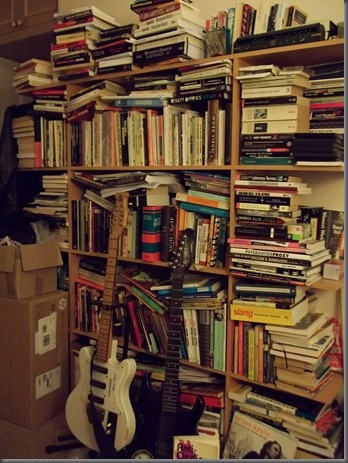
Stumbling around the house trying to avoid the partially organised and rather precarious stacks of CDs and books in the office and groaning each time I try to accommodate a new purchase onto the shelf or rack, I can completely understand why people would want to declutter, to reduce their lives. Yet try as I might, I find myself unable to separate the intangible – the music or the words – from the tangible, the physical – the record or CD or the book.

Nevertheless, I like my intangibles to present a physical form. The way I respond as a reader to words contained in the books I read is a complex process, which, while admittedly develop through conditioning and personal experience, is nevertheless intertwined with the act of reading. An audiobook may contain exactly the same words, but will not cause me to react in the same way. On a purely personal feel, the act of reading also entails the turning of the page, the look, feel and smell of the book. The quality of the paper, however poor, the print, the formatting, the cover, while peripheral, are all integral to varying degrees in combining to create the experience as a whole. Even the process of sourcing books is a part of the relationship I have with it: memories are made in the locating of a book in a little secondhand shop while on holiday just as much as they are of recalling where I was when I read the book, and how I was feeling at the time.

The same is true of music and many other objects – objects that now clutter my home, but collectively tell a version of the story of my life. This isn’t to suggest in any way that I am my possessions, or that my possessions own me and not vice versa. Nor would I really describe myself as a materialist in the conventional sense.

Perhaps it’s my age, but I want to feel as though I’m actually buying something when I part with my money. Yes, I know that in reality that it’s the production – the recording, the creative process – that is where the bulk of the cost actually lies. The physical object – the CD or the book – coat pence each to manufacture. A CD may cost in the region of 49 pence to produce, but paying the artist a wage of some descrption, that allows them to eat while they record the album, for which it’s necessary to hire (and pay for) a studio, engineer., etc., soon becomes a substantial expense, and one that must be recouped – usually before the artists gets paid, too. Then there are the designers, the PR people, and all the rest. So, the difference in production cost between a CD and an M3 version of an album comes down to the medium. However, this is only partly true: depending on the size of the manufacturing run, the cost of producing a CD is in fact negligible, and the same is true of a book. Yet as a consumer, I don’t really care about these matters: it feels like the difference is a yawning chasm that spans half the universe.

It’s not just the sound quality (I know the sound of Mp3 files has improved enormously in the last few years, but even if an MP3 isn’t compressed to fuck, it’s still inferior to the digital spectrum we were once sold as being the glory of the CD, which in turn lacked the vibrance and depth of vinyl. Forget clarity, that clinical crispness strips something from the recording that can’t be substituted or compensated, and the MP3 is the CD’s poor cousin, lacking the physical presence and lyric booklet in much the same way that a virtually turning page is not, however hard it might pretend to be, a fair substitute for an actual page.

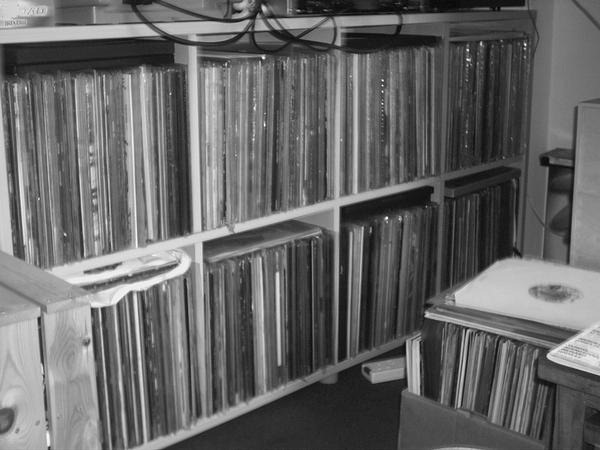
I’m aware of the issues of storage, perhaps more than most. 1,500 or so LPs and 12” singles, 600 7” singles and in excess of 2,000 CDs are a real bastard to house in a two-bed terraced property, and to move when it comes to relocation. But at least I know where my money’s gone and what I need to insure. Picking up a storage device no bigger than an audiocassette knowing that it contains not only my entire music collection, but also music to the value of something in the region of £30,000 is almost inconceivable. The same is true of a virtual library. The fact that a fire tearing through the house would – or could – have the same effect regardless of my choice of ‘file’ type is really beside the point.

It’s curious to note how times have changed: time was when an extensive library of books and an expansive record collection were perceived as accomplishments. They inspired respect, even awe. Now, the owners of large volumes of material possessions are considered to be simply behind the times, information dinosaurs plodding a Luddite land of clutter that’s cumbersome and difficult to navigate. Why would anyone want a 10-volume encyclopaedia when mankind’s entire learnings can be obtained on-line via Wikipedia (or other sites if more specialist knowledge is required, but why would you want that, really, unless you’re a real nerd)? In fact, what’s the point of a space-hogging PC base unit and monitor when you can have everything you need on a tablet? A music collection and library that not only occupies considerable space, but cost a fortune and took a lifetime to accumulate seems entirely redundant beside a small, flat piece of digital kit that costs around £300 and can be transported anywhere. And I suppose if you’re happy or able to accept a life of precarity, instability, endless mobility, that’s fine, but it’s not for me.

In fact, for many, owning music seems superfluous when you can stream it all via Spotify. It frees up funds to purchasing other ephemeralities and experiences. Again, the idea of a life recorded on Facebook is one that doesn’t appeal to me. The public nature of the medium aside, I struggle with the concept of a reliance on something that may disappear at any time. If there’s one thing we’ve learned in our world of rapid development is that technology attains obsolescence at an evermore speedy rate. There was a time, believe it or not, when the 8-track, the cassette and the videotape were all cutting edge. Betamax, laserdisc and minidisc were all the future, yet despite the qualities these media offered, early adopters were left out of pocket and out of style, not to mention out of the technology loop. CD was supposed to supersede both vinyl and the audiocasette – yet strangely, the MP3 killed both CD and tape while vinyl hangs in there, with a whole new wave of audiophiles sustaining a market that previously didn’t exist. I digress: the point is that Facebook could be next year’s MySpace, and a life on line is only a transient representation of real life: it’s a history that can not only be easily misrepresented and misappropriated, but one that could even more easily be erased. Obviously, nothing’s forever, but the physical – especially if backed up, duplicated somehow – has a greater capacity to be futureproof than anything that relies purely on the intangible (but then I find the idea of playing a virtual guitar while playing at being in a virtual band equally abhorrent and not just a little strange Step away from the console, pick up a real instrument, learn to play and form a proper fucking band if you have any interest in Rock Stardom!).

I’m not doing technology down as such – at all, in fact – but can you imagine future generations, instead of looking through albums and biscuit tins of family photos and shoeboxes of postcards and correspondence, gluing themselves to a screen and reminiscing about the day that prompted that romantic email, the wonderful day out to the coast captured magnificently in 6 megapixel digital colour, or even the idea of returning to that book you so loved in college and forwarding your friend or child the Kindle download to read and share the wonder? In all of the streamlining, the decluttering, something has been lost. An on-line playlist is not a direct or equal substitute for a lovingly-compiled mix-tape with lovingly-written, hand-scribbled notes on a piece of paper torn from an exercise book and inserted, tightly-folded, into the plastic case. If, as Marshall McLuhan suggested, the medium is the message, what sort of message is a medium that’s so theoretical say about our times and its users?

The bottom line is that if I’m spending money on something, I want something to show for it. I’m not suggesting that it needs to be big to justify the expense, but in a world where so little is fixed, stable, reliable, there’s a lot to be said for keeping it real as a means of keeping it grounded, and as a way of keeping it accessible in the future.

 

Vinyl


100_0044


And if you’re loving my work, there’s more of the same (only different) at Christophernosnibor.co.uk.
Sales Fever! Looking Back on Christmases Past

I spent a large chunk of my day today at an out-of-town retail park, where I parted with a small fortune. It was hell on earth, but needs just: I’d been planning to sort myself a new laptop, printer and external hard-drive (I’ve learned – and re-learned – the hard way the importance of backing up all of my work) for months and had been stalling (and saving) for the sales because, being on a budget wanted to make my money go further. And so it was I returned home with an ASUS X53U, an HP Photosmart 6510 and a Samsung hard-drive that measures roughly the size of my wallet and has a whole Terabyte capacity, plus various other non-computing related items for the house.

Needless to say, it was a relief to get home again, and having reserved most of my items on-line in advance, the excursion kept the trudging and legwork and general pain to a minimum. But while out I was acutely aware of just how many people are out there raiding the sales just because goods are discounted, a point reinforced by endless footage n television. Haven’t people got anything better to do, and why do they feel the need to spend money just because? The justification that a £200 jacket had 50% off doesn’t wash – or dry-clean – when considering the flipside of the equation, namely that there’s still 50% on. The last I heard, we were in the middle of a financial crisis. Are people really still dim enough to max out their credit cards just because they can’t resist a ‘bargain’? It would appear they are.

So once again I was reminded that people are idiots, and of the adage that a fool and his money are soon parted. I was also reminded of a blog I posted back in the MySpace days, which I found on my old (and now full to capacity) 300G hard-drive. It may have been posted on this day in 2007, but most of the points still stand, and it’s somehow comforting to observe how little I’ve changed my position. I like to be consistent (although I have taken time off work this year)….


Sales Fever! (2007)


The fact I haven’t been present on-line for the last couple of days shouldn’t be misinterpreted that I was busy wholeheartedly embracing the traditional Christmas rituals. I don’t absolutely hate everything about Christmas, and for me, it’s a good opportunity to spend a couple of days not straining my eyes in front of the PC and to actually have something approximating a rest.
 
Still, because I don’t consider Christmas to be quite as big a deal as many, and don’t consider it a reason to go on a month-long bender with everyone I’ve ever met, and don’t feel the need to eat my own body weight in poultry and pork, I didn’t feel the need to book the days between Christmas and New Year off work. Being at the office – a place I abhor with a passion – is always more bearable when there’s no work, no phone calls and no other staff in to drive me to distraction with their inane waffle.
 

Business as usual it isn’t. and while I’ve been able to potter around without distraction and amuse myself by switching the contents of people’s drawers and so on, I’ve also given a thought to those thousands of people who work in the retail sector. As I’m writing this on January 27th, I’m quite relieved to be hiding out in an office: I learned from Breakfast on BBC1 that today was expected to be the busiest shopping day of the year. And the footage I saw of the queues and the rucks on Boxing day were disturbing enough. It raised a few issues, not least of all the question ‘why?’ I mean, after a month of intensive shopping, why would anyone want to go shopping through choice? It’s insane. We’re a nation in financial crisis, in case no-one had noticed. But then, it’s this inherent greed and an inability to say ‘no’ – or to be seen to be unable to keep up with the pack – that’s got us here in the first place.
 

But irrespective of whether or not we (collectively) can afford to splurge, one would think that the last thing anyone would want to do after a period of intensive shopping in the run-up to Christmas is go shopping. I mean, it’s hell. It’s not so much a jungle out there as it is total war. There was an item on Breakfast in which some ‘fashion guru’ was giving tips on how to succeed in the sales, revealing a handbag full of energy-giving drinks and snacks (‘bananas are great for energy…’) and advising that in order to grab that must-have bargain, if you need to kick or punch, then so be it. To condone or promote such behaviour is beyond me. It’s not a loaf of bread in the middle of a famine, it’s a fucking handbag. Let’s get things in perspective here.

Despite my general disregard for many of the traditional aspects of Christmas, this eagerness to hit the shops on Boxing day or the day after is concerning. One issue is the fact that people seem to expect shops to be open all the time, and we do appear to be very slowly heading the American way, toward a 24-day society. The demand is for convenience, and that demand is coming to be supplied. And why not? Well, it’s all very well to demand, and to receive supply, but what of those who are required to deliver that supply? I’m talking primarily about those in retail here, of course, because 24-hour shopping requires 24-hour staffing of shops, but there’s inevitably a knock-on effect. We already have 24-hour / overnight couriers and so on… and where’s it going to end? And 24-hour is one thing, but what about 365-day-a-year?

Time was when everything closed on Sundays and Bank Holidays. Now, banks are about the only things closed on Bank Holidays (well, the clue’s in the name). A friend of mine said “they’ll have us working on Christmas day soon, mark my words.” Now, he’s a cynical old goat, but I think he may have a point. And similarly, the synchronicity of Christmas and the exchange of gifts may actually become a thing of the past the way things are going.

Consider the facts: the January sales now start on Boxing day. December 27th is the biggest shopping day of the year. Many take unwanted gifts back and exchange them for things they ‘really’ want in the sale, and I’ve heard a number of people say they’re waiting till the sales for their presents. So it’s not that much of a stretch to see, 10 years hence, people going shopping on Christmas day when the sales start, perhaps having a slap-up meal in the evening, and exchanging gifts on New Year’s eve, with New Year’s day remaining the only day the shops are closed because half of the population’s too hungover to go shopping. Of course, the reaction to this may eventually be to put the sales back to January again, and dog knows what kind of mayhem or rioting may ensue as a consequence.

The trouble is, the people who are at the head of the queues, who will punch and kick and trample to get their bargains and are demanding most vocally to be supplied appear to the, somewhat ironically, the same people who most rigidly adhere to the notion of a ‘traditional’ Christmas – extended family round for dry turkey and Aunt Bessie’s roast potatoes, followed by falling asleep in a cloud of flatulence in front of Eastenders, before re-enacting Eastenders with a major drunken barney of their own over something petty but that will prevent the different factions within the family from speaking to one another until the same time next year.

I’m not defending Christmas as a religious holiday of course, but given that I’m of the opinion that people should hibernate during the winter months, do think that in terms of maintaining a work/life balance, the demand for everything on tap at all times there should be some time off.

So I’m keeping out of it (I’ve quite enough handbags already, thank you). But alas, I may not be able to avoid the sales entirely. Whereas I usually receive more calendars than I have rooms in the house, this year I didn’t receive a single calendar. Ok, so I’ll buy my own. I just hope I’m not too late and won’t have to end up with a Russell Brand picture calendar.


And if you’re loving my work, there’s more of the same (only different) at christophernosnibor.co.uk


The Changing Face of Consumerism VIII: State of Independence, or, All’s Well at The Inkwell

The seven ‘Changing Face of Consumerism’ articles I ran on MySpace in 2008 and 2008 all shared a common theme, namely lamenting the sad decline of the real – both in media and commodity, with ‘reality’ television being a pisspoor ersatz approximation of any reality I’ve ever known, and ‘real’ shopping experiences being slowly subsumed by the virtual marketplace.

Don’t get me wrong, I’m all for progress, and have long been a big fan of on-line shopping, being one who doesn’t cope well with crowds or endless hours of pavement-pounding in search of goods, but by the same token, I’m a strong advocate of consumer choice. Despite what the global marketplace on-line tells us, we as consumers do not have infinite choice, not least of all because while some niche outlets fare well on-line, many have gone to the wall because the same kind of corporate giants that slowly erased all of the small independent stores from the high streets of each and every town have steamrollered the little on-line traders out.

As city centres everywhere become identikit clones of anywheresville, so our sense of location becomes diminished: the only thing to differentiate, say, Leeds from Lincoln, isn’t the choice of shops, but the size of each branch, and after a mooch round M&S, Boots, Game and HMV, stopping for a uniform coffee in a Starbucks or Costa before going on to… well, it doesn’t matter. I mean it really doesn’t matter where you are, the experience is pretty much the same. Fine, so you know what you’re going to get, but the experience of discovering a little specialist shop tucked away somewhere is radically different and appeals to a whole range of senses. However hard Amazon try to replicate the browsing experience of specialist independent book and record stores with features like ‘look inside’ and the song snippets you can listen to, in addition to the list of recommendations based on what you’re looking at and what other shoppers have also purchased or viewed that functions as a mimesis of the friendly and enthusiastic guy behind the counter who just loves his books or music and knows everything there is to know, like a living, walking encyclopedia, it just isn’t the same. There’s no substitute for browsing.

And so it was that I was practically skipping when The Inkwell opened in York a few weeks ago. A little shop stocking secondhand books, records (with a few selected new titles), CDs and cards, it’s the kind of shop you used to drop into, rummage around and find something wonderful you didn’t even know you wanted. The owner, Paul Lowman, is clearly an unashamed enthusiast first and a businessman second, and while such a venture is the kind that will never make him rich, and would make many lenders and entrepreneurs alike squirm in discomfort, it’s a shopper’s delight. Perhaps not surprisingly, The Inkwell is aimed at a niche market (by which I mean discerning shoppers: Paul’s philosophy is according to the website, “COOL STUFF FOR ALL!” Popular Culture is about democracy – inclusivity, not exclusivity) specialising as it does in books on music, film and pop culture, with sections on the Beat Generation, Art, Philosophy and a noteworthy – not to mention impressive – selection of pulp paperbacks, all in remarkably good condition (yet reasonably priced, with titles marked up at between six and ten quid).

The vinyl, too, is all in great nick, and the range, though limited, is all about quality and catering to a particular kind of discerning alt/hipster customer. There’s no mainstream pap to be found on the racks: instead, there are sections devoted to Garage, Psych, 90s Indie, Spoken Word / Comedy, and even Burlesque. Yes, if you want the kitsch sleaze of yesteryear, then the range of sexploitation titles in both audio and written media is exceptional.

It’s a tiny little place, made all the more cramped by there being a pair of school desks in the middle of the room, upon which a choice of books are casually laid. It’s all about the browsing experience (they serve coffee too), and an eclectic mix of music is spun – at high volume, and all on vinyl, naturally – on the turntable in the corner by the counter. Of course, it’s simply one’s man’s vision, one man’s obsession made manifest… but what’s wrong with that? But equally, why should a shop such as this succeed in a climate where major chains are going to the wall? The answer, I believe, is simple. In attempting to appeal to everyone, the major chains ultimately cater for no-one. In aiming to cover a vast market based on some kind of assumed generic average consumer and broad populism, the chains become Xerox copies of one another: reliable, perhaps, but ultimately forgettable and wholly impersonal. A shop like The Inkwell isn’t about conquering the world or trying to cater to all tastes: it knows its market and knows it well – because by being the shop its owner wants it to be, it’s catering for like-minded individuals (there’s that word again!). It’s unique in every way, and every item in stock is essentially a one-off. It has the personal touch and is memorable. And that’s why it has a better than average chance of success.

So, on the opening day I left with a brand new hardback copy of Brion Gysin: Dream Machine (a bargain at a tenner given that it retails at £25), a read but respectable copy of The Dark Stuff by Nick Kent (£3) and a vinyl LP – a copy of Fade Out by Loop, again in top condition (EX as Record Collector would have it), for a fiver.

I returned this week and was pleased to see some of the stock had gone and new stuff had taken its place, meaning I was able to add a copy of the original 1971 Olympia Press edition of S.C.U.M. Manifesto by Valerie Solanas to my library. The tenner asking price was more than fair, especially given the condition.

Does The Inkwell represent the vanguard of the counter-revolution in the world of retail? Perhaps not, but I’d like to think that other independent stores will begin to pop up, not just in York, but in every city, and soon. It’s unlikely that this is how the economic situation will be recovered, but being able to rifle some good books and records in a pleasant environment certainly makes these dark times a lot more bearable.

The Inkwell Online is cool – www.ink-well.co.uk – but not nearly as cool as being there.


Inkwell


And if you’re loving my work, there’s more of the same (only different) at Christophernosnibor.co.uk

Dead Pop Stars: Amy Winehouse and Why the Media Loves a Fuck-Up

For a moment, I felt the same incredulity and momentary slip of the sprockets of reality as when I turned on the news to discover that Princess Diana had died, and, some years later, Michael Jackson. Amy Winehouse, dead? Surely not? The way these three stories reached me was different for each: Di was a Sunday morning, I turned on the television to find nothing but blanket coverage on every station… I was at a gig when Jackson met his end, and someone in the audience had received a text and shouted out to the band between songs. From then on, we got updates from the stage via texts to audience members. It was through Facebook and Twitter than news of Amy Winehouse’s death circulated like wildfire, although I still turned to the television for confirmation… just in case. And sure enough, it was the breaking news on all of the channels.

Well, why wouldn’t it have been? Winehouse was a celebrity, famous and notorious in equal measure…actually, that’s not quite true. With only two albums to her credit (which collectively spawned just one top-ten UK single, her biggest hit being a cover on which she featured as guest vocalist) – and with many casual music fans unaware of her her debut, which achieved only moderate success – she might have been a reasonably successful singer, but it wasn’t until she careered off the rails and got fucked up that the media really got interested. Like Courtney Love – who is very much still alive – she only went stellar when things went wrong. The whole media circus didn’t only eclipse the short-lived musical career but also became self-perpetuating. There’s no more powerful blocker of creativity than intense scrutiny 24/7, a bunch of paps in your face every time you leave the house and endless speculation and commentary over a person’s varying degrees of wastedness. And if you have a propensity for drink and drugs, how are you going to escape it all? With more of the same, of course. And thus it becomes a vicious cycle.

Pete Doherty’s band may have been NME darlings, but being a pretty mediocre, shambling, jangling shit indie band, they were never going to become a household name (something also true of Hole, only they were a half-decent alternative rock band, at least until Courtney lost it after Kurt’s suicide and the mess and mud-slinging that ensued, which was at least partly media created). It was only the drug-related carnage and dalliance with Kate Moss that propelled him into the headlines. It’s hard to tell how much of it is driven by the media and how much it’s driven by a genuine thirst for scandal, but however you look at it, fucking up in public is the way to hit the stratosphere in terms of coverage. The media love it, of course: pick your target and shadow it, with the guarantee that there’ll be something outrageous to report most nights of the week and you’ve got an easy way of filling time or column inches. Are the public genuinely interested, are they really that thirsty for salacious gossip about the not-so private lives of celebrities? Maybe the they weren’t but tell them often enough and they’ll become convinced that they are interested.


article-1054873-02A0396600000578-194_468x533


The BBC had a reporter stationed at the cordon on the street where Winehouse lived. The reporter commented on the sixty-five or so fans who had gathered and remarked on her dedicated following. There’s no questioning the size of her fan-base: Back to Black has sold in excess of 10 million copies. But mainstream artists rarely have truly dedicated fans: were these dedicated fans the same ones who booed her off the stage not so long ago when she rocked up, wasted, stumbling over her feet and the lyrics and generally in no fit state to perform? Sixty-five people is hardly a crowd, and besides, how many of those loitering – when there’s nothing to see, so why not move along, now? – were actually fans? How many were police, and how many were media reporters and photographers? That’s a rhetorical question.

Most saliently, the number hanging around that street in Camden was significantly lower than the body count in Norway. Yet in the rush to give live, up-to-the-minute, as-it-happens coverage of another dead pop star, that story had plummeted off the radar. The hacking scandal was all but forgotten and I can only assume that the fact Greece – not to mention America, but that’s being kept strangely quite – is on the brink of financial ruin and there are wars raging across the globe are only of minimal significance in comparison. I’m reminded of Derrick Bird’s killing spree in Cumbria last year, which saw 12 people shot dead and 11 more injured before he turned the gun on himself. It was major news for a short while, until Raol Moat went on the rampage and the story was all but forgotten about. Despite a much lower body count, a siege was ready-made for live streaming news and much more likely to capture the nation’s imagination than something that was over before the cameras could be on the scene.

I’ll admit, I was never a fan of Winehouse’s work, and don’t think she was an ‘incredible talent’, and the monumental outpourings of grief on-line seem wholly disproportionate. In the same way that everyone loathed Jade Goody for being a fat racist ignoramus until she was diagnosed with cancer, when she was immediately presented with a halo and became a national treasure, it seems that dying young alters the mass perception to such an extent that all is forgotten. Seemingly, dying young it a tragedy no matter what, and makes one a better person, a hero, an instant deity. Thus, while I have no wish to disrespect the dead, I’m not going to suddenly change the opinion I held of her while she was living – a rough, skanky no-mark who got lucky.

But this isn’t about my opinions of Amy Winehouse or her music. I’m more concerned about taking an objective look at the media response – by which I also mean on-line media, interactive media. Sure, a lot of people did like her music, but did she and her work really touch the lives of so many, so profoundly, as to require the Twittersphere to become clogged and Facebook to become a no-go zone for those who want to read anything other than ‘RIP Amy Winehouse’ and what a tragedy it is that the world’s lost one of its greatest talents? Or is it simply an example of people being seen to do and say what’s expected of them, the herd mentality of not wanting to be left out? ‘Yes, me too, I never got any of her albums, but I really loved her music, so amazing, blah blah blah’.

It’s all a matter of perspective. It’s about time people started to think for themselves.

And if you’re loving my work, there’s more of the same (only different) at Christophernosnibor.co.uk

Hiding in Plain Sight: So, About These Bargain-Hunting ‘Secret’ Dealers…?

So, the premise of the ‘hit’ ITV1 show Secret Dealers is – and please, correct me if I’m wrong – that householders apply to be on the show, and, if selected, three antiques dealers rock up (with a camera crew and host Kate Bliss, who previously appeared on Bargain Hunt and Flog It!). Then, while the householders are out (presumably they’re taken for a meal or something by some TV people and transported back when the word is given, rather than simply being booted out of their house and told to come back in a few hours), check out the contents of the house. Anything the dealers like the look of, they’ll pop a card next to, with the amount they’re offering for said item written inside. Each dealer is identified by the colour of their cards.

When the householders return, the host takes them round and shows them what’s been offered for each item. Where multiple offers have been made, the householder can sell to the highest bidder, or keep the item if they think it’s worth more. The dealer who buys the most wins, and the householder ‘wins’ the proceeds of the sales, and winds up with a house stripped of any items of value.

Fine. So it’s a glorified house clearance, daytime TV style, and everyone loves it because it’s got real people and everyone think they too might have some rare antique bric-a-brac lurking in the loft. I get that.

But where’s the secret? The title implies they’re undercover or otherwise anonymous, like the ‘secret’ millionaires and the ‘secret’ bosses. How are the dealers remotely secret when the householders know they’re coming – because they invited them – and it’s not only revealed how much was offered for each item, but who made the offer? The dealers know they’re dealers, and all of the dealers know what the other two are up to. The only secret is that the dealers don’t know how much the others have offered… which is essentially how sealed bidding works. It doesn’t make the dealers secret, though, does it? No, only the bids.

The threadbare premise for an hour-long show is one thing, but the completely misleading title is quite another. But then, I suppose A Bunch of So-Called  Antiques Dealers Place First -Price Sealed Bids on Stuff to Fleece Idiot Members of the Public on TV in the Name of Cheap Entertainment doesn’t have the same ring to it.


secret-dealers-2011-06-28-1500-230

Kate Alcock – sorry, Bliss – being secretive, yesterday.


And if you’re loving my work, there’s more of the same (only different) at Christophernosnibor.co.uk 

Liberator! Part 9

Tim was spending a lot of time as he pleased, but was far from being a man of leisure. Things were shaping up on the allotment, but he was a long was off being self-sufficient. All too often, he found the temptation to do something else less boring instead too great, and would take himself off on long, meandering cycle rides or sit in the pub on his own with a book or a magazine, or even a newspaper. He’d never been a big reader before, but was starting to find it an enjoyable and stimulating pastime, although he preferred non-fiction books and still found the news as depressing as hell. Still, it only reinforced his belief that what he was doing was for the best. The world was sick and he wanted no part in it.

Amy saw things differently though. Tension had been mounting and the more Tim refused to join her on her social climbing excursions and uncomfortable engagements with people neither he nor she really liked, the more irritated she became.

It all came to ahead one Wednesday evening. Amy had been working late and Tim hadn’t been working at all. It had begun with Amy’s daily harangue about him getting another job, and he’d had to admit that money was beyond tight. His suggestion that they sell some of Amy’s DVDs and unwanted clothed had incensed her and she had given him a piece of her mind with a few home truths expressed in the most straightforward of terms.

‘You don’t get it, do you?’ he had said.

‘You’re right, I don’t. I don’t know what the hell’s wrong with you,’ he had snapped in reply. ‘You need your head checked. You’re not living in the real world!’

‘No,’ he’d replied in a measured tone, solid with confidence and conviction, ‘I’m part of the solution. Your way of living, following the herd, running on empty and perpetual stress, as though you’re actually gaining from it, is all wrong. Success – material success – is an illusion. No-one sees it because they’re scared.’

‘Don’t talk like that, you sound like you’re mad!’ Any had screamed.

Tim had shaken his head. ‘If only you knew’, he had sighed. ‘Look, you’re off to a party for Paul’s birthday tonight, right? Why are you going? You feel obliged,’ he had lectured. ‘You can’t say no because you can’t be seen to not be there. Keep your friends close and your enemies closer, right? But what’s in it for you, really? You’ll make like you’re having a great time, but it’s all a complete lie. You think he’s boring and his girlfriend’s an idiot. Although to be honest, I think you’re jealous of her because she’s on a higher salary and likes everyone to know it.’

‘Look, I can’t be with you if you’re going to be such a prick,’ Amy had snarled. ‘I’ll be back for my stuff later.’ Then she turned tail and walked out, slamming the door behind her.

Tim’s face flushed, a combination of humiliation and anger. Fuck her. If Amy couldn’t get on board with what he was doing, and support him in making a better life for himself in an insane world based on facades and superficial exchanges devoid of contact or humanity in a culture of hyperinformation, he didn’t need her. It was her loss. One day she would realise he was in the right.


And if you’re loving my work, there’s more of the same (only different) at Christophernosnibor.co.uk 

Tales of Everyday Banality: What’s Your Flava?

    ‘Hey, look what I won, a mug with chocolate things on sticks.’
    His colleague looks up. ‘What’s that?’ she asks.
    ‘It’s a mug, right, and…’ reading the instructions on the chocolate swizzle stick, he explained how ‘you pour boiling milk into the mug and then stir the chocolate thing round on the stick till it melts and you’ve got hot chocolate. Two flavours, mint and bourbon.’
    ‘Bourbon?’
    ‘Yeah. Do you want one? I don’t really want both. I’m keeping the mug though.’
    ‘Yeah? Oh, thanks, yeah.’
    ‘Which d’you fancy?’
    ‘I don’t mind, whichever you don’t want.’
    ‘I think I’d prefer the mint chocolate, so you can have the bourbon,’ he says.
    ‘Ok, cheers. I’d never have thought of making bourbon flavour. that’s really unusual.’
    ‘Innit? Weird. That’s why I’m sticking with the mint. I know what to expect. I can’t really imagine bourbon flavoured hot chocolate.’
    ‘Oh I’m sure it’ll be nice. I like bourbons.’
    ‘Me too, but I’m not sure about the flavour as a drink, y’know?’
    I can take no more.
    ‘Surely it’s bourbon flavour,’ I interject.
    The girl looks as the chocolate swizzle stick she’s been given. ‘No, it says bourbon flavour.’
    ‘Yes,’ I reply, but bourbon and bourbon are spelled the same but are pronounced differently.’
    ‘Really?’
    ‘Yes.’
    ‘Are you sure?’
    ‘Positive. And I’d wager that it’s bourbon whiskey flavoured chocolate rather than biscuit flavoured chocolate.’
    ‘It might be biscuit.’
    ‘But I would expect that it’s probably whiskey.’
    ‘Well I’m going to drink it at the weekend and I’ll let you know if you’re right next week.’

***

    ‘So,’ I begin, trying to suppress a smirk, ‘was it whiskey or biscuit?’
    ‘Sorry?’
    ‘The hot chocolate thing you had. The bourbon / bourbon chocolate on a stick, what flavour was it, whiskey or biscuit?’
    ‘Biscuit,’ she replied.
    ‘No? Really?’ I couldn’t hide my incredulity.
    ‘Yeah. Well I didn’t have it in the end, my friend did, but she couldn’t taste any whiskey. I looked at the ingredients and there was no alcohol in it, so it must have been biscuit.’
    ‘How would you taste biscuit?’
    ‘It mostly just tasted of chocolate, but there was definitely no alcohol. So I was right all along, it was bourbon, and not bourbon.’
    ‘But why would they make biscuit flavoured chocolate?’ I asked, amazed.
    ‘Well they make chocolate flavoured biscuits.’
    There’s no arguing with logic like that.


And if you’re loving my work, there’s more of the same (only different) at Christophernosnibor.co.uk 

Spin on this! When the Machines Take Over

So things are starting to happen where the publication of the paperback edition of my novel, From Destinations Set is concerned. The publisher have the first batch in hand – I’ve seen one, and they look great – and are starting to mail out review copies. They’re circulating press releases, too, and from what I can tell, these are beginning to generate traffic already.

Stuart at Clinicality Press has penned some very nice press releases and made use of the rather tidy synopsis / blurb he did for the book. I was amused, then, to find a version of the press release that didn’t remotely resemble those Clinicality have issued, not least of all because one of the threads of James Well’s book, Hack, that Clinicaliy will be putting out later in the year, is concerned with word-spinning.

Unsure of precisely what this entailed, I conducted a spot of research, to learn the following:

Article spinning is a search engine optimization technique by which blog or website owners attempt to manipulate their rank on Google and other search engines. It works by rewriting existing articles, or parts of articles, and replacing elements to avoid being penalized in the Search Engine Results pages (SERP) for using duplicate content. The original articles are often plagiarized from other websites and can often also be copyright infringements if the original article was used without the copyright owner’s permission.

Website owners may pay writers to perform spinning manually, rewriting all or parts of articles. Writers also spin their own articles, manually or automatically, allowing them to sell the same articles with slight variations to a number of clients or to use the article for multiple purposes, for example as content and also for article marketing. There are a number of software applications which will automatically replace words or phrases in articles. Automatic rewriting can change the meaning of a sentence through the use of words with similar but subtly different meaning to the original. For example, the word “picture” could be replaced by the word “image” or “photo”. Thousands of word-for-word combinations are stored in either a text file or database thesaurus to draw from. This ensures that a large percentage of words are different from the original article.

The spun version of Stuart’s press release is a brilliant example of automated article-spinning 9and why it doesn’t work). The words substituted so inappropriately that much of the initial meaning is lost. Nevertheless, it’s highly amusing, and while it’s great to see my work continually cropping up in unusual and unexpected places, I very much doubt that this piece will do much for the sales of From Destinations Set. Ah well….  http://42.cm/clinicality-press-push-the-boundaries-with-a-book-of-two-halves-coming-march-28th/

Order! Order! Book Retailer Defies Logic and Sends OCD Shoppers to the Edge

I’ll admit that I’m prone to extreme pedantry and display many behaviours that are classic traits of the obsessive, the anally retentive. To be honest, I’m fine with that. I have a lot of books, records and CDs, and so storing them in alphabetical order by author or artist makes sense if I want to avoid having to spend hours rooting through haphazard piles of stuff. That I store items in order of publication or release date for those authors or artists I have multiple items by is also helpful, if not quite as essential, and that all of my records are stored with the A-side facing the front and records and CDs are kept with the labels the right way up is simply a preference. In a world where have very little control over anything, it’s comforting to maintain a sense of order in those aspects of my life where it actually benefits me. I choose the alphabetical by author / artist system because it’s ‘the standard’. Libraries, book stores, record stores… the simple fact id that it makes sense and is based on an indisputable logic.

Yesterday, for something to do and because, since they became a ‘media’ store rather than a music store (CDs now occupy less space than DVDs and are generally receive equal billing to console games), HMV have been known to stock some reasonable cult fiction at generously discounted prices. Burroughs, Palahniuk, Bukowski, Plath; all names I spotted amidst the predictable selection of music-related books, celebrity biographies and populist cack, and all with a decent whack off the RRP.

What perplexed me, however, was the arrangement of said books on the shelves. Stephen King books were interspersed throughout the display, which was some five shelves high and eight to ten feet wide. Burroughs’ The Place of Dead Roads was somewhere in the middle, while Kurt Vonnegut’s Armageddon in Retrospect was on the top shelf on the far left. What the fuck?

It actually took me a little while to realise that the books were arranged alphabetically by title. Apart from biographies, which were placed by order of the surname of their subject. And apart from books about a band, in which case the book’s placing was dictated by the name of the band. And apart from Frankie Boyle’s My Shit Life So Far, which appeared to be amongst the Cs.

On reflection, I suppose that’s probably right.

Of course, this begs the question, why aren’t the CDs arranged using the same system?


And if you’re loving my work, there’s more of the same (only different) at Christophernosnibor.co.uk