Something Must Break: A Taste

I shall be self-publishing Something Must Break – a long short story, or miscro-novel (7,000+ words) as an e-book via Amazon Kindle soon. With no budget, time or publisher, promotion will be limited. It’s more about putting it out there. ahead f its publication, here’s a taste:


Blood… the roar of blood in my ears. My heart isn’t racing: that connotes an even but rapid pace. Nothing nearly so regular: it heaves, lurches and palpates in my chest. Each beat drives like a hammer, forcing blood in hot, agonized surges through my slowly narrowing veins. My aorta throbs, valves straining and corpuscles pushed to the brink of haemorrhage with every explosive spasm. This is no red mist descending. The mists come in all different hues, dependent on which of the myriad triggers has induced the symptoms on any given occasion. This time, a white haze obfuscates everything, pluming like smoke across all of my receptors.

I inhale slowly, deeply, mindful that I don’t hyperventilate. An oxygen rush would only exacerbate my condition. Which is what? It’s hard to say. But when one of these episodes manifests… it’s not so much that I’m not in control. I’m simply not present, not myself.

My mobile phone vibrates in my shirt pocket and I answer without looking at the display: I can’t focus anyway.

‘Hey, are you ok?’ The voice on the line is Faye, my wife.

My greeting must’ve sounded even worse than I’d thought. ‘Just a bit spaced out,’ I mumble, my voice sounding distant and muffled in my own ears, ‘it’s been a long day.’ She’s aware of these episodes of mine, but I try not to cause her undue worry. I forget the rest of the conversation. I killed the call. My vision was still blurred and my hands were trembling, but otherwise, normality was beginning to return.

I power down the PC, lock up my office and leave.

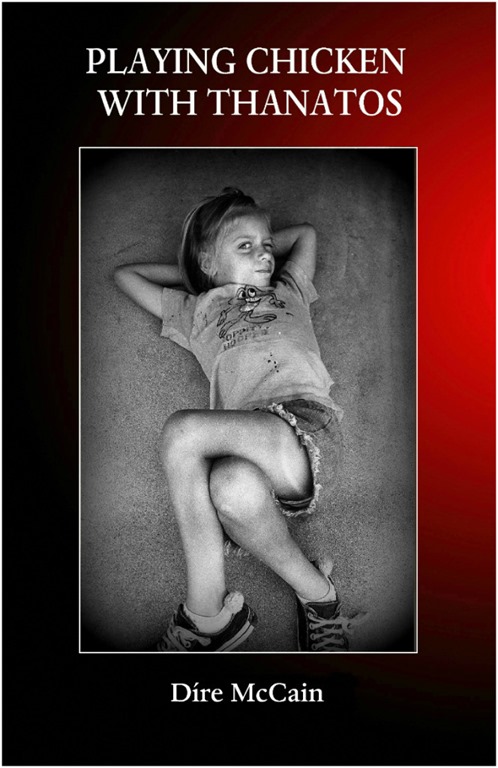
Review: Playing Chicken With Thanatos by Díre McCain (Apophenia Books)

I had the great and rare privilege of reading a manuscript version of this book some time ahead of its final draft and subsequent publication. Then, it had a different working title and a number of changes would follow which made tracing some of the identities of the real-life characters who populate the book rather more difficult. But even in its not-quite complete stage, I was struck by a number of things, not least of all the vibrancy of the narrative, the immediacy of it all, how relatable and accessible the narrator was.

Now, I’ve known the author – virtually, at least, and over Skype – for a number of years: under the auspices of co-founders Díre McCain and D M Mitchell, Paraphilia Magazine generously published my work from the very first issue at a time when no-one else would (a situation that continues, if the truth be known) and have been immensely supportive through the years, long before I clambered aboard as a contributing editor. Díre also graced the Clinical, Brutal anthology I edited for Clinicality Press in 2010 with a piece that was stunning, not to mention truly brutal. So I had an inkling of her abilities as a writer, and indeed of her turbulent formative years. But none of this could have really prepared me for her autobiographical novel.

It’s everything you want from a novel: the narrator drags you along on the journey: at times you sympathise, at others, not so much, but that’s how it is with friends, you take the rough with the smooth. It’s the raw honesty of Díre’s narrative, delivered in a strong, individual voice, that’s so compelling and so human that means you forgive, and you worry about what will happen, you’re there in the moment.

It’s also the fact that however bad things get, however badly she’s treated and however low she sinks, she never plays ‘the victim’, and herein lies the book’s greatest strength: she just tells it straight, and never uses sensationalism to detail sensational events. In this way, Playing Chicken With Thanatos doesn’t sit with the contemporary vogue for memoir, but instead belongs to a strain of classic American autobiographical reportage: Bukowski’s Post Office springs to mind; Jack Black’s You Can’t Win; Burroughs’ Junky, and from over the pond, Colin Wilson’s Adrift in Soho and Terry Taylor’s Baron’s Court, All Change. What all these books share is an episodic approach to storytelling and a lack of pretence.

There are moments that are utterly terrifying, and the happy-go-lucky easy rollin’ of teen experimentation with whatever substances are on offer takes a turn into extremely dark territories, and the later sections of the book are indeed harrowing. But it’s by no means a depressing book: even through the bleakest sections, the way the words simply flow is a joy, and the author’s sharp intellect and extensive vocabulary set Playing Chicken With Thanatos leagues apart from any drug-addled confessional. And, despite placing a clear distance between her past and present, at no point does Playing Chicken With Thanatos become a vehicle for anti-drug rhetoric, high moralisation or preaching: the fact Díre doesn’t insult the reader’s intelligence – or mar the narrative – with such interjections is another aspect of what makes this book such a great read.

It’s from a purely objective mindset that I say that this book is special, bursting with life and emotional resonance and that for these reasons I give it my strongest recommendations. So do as the preface bids: ‘fasten your fucking seatbelt and hold the fuck on….’


PLAYING-CHICKEN-WITH-THANATOS-Cover-664x1024


Link: http://www.paraphiliamagazine.com/diremccain/playing-chicken-with-thanatos/


And if you’re loving my work, there’s more of the same (only different) at Christophernosnibor.co.uk

2013: A Year in Books

When I’m not writing music reviews or books of my own, I spend a reasonable chunk of my free time reading books, for pleasure or for education. I’m not all about the hot new releases, the recommendations or the best-sellers. I read what I want, when I want, and occasionally, I read what I get sent (which is usually something I want to read anyway, which is a double bonus in many respects). So, in 2013, I read 28 books. They’re listed below. It’s not a ‘best of’ list, and the list isn’t about critical appraisal. I enjoyed some of the books I read more than others. Some, I’ve reviewed. Most, I haven’t. A handful of them I’d read before, the majority I hadn’t. So there you have it.

Warren Ellis – Gun Machine

Stewart Home – Mandy, Charlie and Mary-Jane

Arthur Miller – Focus

Davis Schneiderman – Blank

Davis Schneiderman – Drain

John Tottenham – Antiepithalamia & Other Poems of Regret and Resentment

JG Ballard – Concrete Island

Carl van Cleave – Incisions, Collisions and Aborted Missions

Michel Houellebecq – The Map and the Territory

James Higgerson – The Almost Lizard

Christopher Landon – The Shadow of Time

John D. Chadwick – The Theosophical Teapot

Robert Silverberg – The Second Trip

Jim Thompson – Savage Night

Mark Thomas – Bravo Figaro!

JG Ballard – Rushing to Paradise

Jim Thompson – The Killer Inside Me

Valerie Solanas – S.C.U.M. Manifesto

Brendan Behan – Borstal Boy

Davis Schneiderman – [SIC]

Elmore Leonard – Djibouti

Martin Amis – The Information

Aldous Huxley – Brave New World

JG Ballard – Kingdom Come

Clinton Heylin – Bootleg! The Rise & Fall of the Secret Recording Industry

Ed McBain – The Heckler / See Them Die

Michel Houellebecq – Whatever

Mark Manning – Crucify Me Again

THE PLAGIARIST Strikes Back: Losing the Plot (Again)

When I signed up to participate in the segment of the Leeds Bookend Festival curated by Pastiche Magazine, which has been good enough to publish my work in the past, I figured it would be a good lineup and moreover, the availability of a multimedia lot meant I would have the opportunity to try something I’d been wanting to do for years, namely the full PLAGIARIST multisensory live experience.

It was a gamble: one of those pieces that if I pulled it off, it would be spectacular and annihilative all at once. But if it didn’t quite happen, it wouldn’t so much be a disaster as a pathetic disappointment, akin to Spinal Tap’s ‘Stonehenge’ debacle. Conceivably one of the funniest moments in film, you wouldn’t want to be in the band it actually happened to. But artistic achievement is all about risk-taking.

The idea was to take one of the versions of film I’d posted on YouTube (I’d made three different edits), remove the bulk of the audio track of me reading, add significantly more white noise and feedback audio (a ‘sample’ of course) and then perform the bulk of the reading live. What could be simpler?

Aware that I only had a couple of weeks I set to work straight away. By which I mean I set to scouring my hard-drive for the files, but to no avail. The final AVI files were there, but not the editable projects, which I’d (foolishly) assembled in Windows Movie Maker. They weren’t on my backup hard-drive either. I should by now have realised I was asking for trouble in having offered to take the slot, which was still unconfirmed. Nevertheless, I figured they were probably on the hard-drive of the PC I’d used to produce thee original film, which was still in storage in the loft. So,at the weekend, after an hour and a half trying to locate the old HP base unit and monitor, and another half an hour almost breaking my neck trying to lug it down the loft ladder perched on top of my head, I discovered that the project files were missing. This left me with a week to recreate something that had taken me almost two months to create the first time around,some three years previous. But at least I had made an important decision: to flog the old desktop, because it’s needlessly cumbersome and completely redundant (although I do yearn for a more solid keyboard than the one on my new Toshiba Satellite Pro, which is nice enough laptop overall but doesn’t type as well as my old Asus. Yeah, yeah, workman, tools, etc.).

As I slogged away for a succession of late nights, I became increasingly square-eyed and more concerningly, debilitated and frantic in equal measure. Progress was reasonably swift, and infinitely less fraught than thee first time around, partly because I knew what as doing and partly thanks to a significantly more powerful computer. Even so, as the deadline loomed I had to break off to complete my research for, compile questions and then conduct an interview with Joe Cardamone of The Icarus Line for Paraphilia Magazine. He’s in LA, I’m in York and I had to sync times and dick about with software as I’d lost the programme I used to record Skype hook-ups when the Asus had croaked a couple of weeks before.

Having the interview in the bag and an email confirming times for Saturday’s show didn’t resolve my reservations about performing what was perhaps my most brutally confrontational conception in a shopping centre in a large city in the late afternoon / early evening. The lineup, however, was excellent, and included a number of writers I’ve been impressed by in the past, notably Rab Ferguson, Laurence Reilly and ‘punk poet’ Henry Raby.

Anyway, Saturday rolled around and I had my reworked audiovisual tracks ready and while I knew there’d be a projector and screen, wasn’t sure about a PA so bunged my speakers – a pair of Labtec Spin 85s I’ve had for about eight years – into my rucksack before heading for a train. I’d road-tested them in the living room after they’d been in storage for a couple of years in the loft and was pleased by how much poke they had given their dimensions and wattage. I was reasonably well-rehearsed, but had elected to pick some passages at random in keeping with the spirit of both the book and the performance. The only real downer was that I’d developed conjunctivitis in my left eye, which was by now swollen and streaming. I also managed to get confused about train departures and arrivals in relation to the slot, so arrived more than an hour early to find the place dead.

At least I’d located the venue and this uncommon error on my part afforded me an hour in which to sip a leisurely pint of the Magic Rock Brewing Company’s superbly hopped High Wire West Coast Pale Ale (5.5%ABV) in the Brewery Tap and read some of Jim Thompson’s Savage Night while I reflected and mopped my eye, which was growing increasingly itchy and painful.

On my way back to the Customer Service Lounge, where the readings were taking place, I took the time to truly soak in The Trinity shopping centre. I ambled casually past the shops – standard fare and then some: H&M, Boots, Next, a new Primark to be opened later in the year – and made a lap of the watering holes I’d bypassed in my eagerness to hit the Tap. It was in passing these sleek, anonymous façades that I began to feel particularly uncomfortable, and peering in past my reflection in the plate-glass frontages and through blurred eyes into the interiors the the full horror of the air-conditioned nightmare that is The Trinity really hit me. The Trinity is a faceless, shiny architectural vacuum of personality that is in so many ways the physical manifestation of the multi-layered geometrical hells Ballard depicted in High Rise and The Atrocity Exhibition.

It wasn’t simply the construction and layout and the lack of soul, but the vapid, superficial nonentities it seemed to be packed with, all shouting at one another to be heard over the reverberated sounds of music and other people’s interlocutions and telephone conversations. This was all amplified through my own filters, and as such my response to the situation was more pronounced and more acute, but even had I not been feeling particularly edgy, I would have still felt an intense paranoia as I paced by traversal to make a suitably timely arrival at my destination.

Before the event got under way, I had the opportunity to chat with Henry Raby, and to speak briefly with Laurence Reilly, who informed me that reading The Gimp had left him somewhat traumatised. I deferred thinking what kind of effect the piece I as about to do might have. Frustratingly, I would have to leave before Henry’s session-ending multimedia piece, but Rab Ferguson would subsequently deliver a reading that was confident and solid and Laurence’s performance – and performance is the word – was immensely powerful: he guy really got out of his skin and into character.

As the first few of speakers took their turns following a brief introduction from curator and Pastiche editor Clare DeTamble, I found myself struggling, again with the space and the context, namely of a large bright-lit area resembling an airport lounge, with an pen front and situated off a large brightly-lit concourse. The customer service desk, compute terminals and large-screen TV with BBC News 24 playing silently but with subtitles all contributed to the disconnected sensation and the strangeness of the whole thing. Most of those present were either reading or had come along with a reader for moral support. The Trinity staff would occasionally answer the phone, but mostly milled about distractedly, but very few casuals crossed the threshold, and even fewer took seats.

It wasn’t entirely surprising: I found myself struggling as I watched the other readers. It was no discredit to their texts or performances that I was finding it difficult to focus on their words, as they were half-buried in passing noise and conversations. Even amplified, I suspect it would have been a challenge. And it was at this point that I realised THE PLAGIARIST REWIRED was the perfect piece for the setting.

Having endured torture of shopping mall, it was only right I should be afforded my revenge and wreak psychic havoc on the very location that caused me such existential alienation and distress. By the time it was my turn, I was adrenalized and raring to go. The lack of volume, the less than perfect angling of the screen, the small audience, the TV in the background, the weird, bright performance space that no-one could possibly describe as an auditorium… none of it mattered.

I paced the area in front of the audience like a man possessed, stamping one way and then the other, and then standing close to the front and presenting a confrontation stance. Behind dark glasses (handy at the best of times, essential for creating mystique and hiding the sick eye) I was wired and observed an array of expressions ranging from nonplussed to horrified. I was in the zone. The words flowed from me at increasing volume and pace as the images flickered and the shards of noise shot from the speakers – not nearly as loudly as Id have liked, but still, the effect was there. As the piece reached its climax, the words looped and fragmented, while the images strobed behind me and electronic white noise completed the sensory assault.

My other prior engagement back in York meant I had to slip out during the next speaker’s set, so I wasn’t able to stick around for feedback and to gauge the reaction. I suspect most of those who witnessed the performance thought I’d lost the plot. And that’s fine, because as I always say, plot’s overrated anyway.


And if you’re loving my work, there’s more of the same (only different) at Christophernosnibor.co.uk

Reviewed: The Theosophical Teapot by John D. Chadwick

A little thematic unity can go a long way in bringing a thread of cohesion to a collection of short stories. The Theosophical Teapot, which features some of Chadwick’s earlier works of fiction, some of which have featured in various small publications and others which are previously unseen, present the reader with a disparate range of strange, desperate and ugly characters, from all walks of life and spanning a range of historical times.

Stylistically diverse and presenting a litany of different voices and scenarios, Chadwick returns – like a dog to its vomit – to the maladjusted, to the dark, to the mysterious, to magic, to Aleister Crowley, to Jack the Ripper, to William S. Burroughs.

There’s some strong writing to be found in here, but what really stands out is Chadwick’s knack for a killer twist. On many occasions, just as you find yourself wondering where he’s going, he’ll slam the most unexpected of turns, and often save it as late as thee last two or three lines.

By turns funny and bleak, The Theosophical Teapot shows Chadwick to be an innovative and imaginative writer, while the illustrations that separate these twisted tale prove he’s pretty adept on the visuals front too.


9781291212167


The Theosophical Teapot on Amazon.

And if you’re loving my work, there’s more of the same (only different) at Christophernosnibor.co.uk

Redressing the Balance: This Book Isn’t Nearly as Stupid as the Title Suggests… Or Is It?

For all of the claims made by myself and my publisher for the audacious anti-literary bent that drives my latest novel, This Book is Fucking Stupid, the fact that the core thread – the story itself – is essentially a straightforward piece of contemporary literary fiction is something that’s been very much underplayed.

As the paperback edition is out today, I thought it would be an idea to post an excerpt from one of the more conventional narrative passages, if only to prove to the world that as a writer I am capable of ‘normal’ things like plot and character development (after a fashion) and not only about text that function on a theoretical level…. Ok, well I half mean it…


from This Book is Fucking Stupid


It was just another day at the office, the same as any other. Ben sat at his desk. He had spent the last three hours trying desperately to compile his latest report based on a series of site visits to out-of-town shopping developments ahead of Friday’s deadline, but it was proving nigh on impossible. For a start, the buildings were in a poor state of repair: his surveys had uncovered a number of significant structural flaws which were bad news all round. The trouble was, he found these modern prefabricated monstrosities composed of concrete and corrugated iron the most uninspiring of all buildings to assess, and while he had most of the information he required to hand, some of his notes were a little patchy regarding some of the sites, as he had been tired, bored and hungover while conducting the surveys. That said, he didn’t really find buildings in themselves all that inspiring. Surveying hadn’t been a calling for him, but then, for whom is surveying a calling, a passion? Surveying was a job, which required an even and pragmatic approach to factual data and a grasp of figures and certain scientific concepts regarding the deterioration of concrete, the weakening of iron girders, the flammability of certain materials and so on.
    The appreciation of architecture was not a prerequisite for becoming a government inspector of commercial property. Yes, a civil servant. But the modern out-of-town retail park developments were still the worst: once you had seen one, you had seen them all. But feeling tired and grotty made any report on such buildings even more wearisome, and with a tight deadline looming, even more troublesome to a man who was not a big fan of typing long reports, preferring, if possible, to keep communications down to brief notes and bullet-points. Equally troublesome, his phones – landline and mobile – kept ringing, interfering with his train of thought. No sooner had he regained his flow and begun formulating a coherent sentence detailing the defects in the roofing structures or damp coursing than another call would demand his attention and haul him away from the job at hand for just long enough for him to forget exactly what it was he had been about to write next.
    Ben sat and rubbed his eyes with his thumb and forefinger. His skin felt rough and dry, his eyes sensitive and watery. He had been staring at the screen for what felt like hours. How long it had really been, he was uncertain. The text was beginning to drift before his eyes as he read it again and again. The text was beginning to drift before his eyes as he read it again and again. He was exhausted, and this was reflected in his sallow appearance. He had spent the last week and a half driving long-distance between the sites he was surveying for this report – Wednesday last, Southampton, Thursday last Birmingham, Friday last Nottingham, followed by Bath on Monday, Stoke on Tuesday, Newcastle on Wednesday and Norwich this morning – before returning to the office with a sheaf of scribbled notes, digital camera shots, notes recorded on a Dictaphone while on the tops of various buildings, muffled and inaudible due to high winds blasting across the mic as he had mumbled tiredly and unenthusiastically about various joists and joints. He rubbed his eyes again and returned his bleary eyes to the screen. He rubbed his eyes again and returned his bleary pupils to the screen. He needed a break. Needed to clear his head, to regain his focus. Yes, he had a deadline looming, but he’d never make it like this, he simply couldn’t focus his mind.
    The Foo Fighters’ track ‘The Best of You’ rattled from his pocket for the umpteenth time that day. He loved that song – it rocked – but he was beginning to tire of its polyphonic yet stunted ring-tone version intruding into his life every five minutes. He was also weary of his works mobile. Why they wouldn’t upgrade to something more contemporary and functional like an iPhone or a Blackberry, he had no idea.
    It wasn’t that Ben was a he fan of the iPhone, although he did rather like its multimedia functionality, and its now classic design. He liked its dimensions, a cozy yet suitably chunky 115.5mm x 62.1mm 12.3 and comforting 133g weight. He also had an appreciation for its TFT capacitive touchscreen, even if its sleek surface, with its with its scratch-resistant oleophobic coating, became a slick of greasy thumb-prints within seconds, even while in the pocket, and these obscured the screen, despite its presenting a respectable 320×480 pixel 3.5” view at a density of 165 pixels per inch. Similarly, the Blackberry was a classic example of contemporary design. The Curve 8900 had real appeal. Despite the rather fiddly QWERTY keypad, it was practically a mobile office that would fit in the pocket, and with its 256MB ROM memory, 250ppi display, albeit at a smaller 2.5” – a whole inch smaller than that of the iPhone – its 65K colours made it suitable for checking out pics emailed from different sites while on the move, and then there was the card slot with a reader that could handle an SD card of up to 32GB. It also had the better camera. Still, neither the iPhone nor the Blackberry had a battery life worth writing home about, while the clunky piece of Nokia crap work had provided him with only needed charging once a week.
    He checked the name on the incoming call. It was Ruth, his ‘better half.’ They had been together almost eight years now – long enough for him to have known almost instinctively that it would have been her ringing.
    “Hi, Ru,” he said, half sighing, half croaking, his voice cracked with fatigue.
    “Hey,” she chirruped back.
    A slight pause – as was customary. He never liked to jump in and ask why she was phoning this time – it sounded tetchy, and she was the sensitive type – but she never came straight out with anything either, hence the waggledance of telephonic etiquette each time they spoke, even after all this time. Particularly after all this time: it had become habit, and he knew it. He knew not, however, of a way to break it, or even if there was any point in doing so – or even if he wanted to do so. It was harmless, but did take seconds out of his busy day. Seconds that could have been spent on other matters. He fought this involuntary irritation that he felt – that he had been feeling for the past few weeks, or possibly longer, he’s not been paying that much attention as he’d had a lot going on – and reminded himself that Ruth didn’t actually do anything to annoy him and that his tiredness was simply making him irrationally irritable. It wasn’t his fault he was tired and stressed. It wasn’t her fault he was tired and stressed. He just was.
    “Hey,” he echoed back, as he commonly did. It bought time, breathing space, signalled to her that he was listening, like a call-and-response of ‘Copy,’ ‘Roger.’
    “I was just wondering what time you’d be home for tea tonight,” she said in her usual even, gentle tone.
    He sighed and rubbed his tired, itchy eyes again. Ruth liked her routine. Daily, she called around 3.30 or 4pm to enquire when he’d be home, although he was rarely able to give a specific answer. There were invariably deadlines to be met, which frequently entailed working later than anticipated, however he budgeted his time, however hard he worked, and however closely he worked to the premise that however long one anticipates something taking, double it and add ten per cent to get a more accurate estimate. Then there was the matter of the drive home. On a good day – or a weekend – it would be a 40-minute drive. But on a weekday, during the rush two hours, it could be anything up to an hour and a half, and that was provided there were no accidents, freak storms or other unusual circumstances which may extend the journey time still further. Ben enjoyed driving, but did not enjoy being stuck in slow-moving traffic for hours on end on the same stretches of rode night after night. Open country roads with the windows down, the wind in his hair, shades on and the stereo up loud and his foot the the floor, that was his idea of driving. It was to liberating, that sense of freedom, the idea he could go anywhere he wanted, and fast. It was the precise opposite of being hemmed in between the mushroom walls of the office in which he worked, with its Jacobs Twist Axminster carpet in a fetching shade of blue-grey by the name of Fen and regimented rows of desks, each with identical Dell base units and monitors, accompanied by ergonomic keyboards and mice and standard-issue high-backed office chairs without arms.
    “I dunno,” he replied after a pause. “I’ve got a lot on at the moment.” “Ok, do you think you’ll be home before eight-ahuh?” she asked, her voice rising at the end and a small not-quite-laugh following the last syllable. He pictured her, smiling as she did, her nose wrinkled a little and her eyes half-closed, an endearing expression which he had been fond of from the outset when they had met some seven years ago. How time flew! He had been in his early twenties then, and having recently relocated following the securing of a decent job in Sheffield, Ben had been on the brink of embarkation on his career proper.
    “I don’t know,” he reiterated. “I hope so, but I wouldn’t like to say for definite.”
    “Ok, well I thought we might have chops tonight and they grill in no time, so I shall wait until you get in before starting the tea.”
    “Fine.”
    “Call me when you’re leaving work?”
    “Sure.”
    “Ok, I’ll speak to you later, bye.”
    “Yeah, bye.”
He couldn’t help it, he knew he sounded ‘off.’ The simple fact was that he had been feeling decidedly fractious lately, and it was difficult to pinpoint the exact reasons why. And because he didn’t know, he felt he couldn’t really talk about it with Ruth – what was there to say? It was his problem, and he didn’t want to push it onto her. She had her own things going on, namely the fact that she would soon be unemployed – again. After a succession of unappealing and unsatisfactory temporary jobs, mostly in big corporate offices, the type of place she hated – so many people, so many awful people, the sort she’d not have given a moment of her time to through choice – she had landed herself a fantastic job on a medieval library archiving project. Only now the project was almost done and the funding had run dry and so her contract was to be terminated in a couple of weeks. Ruth’s unemployment, or otherwise low wages did place a strain on things for them financially. Again, Ben never liked to make an issue of it, because to do so would be unfair. He accepted, and in some ways, thrived on fulfilling his role as the dominant male, the breadwinner. He’d always been ambitious, and while he’d never been certain as to what career he wished to pursue, he’d always been ambitious to earn. A good income, a nice house, a fast car…. It’s what every man wants, and it had always been his dream to live the life, to work hard and to reap the rewards, and to spend those rewards in such a way that everyone who saw him knew it, that he was a successful person.
    But right now he didn’t feel successful, and he was struggling to put his finger on exactly what the root of his niggling discontent was. But he had realised that he was not content, and despite his reasonable income – £42K pa plus car plus mobile phone, etc., was a fair salary, he knew that, although after tax there was little benefit, he felt, to earning £42K over earning £25K. He knew he wasn’t like those he left behind in school, those whose profiles he had read on Friends Reunited….

One Star


And if you’re loving my work, please buy a book. This Book is available in print from Clinicality Press and as an e-book through Amazon.co.uk and Amazon.com.

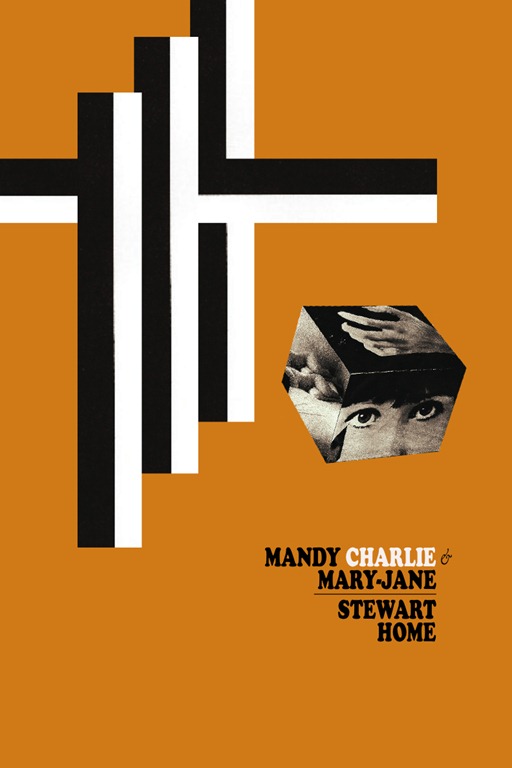
Reviewed: ‘Mandy, Charlie and Mary Jane’ by Stewart Home (Penny Ante Editions, 2013)

The one thing it’s possible to predict with the publication of any new Stewart Home book is Home’s unpredictability, and his latest book to be published, Mandy, Charlie and Mary Jane is a suitably unpredictable and audacious assault on cultural studies – and a broad range of targets, as it happens.

Although Home is by no means an author who adheres to the adage ‘write what you know’, he does freely admit to drawing on his immediate environment for source material, having presented journal-like reportage in Memphis Underground and based countless characters on thinly-veiled representations of figures in the art scene throughout his career.

It’s for this reason that Mandy, Charlie and Mary Jane contains lengthy lists of films, and on-line DVD purchases that look suspiciously like the sort the author himself would buy, along with lengthy reviews of exhibitions written in the style of Home’s blogs, and screes of dialogue on trains and in lecture theatres that appear to have been transcribed from real-life scenarios almost ver batim, or otherwise exist solely to facilitate the expounding of some theory.

I’ve always been one to appropriate dialogue myself, because creating dialogue that reads like it might have actually been spoken is difficult. Ironically, in my experience, and as if to prove the adage that truth is stranger than fiction, my lifted dialogue has been criticised for not being credible. In Home’s hands, the absurdity is heightened by the incongruity of context.

There’s also the issue of the 7/7 bombings and the way Home ties this in with the narrator’s delusional quest for some vague domination. This particular event – as Home explained in one of his blog posts – features in the book primarily because it was happening at the time the book was being written and some of the observations on the event are from the author’s own experience of being in London on that day. Yet its inclusion is one of the reasons it’s taken so long for Mandy, Charlie and Mary Jane to arrive in the public domain. Recent history, when absorbed within the context of a postmodern novel, is just too sensitive and problematic for most publishers. Of course, Home’s contentiousness is a part of his appeal, and his portrayal of academic life is as likely to cause a stir in certain quarters as the terror thread of the plot.

I’m not referring to the countless sexual antics with students – real or imagined – but the narrator’s criticisms the university system in the UK. Of course, highlighting the issues of the effects of tuition fees and the squeezing of academic resources in the name of profitability is all part of Home’s ongoing critique of capitalism. However, where Mandy, Charlie and Mary Jane differs from his earlier ‘skinhead’ books which were overtly and explicitly political, is in the way the issues are addressed. Instead of using his third-person characters as parodic ciphers delivering blunt sloganeering polemic and slabs text by Marx et al, the first-person narrator of Mandy, Charlie and Mary Jane offers more subtle yet even more scathing observations from the coal face, as it were.

Home slings in large chunks of review, criticism, critique and theory in trademark fashion (echoing previous works, notably 69 Things to Do With a Dead Princess). The narrator’s Marxist reading of Deep Throat is as amusing as it is audacious, and is, of course, classic Home. By establishing his narrator, John – or Charlie – Templeton as a cultural studies lecturer with a chronic drug habit, these skewed academic musings are fitting, and what’s more, in Templeton, Home is also able to play with and dismantle notions of fixed character – even the narrator doesn’t know who he is at times and frequently contradicts himself throughout the story. It may revisit the character shifts in his 1997 novel Come Before Christ and Murder Love, and draw the more absurd elements from Memphis Underground together with elements of Cunt, but then formula has always been an integral aspect of Home’s output, and it never worked to the detriment of the work of any genre author, or Ballard for that matter.

And so the resurfacing of phrases that have appeared variously and numerous times in his previous works is all part of the joke. It isn’t supposed to be subtle, and by now, the reader is supposed to be in on the gag which centres around the fact that Home’s built a career on declaring himself a rampant plagiarist (and notorious / celebrated self-promoter) and now we see him appropriating from himself quite liberally.

Noting in one of his blogs that Mandy, Charlie and Mary Jane, like its predecessor Blood Rites of the Bourgeoisie was written – at least in part – while installed as a university writer in residence, it’s therefore unsurprising to find Home use the campus as his novel’s primary setting. Equally unsurprising, Home’s choice of location, the City University of Newcastle upon Tyne facilitates the use of its acronym repeatedly throughout the text, adding the type of shock value Home is notorious for before immediately debasing it through endless repetition – which in Home’s eyes renders it all the funnier, in accordance with his recurrent citation of Bergson’s theory that suggests repetition is the basis of all humour. No doubt by the end of the book and the thousandth repetition of CUNT, Home had split his sides and jizzed himself to a husk at his own wit and genius. And rightly so: it was certainly my instinctive reaction. Because as one of the few authors to take postmodernism to a new level and turn its self-celebrating, self-collapsing theoretical existence back in on itself, Mandy, Charlie and Mary Jane sees Home remain several steps ahead of the game (even taking into account the fact that this book was written five years ago).

It’s not just the narrator who loses the plot as the book progresses, and what begins in a relatively grounded realist setting (d)evolves into surreal flight of fancy. The ending is, of course, a complete joke, but also – even despite Home’s previous flights into the surreal – a surprise that’s likely to leave you shaking your head. I’d argue that you don’t really read Home’s novels for their plots, however, so much as the explosion of ideas, and on that level, Mandy, Charlie and Mary Jane certainly doesn’t disappoint, and, equally importantly, it’s perverse, it’s funny and, put simply, a cracking read.


mandycharliemaryjanejpg


And if you’re loving my work, there’s more of the same (only different) at Christophernosnibor.co.uk

Paul McKenna, Gnostic Bastard – The Power of Persuasion and the Great Hypnotic Con

Since the new year, there’s been a large poster on the bus shelter where I catch the bus to work each morning advertising Paul McKenna’s latest book, Hypnotic Gastric Band. The first time I saw this poster, bleary-eyed at 7:45 on January 7th, I misread the title looming out of the darkness at me as Gnostic Bastard. Having made this rather curious error, I’ve since had to force myself not to read it as such each subsequent morning. In order to do so, I’ve found myself staring long and hard at the hoarding, and each time with growing consternation.

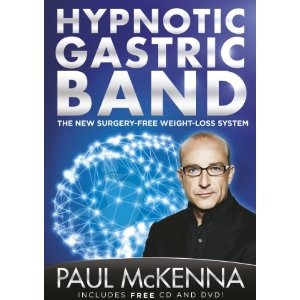
The poster itself is fairly bland: a large image of McKenna’s book, with the title and subtitle (‘The New Surgery-Free Weight-Loss System’) at the top, and at the bottom, the deal-clinching information that there’s a ‘free CD and DVD’ with the book. This is the same text that appears on the book cover itself, meaning the same words appear twice on the poster. Since repetition is the most basic but often effective form of brainwashing, I can’t help but wonder if this isn’t some form of brainwash to make people go out and buy the book – beyond the overt premise of the poster being an advertisement and therefore designed for that explicit purpose, I mean.

The book’s cover itself is interesting. On the face of it, it looks like any other crappy mass-market self-help book. The typeface is plain and bold, clean white lines on a darker background. It says ‘empowerment’. McKenna’s face stares out of the cover. But whereas most self-help gurus wear an expression that shows tranquillity, assurance, confidence, trustworthiness, in a way that say ‘I understand your problems and your pain. I’ve been there. I’ve turned my life around and I can help you to do the same. Have faith. I’m not going to lie to you or fob you off. I’m happy with my life now, and with my help, you can be too’, McKenna’s gaze is focused on… you, of course. He’s looking into your eyes, into your very soul. It’s not a calm look of inner peace. He’s lasering straight into your brain.

You’re so engaged in eye contact with Paul that you don’t really notice that nebulous cloud of lights, a little like a cut-out-and keep magazine rendering of an astronomer’s chart, over his shoulder. It’s a little fainter than McKenna’s image and the strong text above and below.

Within this two-dimensional representation of a multi-faceted polygon, fainter still, is a pale blue sac with tubing above and below – a representation of a stomach, no less, with something resembling a belt pulled tight like a noose just above the top of the bulbous mid-section. This, of course, is a gastric band. Because you need to visualise that band, drawing tight around your intestine, restricting your capacity for food. You’re not hungry, you’re full, and if you eat any more that band will draw so tight and constrict your internal organ that you’ll die.

The image itself is curious and compelling in equal measure. On the one hand it’s quite obvious what its purpose is, there on the cover of the book. On the other, it’s rather weird. I mean, in short that it looks odd. Compositionally, representationally. A sanitised, pseudo-scientific representation of a bulging pouch of muscle in the lower reaches of the intestine in the middle of something not dissimilar from an architectural sketch of the done from The Crystal Maze. What is it saying, and precisely to whom is it speaking when it issues forth those enigmatic utterances?

The kind of people who don’t really consider what they’re consuming to the extent that they may require a gastric band are the kind of people who struggle to associate images of life-threatening obesity, enlarged organs and stupendous amounts of fat when they’re shown on television with their own ruined bodies. But this image on the cover… As I stand, waiting for my bus to arrive, music injected into my ears through my in-ear phones attached to my MP3 player, I find myself mesmerised and wondering as I’m drawn into the billboard, is the gastric band itself hypnotic?

Never mind how the ‘system’ works (note, it’s not a ‘diet’ – largely because any food intake is a diet and we’re looking specifically weight-loss diets here, but more to the point, ‘weight-loss system’ is a perfect example of pseudo-scientific meaninglessness), I find myself totally absorbed by the image. And then I remember it’s all utter bollocks. If it was as easy as all that for the people this book is aimed at to exercise mind over matter to lose weight or otherwise remain at a size that’s considered healthy by the medical profession, then there’d be no need for the book, with or without the ‘free’ CD and DVD. And while only an idiot would believe that the CD and DVD are actually ‘free’ rather than incorporated within the purchase price (CD and DVD cost pennies and the cost of producing a book that’s a mere 144 pages in length (at least in the quantity of print run this is indubitably produced in) is negligible against the RRP of £12.99 which is approximately 9p per page), equally, only a complete cretin would buy into this crap. Let’s face it, The Hypnotic Gastric Band is another way to shift responsibility from the lazy and the weak-willed: which plus-sizer wouldn’t want the results of a weight loss diet without actually dieting? When it comes to mind over matter and the power of persuasion, the only trick here is getting desperate and gullible chubbers to part with their cash. But it’s a massive market (in all senses), which probably explains why the book’s sitting comfortably in Amazon’s top 10 right now….


Hypnotic Gastric Band

Paul McKenna: Gnostic bastard or con artist?


And if you’re loving my work, there’s more of the same (only different) at Christophernosnibor.co.uk

2012: A Year in Books

This is not a ‘best books of 2012’ list, and I have neither the time nor the inclination to review or comment on the books listed here (other than those I’ve written reviews for or otherwise commented on, and those reviews can be found here and there and wherever). I spend enough of my life reviewing stuff and spouting opinion: I read for pleasure and research and reference and sometimes purely to learn. Some of the books I read during 2012 were books I had read before (Bukowski’s Post Office and Cunt by Stewart Home) and some of the books I read I enjoyed more than others. Many of them have informed my own writing in one way or another, or may do so in the future. The order they’re listed in is the order I read them in. So here it is, just because: my year in books. Nothing more – but nothing less.


Henry Sutton – Get Me Out of Here!

Adam Kotsko – Awkwardness

Jurek Becker – Sleepless Days

Alain Robbe-Grillet – The Voyeur

Marek Hlasko – Killing the 2nd Dog / The 8th Day of the Week

Various – A Dream of Stone and Other Stories

J G Ballard – Cocaine Nights

Chuck Palahniuk – Survivor

Henry Sutton – Bank Holiday Monday

Ian Price – The Activity Illusion

Carl Weissner – Death in Paris

J G Ballard – The Crystal World

Harry Harrison – Homeworld

John Steinbeck – Tortilla Flats

J G Ballard – The Unlimited Dream Company

Terry Taylor – Baron’s Court, All Change

Alain Robbe-Grillet – Repetition

Theodor Adorno and Max Horkheimer – The Dialectic of Enlightenment

Malcolm Mc Neill – The Lost Art of Ah Pook is Here: Images from the Graphic Novel

Malcolm Mc Neill – Observed While Falling: Bill Burroughs, Ah Pook and Me

Supervert – Necrophilia Variations

Colin Wilson – Adrift in Soho

Dire McCain – Raising McCain

Steve Urwin – Tightrope Walker

Charles Bukowski – Post Office

Roger Protz – 300 Beers to Try Before You Die!

Stewart Home – Cunt

Carl Cederstrom and Peter Fleming – Dead Man Working

Karl van Cleave – Incisions, Collisions and Aborted Missions

And if you’re loving my work, there’s more of the same (only different) at Christophernosnibor.co.uk

The Changing Face of Consumerism XII: Applied Economics and the Kindle Generation

Sometimes it’s better just to keep your mouth shut. I know this. I may be opinionated, but there’s a time and a place to express those opinions. More often than not, 9:05am in the office is neither the time nor the place. But sometimes I just can’t help myself.

It was just another day at the office, same as any other. I was trying to do something productive, because despite my abhorrence of ‘the system’ and working for ‘the man’, I appreciate that I’m being paid (albeit not nearly enough) not only for my time, but to use that time fruitfully (when IT permit) and besides, I’m one of those people who prefers to actually make busy rather than feign being busy. Perhaps I’d feel differently if I felt any affinity with the goons who occupy the desks within conversationable proximity to mine, but endless drivel about ‘Corro’ and ‘I’m a Celebrity’ fills me with a compulsion to burrow myself into a small dark corner, meaning that more often than not, I’ll bung a CD in the player or find an album on-line to stream, plug my phones in and create my own virtual cocoon in which to work. But sometimes I find it’s impossible to shut out the babble, and equally impossible to keep my trap shut.

Such was the scenario the other day. Three or four people seated behind me had been discussing books. Books I wasn’t bothered about. By which I mean, I’m not big on thrillers, and am wholly indifferent to the works of multi-million selling thriller author James Patterson. I was able to let the debate over whether or not his name was Patterson or Pattinson drift by, although I was pleased when one of the debaters thought to look him up on-line, and was also thus able to confirm the title of one of his books, courtesy of Amazon.

And so the subject moved to the topic of the Kindle.

“I love having my Kindle,” pronounced the middle-aged woman in the centre of the conversation, who’d been recounting how she’d hooked her husband on a certain author’s books by buying him one once. “But Kindle books are so expensive!”

“I know, I’d have thought they’d have been about a quid or something,” replied the colleague to her left, a tubby guy with a beard and spectacles in his mid to late twenties.

It’s a common complaint. If you read reader reviews of books on Amazon, there’ll invariably be a number harping on about the price of the Kindle edition – especially with new publications – to the extent that some titles attract dozens of one-star reviews without a single mention of the writing, the plot, the characters or any other aspect of thee contents of the book itself. Many of the reviewers aren’t even in a position to comment on the book, having posted their review in a fit of pique at the rip-off price being asked for the text with remarks like ‘I refused to buy it at that price’ and ‘I’ve ordered the paperback instead, but will have to wait several days for it to arrive in the post. And I’ve had to pay shipping on top!’

In today’s culture of immediacy and instant gratification, no-one wants to wait. And no-one wants clutter, either, hence the popularity of the Kindle. As the people behind me noted, it’s possible to store several hundred books, which would otherwise require many feet of shelves, on a single, portable device. But no-one seems to think it reasonable that they should pay for this convenience: they want it now, and they want it cheap, or better still, for free. But of course, that isn’t how capitalism works. Exploitation may be a significant feature of consumerism, with both consumer and producer being exploited for the benefit of the capitalists who hold the real power, but there has to be as degree of give and take, and if there’s no profit to be made from a end product, there’s simply no point in producing it, however useful it may be. But by the same token, the more useful or desirable a commodity, the higher its value in the marketplace. Whether that value is real or perceived is largely down to supply and demand, the market and marketing. It appears the perceived value of an e-book is comparatively low.

And so they whinged on in this fashion for a couple of minutes or so, bemoaning the fact that Kindle e-books are overpriced considering the fact there are no production costs involved.

As someone who has experience of publishing, both as an author and a publisher – albeit on a small scale – I felt qualified to wade in on this debate. Not that these individuals would have been aware of this: I tend to keep myself to myself, and not to talk about my writing or publishing activity in the workplace. Nevertheless, on this occasion, I found it impossible to let it go, and the fact my involvement in the publishing industry is on a small scale means it’s something that’s particularly close to my heart: it’s something that’s real and tangible, whereas with large-scale publishing – as with any large organisation – the realities become more abstracted as the process becomes increasingly distant. As with the music industry, Joe Public only conceives of the colossus: the multi-billion dollar international labels and the major-name chart acts. It’s understandable, of course, but the big names – and the big money associated with them – only account for a fraction of the whole. The common misconception is that everyone who has a book published is coining it in, because they hear about the immense earnings of the likes of J. K. Rowling and E. L. James. The majority of people don’t seem to realise that there are countless books that aren’t on the bestseller list, that aren’t published by Penguin or Bloomsbury. These are the people who buy one or two books a year, or possibly three when they raided a 3-for-2 offer at Waterstones or WHS or maybe their local supermarket. These are the people who, in the days before Kindle, would make sure the one, two or three books they purchased were at least 400 pages long because a 400-page book represents better value for money than a 250-page book that costs roughly the same. They’re the people who read series books because they know the characters and are comfortable with them, but are reluctant to try anything else because they don’t know what to expect: they might not like it. Better to play safe and go with what you know than risk disappointment and wasting money.

I don’t actually believe that all artists (by which I mean musicians writers, film-makers, dancers, whatever) should be able to make a living from what they do, even if such a scenario was feasible. There simply isn’t room for every artist, aspiring or otherwise, to achieve such widespread recognition as to sustain a living wage from their work, and there are many who simply aren’t worthy or, to be blunt, good enough. But I do believe that all artists should be fairly paid for what they do, just as any other form of labour should receive reasonable recompense.

If Kindle e-books really did all cost in the region of £1, you can guarantee that the ones who would see the biggest reduction in their cut of the profit (and there’s scant profit to be made on anything costing a pound) would be the writers. It hardly seems fair that the person responsible for the creation of the product should be paid less because some consumers choose to purchase a different format. The end product may be different, but the input itself remains the same. Would an office worker – the likes of the individuals idling away large portions of their working days debating the ways in which they spend their disposable income and leisure time – consider it acceptable to be paid less for dealing with emails instead of printed letters? Of course not: in fact, I suspect the opposite would be true, and that they would probably consider it reasonable to expect to be paid more, because the reduced overheads associated with e-comms over conventional paper and envelope snail-mail would logically enhance company profits – why shouldn’t they benefit? And this made for the starting point of my interjection into the conversation.

“The writers have still got to be paid,” I began. “On a paperback, they get pence in royalties…”

Naturally, the precise amount varies between books, publishers and authors, and the range is immense, and the actual royalty will depend on whether or not the book sells at its RRP or at a discounted price. But, for simplicity’s sake, it’s not unreasonable to work on the basis of the author’s royalty for a paperback being it’s around the 8% (although anywhere between 5% and 10% would be considered ‘average’), for hardback around 12%, and for e-books in the region of 20%. If a paperback retails at £7.99, you’re looking at 63p per copy going to the author (before tax). It takes a many multiples of 63p to equal a living wage. Given that it’s reported that 95% of all books published achieve sales of 100 or fewer, you can hardly consider writing a surefire route to riches, and when you also take into account the number of hours it takes to write a novel…

“Of course the writer’s have got to be paid,” agreed the woman, peering over her reading glasses. “But there’s no printing cost with a book on Kindle…”

I realised I needed to keep it brief and simple. And so I elected to pass on the details of the debate, hoping against hope that my sowing the seed may at least give them a prompt that would set these everyday consumers on a track of consideration.

I decided not to explain that obviously, the bigger the publisher, the more people are involved in the process. But against that, higher volumes of sales mean it’s easier to reduce unit costs… although it usually takes a bigger marketing budget to achieve those sales volumes. I also let pass the idea of there being a correspondence between market forces and cost in capitalist culture, namely that there’s a clear logic to charging the most people are willing to pay for a commodity. If a significant portion of any given target market are willing to pay, say, £10 for something, but consider £15 too expensive, why would anyone in the business of business, i.e. making a profit, charge only £5 for it?

The fact she’d already told her colleagues, “I buy loads more now I’ve got my Kindle. I keep finding stuff and thinking ‘What’s that?’” was evidence enough that however unreasonable she considers the price of e-books, the cost isn’t high enough to be prohibitive – and so the equation of balancing cost against demand and convenience works. This woman clearly isn’t alone, and as much as anything, I suspect the convenience is the real key here. The Kindle appeals to the demand everything, demand it yesterday if not sooner consumer society we live in and that the Internet has facilitated. Our needs haven’t changed all that radically, but our expectations have. Consequently, our demands have changed in line with those expectations. This then becomes a self-propagating cycle, and like a junky who experiences diminishing returns with every hit as their habit becomes more complete, so the consumer appetite grows evermore insatiable, needing more and faster. Yet each time the demand is met, so expectations grow, and as those expectations come to be met, so demand grows.

“That’s true,” I countered, “but the print cost actually only accounts for some of the actual cost of publishing a book. With an e-book, you’ve still got the bulk of the other costs involved in the publication process, like paying proof readers, like cover art, promotion… and you have to reformat a text for Kindle. Plus you’re paying for the convenience of the format, of having it instantly. Besides, given how little authors do earn on each book sold, if there is scope for paying a bit more, then that can only be a good thing.”

The woman looked at me boredly, then replied, “Yes, I know and understand all that, but I still would have thought they’d be cheaper. You know, like around a pound or so.”


Kindle

A Kindle. Publish a book formatted for this, charge over the odds and make a mint. It works for me! Pass the Bolly, will you?