The Changing Face of Consumerism VIII: State of Independence, or, All’s Well at The Inkwell

The seven ‘Changing Face of Consumerism’ articles I ran on MySpace in 2008 and 2008 all shared a common theme, namely lamenting the sad decline of the real – both in media and commodity, with ‘reality’ television being a pisspoor ersatz approximation of any reality I’ve ever known, and ‘real’ shopping experiences being slowly subsumed by the virtual marketplace.

Don’t get me wrong, I’m all for progress, and have long been a big fan of on-line shopping, being one who doesn’t cope well with crowds or endless hours of pavement-pounding in search of goods, but by the same token, I’m a strong advocate of consumer choice. Despite what the global marketplace on-line tells us, we as consumers do not have infinite choice, not least of all because while some niche outlets fare well on-line, many have gone to the wall because the same kind of corporate giants that slowly erased all of the small independent stores from the high streets of each and every town have steamrollered the little on-line traders out.

As city centres everywhere become identikit clones of anywheresville, so our sense of location becomes diminished: the only thing to differentiate, say, Leeds from Lincoln, isn’t the choice of shops, but the size of each branch, and after a mooch round M&S, Boots, Game and HMV, stopping for a uniform coffee in a Starbucks or Costa before going on to… well, it doesn’t matter. I mean it really doesn’t matter where you are, the experience is pretty much the same. Fine, so you know what you’re going to get, but the experience of discovering a little specialist shop tucked away somewhere is radically different and appeals to a whole range of senses. However hard Amazon try to replicate the browsing experience of specialist independent book and record stores with features like ‘look inside’ and the song snippets you can listen to, in addition to the list of recommendations based on what you’re looking at and what other shoppers have also purchased or viewed that functions as a mimesis of the friendly and enthusiastic guy behind the counter who just loves his books or music and knows everything there is to know, like a living, walking encyclopedia, it just isn’t the same. There’s no substitute for browsing.

And so it was that I was practically skipping when The Inkwell opened in York a few weeks ago. A little shop stocking secondhand books, records (with a few selected new titles), CDs and cards, it’s the kind of shop you used to drop into, rummage around and find something wonderful you didn’t even know you wanted. The owner, Paul Lowman, is clearly an unashamed enthusiast first and a businessman second, and while such a venture is the kind that will never make him rich, and would make many lenders and entrepreneurs alike squirm in discomfort, it’s a shopper’s delight. Perhaps not surprisingly, The Inkwell is aimed at a niche market (by which I mean discerning shoppers: Paul’s philosophy is according to the website, “COOL STUFF FOR ALL!” Popular Culture is about democracy – inclusivity, not exclusivity) specialising as it does in books on music, film and pop culture, with sections on the Beat Generation, Art, Philosophy and a noteworthy – not to mention impressive – selection of pulp paperbacks, all in remarkably good condition (yet reasonably priced, with titles marked up at between six and ten quid).

The vinyl, too, is all in great nick, and the range, though limited, is all about quality and catering to a particular kind of discerning alt/hipster customer. There’s no mainstream pap to be found on the racks: instead, there are sections devoted to Garage, Psych, 90s Indie, Spoken Word / Comedy, and even Burlesque. Yes, if you want the kitsch sleaze of yesteryear, then the range of sexploitation titles in both audio and written media is exceptional.

It’s a tiny little place, made all the more cramped by there being a pair of school desks in the middle of the room, upon which a choice of books are casually laid. It’s all about the browsing experience (they serve coffee too), and an eclectic mix of music is spun – at high volume, and all on vinyl, naturally – on the turntable in the corner by the counter. Of course, it’s simply one’s man’s vision, one man’s obsession made manifest… but what’s wrong with that? But equally, why should a shop such as this succeed in a climate where major chains are going to the wall? The answer, I believe, is simple. In attempting to appeal to everyone, the major chains ultimately cater for no-one. In aiming to cover a vast market based on some kind of assumed generic average consumer and broad populism, the chains become Xerox copies of one another: reliable, perhaps, but ultimately forgettable and wholly impersonal. A shop like The Inkwell isn’t about conquering the world or trying to cater to all tastes: it knows its market and knows it well – because by being the shop its owner wants it to be, it’s catering for like-minded individuals (there’s that word again!). It’s unique in every way, and every item in stock is essentially a one-off. It has the personal touch and is memorable. And that’s why it has a better than average chance of success.

So, on the opening day I left with a brand new hardback copy of Brion Gysin: Dream Machine (a bargain at a tenner given that it retails at £25), a read but respectable copy of The Dark Stuff by Nick Kent (£3) and a vinyl LP – a copy of Fade Out by Loop, again in top condition (EX as Record Collector would have it), for a fiver.

I returned this week and was pleased to see some of the stock had gone and new stuff had taken its place, meaning I was able to add a copy of the original 1971 Olympia Press edition of S.C.U.M. Manifesto by Valerie Solanas to my library. The tenner asking price was more than fair, especially given the condition.

Does The Inkwell represent the vanguard of the counter-revolution in the world of retail? Perhaps not, but I’d like to think that other independent stores will begin to pop up, not just in York, but in every city, and soon. It’s unlikely that this is how the economic situation will be recovered, but being able to rifle some good books and records in a pleasant environment certainly makes these dark times a lot more bearable.

The Inkwell Online is cool – www.ink-well.co.uk – but not nearly as cool as being there.


Inkwell


And if you’re loving my work, there’s more of the same (only different) at Christophernosnibor.co.uk

Too Busy to Blog!

For many writers – both accomplished and aspiring – a common obstacle to productivity is inspiration. Most people run dry at some point. It’s not a brag when I say that this isn’t a problem for me: no, my real problem is time. There simply isn’t enough, and there are only so many ways to stretch it.

Over the past few years, a fair few people have asked me how I manage to maintain my output, how I find the time. The answer has always been that I make time, and type quickly. But then, every now and again, it becomes insustainable, and when it does, something’s gotta give.

I didn’t set out to become a music writer: it was something I once dreamed off, made a few stabs at and did on a very part-time and voluntary basis for a couple of local and regional papers back in the early 90s before giving it up. My applications to music papers for paid work had been unsuccessful, to the extent that none of them had even bothered to reject me, and I decided it was simply too competitive for me, a person who’s not particularly competitive by nature. Moreover, not given to being all that outgoing, and steadfastly refusing to suck up or otherwise ingratiate myself, I decided music journalism wasn’t the career for me. I was 25, working full time and studying at the same time, and in my spare time, attempting to carve out a novel. I was going to be a proper writer!

It took another five years to get my first book, Bad Houses out into the world, and the novel I had been working on, Exiled in Domestic Life, along with its sequel, Rusty Bullet Wounds, remains languishing, unpublished. Still, a lot’s happened since then, and while I have received some help and support – not to mention invaluable exposure – from people who I’ve encountered along the way, my weekly blog on MySpace did contribute considerably to whatever readership I achieved.

People are always going on about the importance of maintaining a blog as a means of building and maintaining one’s profile, and at the time, it seemed that they were right, but when the MySpace community dissolved before my eyes, so the hits to my blog plummeted. Rebuilding a readership from scratch just felt like too much effort for questionable reward, and by this time I had begun reviewing for Whisperin’ and Hollerin’, something I had fallen into quite by accident, but it felt good to be reviewing again. It had been noticeable that the reviews I had posted on my blog had been the least successful by miles, receiving half the hits of my rants. Having a proper outlet for the reviews was an extremely positive thing, and besides, it meant that even if I wasn’t being paid, I was getting free CDs and entry to gigs – plus being able to say that I was a writer for a recognised site meant I was able to approach PR companies directly and have them add me to their mailing lists. This meant even more freeness.

At present, I’m managing to review approximately half of the stuff I get sent, and given that I’m kicking out an average of one to two reviews per day, you can get an idea of just how much the reviewing gig’s grown in the last couple of years. But I don’t want to be known simply as a music writer: I do still write fiction, after all, and have some pretty hefty projects in the works, with the story ‘Corrupted from Memory’ which appears in the new Paraphilia anthology A Dream of Stone being the first of a new wave of fairly dense pieces penned recently.

Then there are the interviews. I’d be daft to turn down the chances I’ve had to meet up with various bands, or to conduct email interviews with Malcolm McNeill and JG Thirlwell. They’re once in a lifetime opportunities. None of them came about because of my blogging, though, and finding the bile to spew out a weekly rant in a blog just wasn’t something I had in me.

The discipline of maintaining a regular blog is healthy for a writer, primarily because it’s so easy to procrastinate, defer and postpone: a commitment to produce a piece each day or week can be a great motivator and can provide the impetus to knuckle down to writing and attempt something new. By the same token, it can all too easily become an obstacle to producing anything else, with the main work becoming sidelined by the thing that’s supposedly a mode of liberation and promotion. Moreover, in churning out pieces on not only a regular but a frequent basis, it’s easy for the quality of output to suffer and to find yourself saying the same thing. If it gets boring to write, it’s going to be equally boring to read: if and when that moment arrives, it’s time to quit.

I had other reasons to quit, or at least cut back though: well, something had to give. I’m no longer studying, but am still working full-time and then some. I can’t not: there are bills to pay, and very few writers actually get to make a living from it. Besides, getting to teach English Literature to undergraduates, albeit on a part-time basis, is often rewarding, but make no mistake, it’s hard work, especially in conjunction with holding down another job at the same time. So how do I find the time to write? Make time, and type fast, of course. But without blogging, at least as often. Has it damaged my readership? No, I don’t think so, and while I receive more hits to my site via searches for ‘Christopher Nonsibor reviewer’ and Christopher Nosnibor Whisperin and Hollerin’, I still get the same number who arrive at my site having searched for ‘Christopher Nosnibor writer’ or for one of my books (more often than not THE PLAGIARST).

But then, I’ve recently found myself wondering if maintaining a blog is as important as it used to be – not just for me, but in general. I still read voraciously, but the number of blogs I read has diminished, and I instead prefer to read a small number irregularly, rather than a large number regularly, partly because many of the blogs I follow tailed off around the same time I allowed my blogging activity to become less of a feature of my writing output. Is the golden age of blogging over? Does it really matter? A world in which everyone has a blog is a cluttered one, but shouldn’t be mistaken for a well-informed one. Knowledge may well equal power to an extent, but with no shortage of blogs brimming with ill-informed opinions and even outright hateful propaganda receiving ample traffic, it would equally appear that misinformation is power, and besides, who cares about what you’re saying as long as you’re popular. The interest in celebrity blogs and Tweets remains unabated. Ok, so bloggers like myself (i.e. the authors of the blogs I like to read) are never going to be in competition with these ‘celebrity’ retards, and never were, but there comes a time when pissing in the wind stops being fun and simply becomes a thankless slog.

For me, the blog always served a dual function: to vent or to comment on the things I had no other outlet for doing so, and, if I’m honest as an indirect means of promotion. Now, I have other channels for both promotion and venting, and besides, I’ve come to the conclusion that the world only needs so many producers of culture and of comment, given that there are only so many consumers. Personally, I try to do both, but it’s hard to consume while producing. It’s simply impossible to read an article and write one at the same time. So, while I continue to work on the job of perfecting a clone or two to enable me to multitask more effectively, the blogs will remain on the back burner while I crack on with the real work…

And of you’re loving my work, there’s more of the same (only different) at Christophernosnibor.co.uk

A Dream of Stone (and Other Ghost Stories), edited by D M Mitchell and Dire Mccain is out now in the US through Paraphilia Books.

A is for…

Way, way back, I began work on a book with the working title of The A-Z of Internet Porn. The project fell by the wayside, but not before I had amassed a fair few entries (boom boom) and outlined a large (oo-er) percentage of the entries (fnarr) the projected book would cuntain. Maybe one day I will return to the project and finish it off (snicker), or perhaps I’ll attempt to flog the concept to a publisher for someone else to take in hand (huh huh), but in the meantime, while it’s languishing on my hard-drive (nyak nyak) alongside the completed novels Exiled in Domestic Life and Rusty Bullet Wounds and the never-ending work-in-progress that is my post-apocalyptic romance novel So Dark All Over Europe, I thought I might shove (arferoo!) a few extracts up here as and when the mood so takes me… Enjoy!


A is for….

ACCIDENTAL NUDITY

It’s a common situation: you’re out clubbing or on a night out with some gal pals and, forgetting you’re wearing something strappy, start dancing rather too wildly (well those 2 for 1 Bacardi Breezers are hard to decline) and suddenly – oops! – your tit pops out. You’re mortified, naturally, and put it away as quickly as possible in the hope that no-one’s noticed. Alas, no such luck: one of your mates had their camera of phone out and just happened to snap at the crucial moment.

The good news is that most mainstream social networking sites like Facebook remove pictures that are in any way ‘adult’ (clearly being off your face and spewing on the pavement is for kids) so should the pics that could ruin your reputation in a matter of hours make it up there (and the chances are that they will), so the chances of them being up for long and seen by the half of the world that didn’t see them in the first few hours won’t get to.

The bad news is that there are people on-line who go crazy for these kind of pictures. And of course, if you’re remotely famous, it’s even worse, because there are paps absolutely everywhere, with their lenses in your life, following you on holiday, to the shops, to the toilet…

Is it porn, though? It’s debatable, it has to be said. But we live in a celebrity-obsessed, sexualised culture in which one man’s poison is another man’s meat and one man’s yawn is another man’s porn…

See also CANDID SHOTS, CELEBRITY NUDES, DOWNBLOUSE, NIP-SLIP, NIPPLE POKIES, VOYEURISM.


And if you’re loving my work, there’s more of the same (only different) at Christophernosnibor.co.uk
Book Review: Allegorical Beasts by Leo Schulz

It’s oft said – not least of all by me – that it’s important to learn the rules before breaking them. Otherwise, it’s not subversion, but plain ignorance. On reading the sonnet sequence that occupies the first half of Leo Schulz’ Allegorical Beasts, it’s clearly apparent that the author knows his way around a sonnet.

That Schulz has actually produced a sonnet sequence is in itself extremely telling: in vogue briefly during the Elizabethan period, it’s hardly the verse form of choice for contemporary poets. Not that the forty-five poems that comprise ‘Sonnets of the Sea’ contain any half-arsed doggerel, sixth-form scribblings self-consciously imitating the Petrarchan or Shakespearean form: this is sonneteering 21st century style, which dispenses with the fussy rhyme scheme and the restrictive metrical dictates of old convention to produce a series of poems that pack some real punch. Schulz certainly doesn’t dress things up in draperies of poetic euphemism. Yet at the same time, ‘Sonnets of the Sea’ does follow the principles of thematic unity, and fills the lines with magnificent imagery, some contemporary, some timeless, and succeeds in doing so without being overtly self-conscious or revelling in the author’s own cleverness, a feat also achieved in the three-part ‘Imitation of Dante.’

If ‘The Devil Writes to a Woman Who Loves Him,’ the first of the three prose pieces, seems a little weak despite its twisted psychology and cunningly-devised scenario, it’s only because it’s overshadowed by the final story, ‘Love: A Confession’. The direct, first-person narrative drags the reader through the emotional wringer as the speaker (who I would hate to align with the author, although its raw intensity is so specific and detailed it makes it more than just a little tempting) picks over the scabs of a defunct relationship. Occasionally amusing, always observed and detailed with a stunning precision, the story is delivered with a vivid sense of tormented humanity, making t one of the most engaging short stories I’ve read in a while.

‘Allegorical Beasts’ is an intense and intelligently-written book that marks Schulz as a unique and remarkable literary voice.

Allegorical Beasts is out now on Königreich Böhmen and is available via Amazon.


6152454


And if you’re loving my work, there’s more of the same (only different) at Christophernosnibor.co.uk

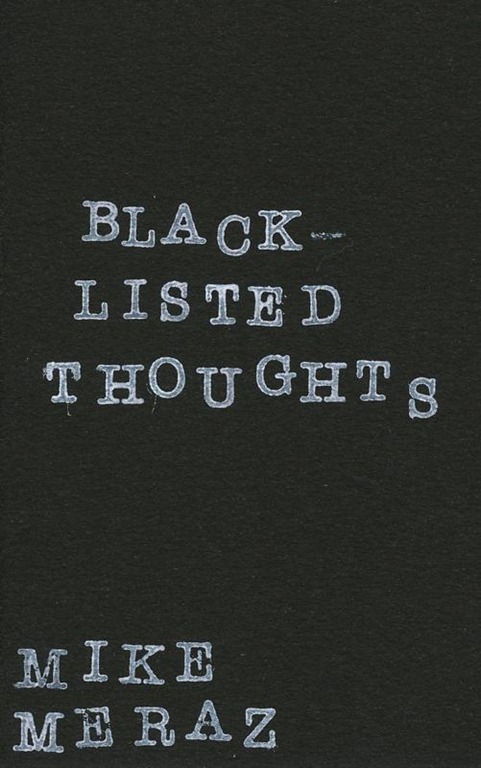
Review: Black-Listed Thoughts by Mike Meraz (Propaganda Press, 2011)

I like reading, and would fairly describe myself as an avid reader. However, I often wish I had the time to read more. As we all know, time is one of the rarest commodities in today’s insanely hectic society, and while films and music offer instant gratification, the written word requires patience and mental engagement. It’s long struck me as odd, then, that the majority of bestsellers are whopping great 500+ page doorstops (that most of them are complete pap is, naturally, less surprising). Still, contra to the trend, and more in keeping with people’s busy lifestyles, the rise of flash fiction seems entirely appropriate, and short stories have been enjoying a welcome renaissance in recent years. And now, Propaganda Press have started doing a line in something truly innovative, the microbook.

Mike Meraz’s Black-Listed Thoughts is a compendium of pithy bon mots, one-liners, ponderences, reflections and scathing put-downs that’s perfect for dipping into, although just as easily devoured in a single short sitting. There are words of wisdom, words of encouragement, and words that are against wisdom and, well, pretty much anything else. By turns cynical and revelatory, Meraz is never less than sharp in his delivery. I found myself nodding in agreement, before turning the page and laughing heartily: Black-Listed Thoughts is a book for our schizophrenic modern age. A quick read though it is, this wallet-sized tome provides plenty to chew on and leaves a long aftertaste.

It might not be big, but it’s definitely clever enough.

Black-Listed Thoughts is out now on Propaganda Press.


black-listed_thoughts


And if you’re loving my work, there’s more of the same (only different) at Christophernosnibor.co.uk 

More than Music….

Believe it or not, I never set out to be a music reviewer. Ok, well, I sort of did, and back in the early 90s, while in my late teens, I did a few reviews for my local newspaper, but even then, I was working on fiction. I stopped writing completely for a couple of years or so, but some time in 1999 I began work on a novel and made fiction my main thrust.

Cut to 2007 and my first collection of short stories, Bad Houses is about to be published and so I decide I need an on-line presence and decide that posting short stories in my MySpace blog is the way forward for promotion.

The book didn’t really sell, but over time the blog grew and a few music reviews began to filter in. Generally, these were the least popular blogs, so when I was offered the chance to write for a proper music site – Whisperin’ and Hollerin’ – I jumped at the opportunity… I’ve since realised I can’t say no to free stuff or new music and the chances are I’m now better known as a reviewer than a writer of fiction or anything else.

However, I do still occasionally produce other kinds of writing, and in the last month, got to interview William Burroughs collaborator Malcolm Mc Neill for the brilliant Paraphilia Magazine, and to provide the introduction to Antony Hitchin’s contemporary cut-up masterpiece, Messages to Central Control, published by Paraphilia Books.

Meanwhile, I’m keeping on with the fiction, with From Destinations Set being my latest novel, and a sort of satellite text, published in pamphlet form and distributed by various divers and subversive methods, now available on-line.

There’s more to life than music you know, but not much more…

And if you’re loving my work, there’s more of the same (only different) at Christophernosnibor.co.uk.

It’s good to talk…

With a new book forthcoming, a little bit of promotion goes a long way. Stuart, who runs Clinicality Press, suggested we have a chat about From Destinations Set. With the prospect of a couple of free drinks and some free promotional coverage, I wasn’t going to turn the offer down.

The resulting piece, which covers the writing process and the aims of the book, as well as a whole heap of other literary topics and writers who have inspired and influenced Destinations, is an edited, expanded and manipulated historical record of the event. Don’t believe everything you read here.


And if you’re loving my work, there’s more of the same (only different) at Christophernosnibor.co.uk.

Things That the Everyday Folk Leave Behind

So I’ve had a pretty busy time of late, what with a couple of interviews I’ve conducted and am conducting for various publications, not to mention interviews and promo bits and pieces for From Destinations Set which is out on the 28th, and a spate of gigs and a tidal wave of new releases to review (90 reviews this year to date), and as a consequence, the blog’s something I’ve let slide a bit (again).

With so much to do, places to go and people to see, I find I spend all of my waking hours rushing about, and my non-waking hours spent with my mind churning through all of the things I’ve done and have got to do and should have done but haven’t yet. To an extent, that’s pretty normal for me, but lately I’ve been so preoccupied and absorbed in all of this activity that I noticed that I’ve stopped noticing things. This concerns me. I’ve always maintained that being attuned to one’s surroundings is the key to being a writer of merit (and while my merits as a writer won’t ultimately be determined by me, it’s something I like to feel I at least aspire to). Besides, it’s not something that’s entirely optional: drawing on the details and minutia of the everyday is a compulsion, it’s something I can’t help, at least under normal circumstances. Observation, those details of life and snippets of overheard dialogue have long provided me with an abundance of material for my writing, be it fiction or blogs or whatever, Absorbing information from the world around me is integral not only to my work, but who I am. Small wonder I was beginning to feel that the workload was swallowing my life: I was beginning to lose myself.

As a consequence, I resolved to pull myself back to life, and I’ve begun to try to observe my surroundings again. I have no idea why I was remotely surprised by the sensory overload this retuning induced, given that I find the wealth of extraneous information dizzying the majority of the time, but having effectively shut down for a period of time, engaging once again with my environment proved to be an immediate culture shock.

So on leaving the house this morning, I was elated to note that day was breaking. It was the first time in months I had hit the pavement in daylight. The air was cold but still. Birds were singing – something quite uncommon given the density of the housing, the lack of gardens and trees and the large number of brutal cats in the neighbourhood. On arrival at the bus stop, I was amused – and also bemused – to see that on one of the seats moulded into the shelter was a handbag. Abandoned, forgotten. Beside the handbag, stretched and strewn across the next two seats, a pair of tights. I wondered if the tights and bag had the same (former) owner. Must’ve been one hell of a night.

It’s not just physical objects that are discarded at random. Conversations, sounds, ideas, all contribute to the flotsam and jetsam. Before long, I’m on the bus, surrounded by blank individuals. The journey is soundtracked by the album The Disaster of Imagination by Sense of Scenery. It doesn’t entirely drown the chatter of the other passengers. I’m reading $20,000 by Bill Drummond. The sensory overload I’m accustomed to is back. Snippets of dialogue filter into my consciousness, on the bus, at the office. Most of it mere babble, some of it so inane it’s beyond belief. ‘Is she still Spanish?’

I’m being flooded with material, more material in a day than I can use in a lifetime. I pick them all up, all of the bits and pieces, and stow them, ready for when I need them. I never know when I might need that discarded handbag, the left-behind tights, the fragments of dialogue, the half light and the birdsong. I’m living the experience that I was supposed to be creating to an amplified degree in THE PLAGIARIST. It’s not funny any more. This is the world.

I’m back and I’m firing on all cylinders….

And if you’re loving my work, there’s more of the same (only different) at Christophernosnibor.co.uk

Spin on this! When the Machines Take Over

So things are starting to happen where the publication of the paperback edition of my novel, From Destinations Set is concerned. The publisher have the first batch in hand – I’ve seen one, and they look great – and are starting to mail out review copies. They’re circulating press releases, too, and from what I can tell, these are beginning to generate traffic already.

Stuart at Clinicality Press has penned some very nice press releases and made use of the rather tidy synopsis / blurb he did for the book. I was amused, then, to find a version of the press release that didn’t remotely resemble those Clinicality have issued, not least of all because one of the threads of James Well’s book, Hack, that Clinicaliy will be putting out later in the year, is concerned with word-spinning.

Unsure of precisely what this entailed, I conducted a spot of research, to learn the following:

Article spinning is a search engine optimization technique by which blog or website owners attempt to manipulate their rank on Google and other search engines. It works by rewriting existing articles, or parts of articles, and replacing elements to avoid being penalized in the Search Engine Results pages (SERP) for using duplicate content. The original articles are often plagiarized from other websites and can often also be copyright infringements if the original article was used without the copyright owner’s permission.

Website owners may pay writers to perform spinning manually, rewriting all or parts of articles. Writers also spin their own articles, manually or automatically, allowing them to sell the same articles with slight variations to a number of clients or to use the article for multiple purposes, for example as content and also for article marketing. There are a number of software applications which will automatically replace words or phrases in articles. Automatic rewriting can change the meaning of a sentence through the use of words with similar but subtly different meaning to the original. For example, the word “picture” could be replaced by the word “image” or “photo”. Thousands of word-for-word combinations are stored in either a text file or database thesaurus to draw from. This ensures that a large percentage of words are different from the original article.

The spun version of Stuart’s press release is a brilliant example of automated article-spinning 9and why it doesn’t work). The words substituted so inappropriately that much of the initial meaning is lost. Nevertheless, it’s highly amusing, and while it’s great to see my work continually cropping up in unusual and unexpected places, I very much doubt that this piece will do much for the sales of From Destinations Set. Ah well….  http://42.cm/clinicality-press-push-the-boundaries-with-a-book-of-two-halves-coming-march-28th/