The Changing Face of Consumerism XI: Back Down on the Street, or, Going for Bust

So a mere matter of days after my last piece on the struggling high street, I woke up this morning to more news of high street stores experiencing a drop in like-for-like sales in comparison to the same time last year, with HMV delivering particularly disappointing figures marked by sales being down 8.2% in December 2010. It is disappointing, too. Of the bigger chain music stores, I always preferred HMV (although Andy’s records had the edge for a while both in terms of pricing and range). First and foremost, they carried a broader selection with less mainstream releases sitting alongside the chart material. And, while a tad pricey, their range of back-catalogue titles was far superior to Overprice / Virgin.

But rather than work to their strengths and make a virtue of their difference, HMV followed the template of its competitors and having killed off the (albeit limited) vinyl section in favour of calendars and games, continued over a lengthy period of time to reduce the music stock – to make room for more games, DVDs and gadgetry. When the music occupies the smallest portion of a music retailer’s floor space, you have to ask questions. HMV’s struggling is an example of how diversification can be counterproductive, and rather than appealing to a broader customer base, can serve to alienate the one already established. How can a music retailer seriously expect to compete in other markets already dominated by specialists. More often than not, gamers will head to somewhere like Game for games, just as you’d probably go to a clothes shop for clothes, a bookstore for books, an electrical store for electrical goods – unless, of course, they go to the supermarket for the whole lot. After a while, I stopped asking questions and also stopped going in, because each time I did I found myself leaving empty-handed and frustrated because they never had the title I was after in stock. I’d invariably end up purchasing my music on-line because I couldn’t source it anywhere else.

I don’t for a second mean to suggest that I’m responsible for HMV’s declining sales (and I certainly played no part La Senza, the purveyors of slinky lingerie, being called into administration with a loss of 1,300 jobs, prompting headlines such as ‘Lingerie firm goes bust’ etc.), but while my musical tastes may be ‘minority’, there are many other minorities just like me, and collectively, they represent a substantial market.

As mentioned in passing in my previous piece, it’s not just music that I have problems tracking down, and it’s not always obscure items I struggle to find in shops either. As if to prove the point, only this week I decided I wanted to get a desk lamp. As my desk also happens to be the dining table and space is of a premium, I figured a desk lamp that clamps onto the shelves to the side of the table would be the best bet. But could I find one anywhere? Working out of time, my choices on a lunchtime were limited, but there is an Argos superstore and BHS Home Store (yes, British Home Stores Home Store) which specialises in goods for the, er, home, rather than home and clothing. A quarter of the store is given to a lighting department, but unless I wanted a lime-green desk-lamp with a regular base I was out of luck. That is, unless I wanted a ludicrously glitzy lamp shade with dangling glass bits all over it, which I most certainly didn’t. Argos carry a much more substantial range of desk lights, from bendy to angle-poise, but the only clamping ones are LED lamps, which just don’t give off enough light. I’d still need to put on the main ceiling light to see my screen, which defeats the purpose of a desk light I can angle in my corner without illuminating the whole room. Really, how hard can it be to find a simple item like a clamp-fitting desk lamp that takes a proper, regular bulb?

The answer is that it’s not hard at all. Five minutes on-line and I found I was spoiled for choice. Even so, on-line shopping is no substitute for real shopping as it’s often hard to get a sense of the precise dimensions or appearance of an item – you can’t ‘feel the quality’ from a description and photo, however detailed. Thankfully, it transpired that a local independent store I pass on my way through town after work had the best selection of all. Once again, hooray for the independents!


-clip-on-desk-lamp-black

A clip-on desk lamp, earlier today


And if you’re loving my work, there’s more of the same (only different) at Christophernosnibor.co.uk

The Changing Face of Consumerism IX – Real, Real, Real

Just as the nature of consumerism has changed dramatically during the course of the last decade – not to mention the last half-century – so the nature of industry has also metamorphasised. In so-called ‘developing’ countries (it’s a questionable term. Technological advances could be seen as development, but an exponential increase in fossil fuel consumption and an insatiable need for unsustainable resource is rather akin to ‘developing’ a 40-a-day smoking habit coupled with some heavy drinking), Industrialisation has caught on, dragging them into the global marketplace. By this, of course, it simply means that large corporations can circumvent domestic legislation in favour of giving workers rights and exploit an fiscally impoverished workforce even more ruthlessly. Driving costs down is good for business, as it increases profits, and the shareholders and the City love that.

As more manufacturing has been ‘outsourced’ to developing countries, the nature of employment in the ‘developed’ countries has moved toward tertiary service industries. Collar colours aside, the most fundamental difference between service and manufacturing industries is the tangibility or physicality of the product. The closest you’ll get to seeing or holding your insurance or shares, for example, is in the form of a certificate or other printed document. When you think about it, these objects which represent the thing in itself but are not in actuality the thing in itself – i.e. the signifier to the signified – you’re buying a concept more than an actual product. Of course, this is simply how money works: the ten-pound note in your wallet is not actual money, but a physical symbol of money. The balance in your bank, if you’re fortunate enough to be in the black, does not mean there’s really £500 that you own just sitting there. This is common knowledge, but it’s hard to separate the concept from the reality. You do not have any real money. No-one ever sees ‘the money’. Tom Cruise could yell till he’s blue in the face, he’s never going to be shown the actual money, just more printed paper that promises to pay the bearer a designated sum on demand. But try making that demand and all you’re likely to get another sign or representation.

We live in a virtual world. In his writing on ‘The Political Unconscious’, Frederic Jameson theorises that one feature of postmodernity is a reality that is infinitely deferred. This theory is now the reality as we exist in our virtual worlds projecting ersatz avatar versions of ourselves into the ether. It becomes impossible to distinguish the real from reflection, not only for others, but for ourselves. Do we become the identities we project, or do they become our real-life selves when the layers of the onion that is the multi-faceted personality are peeled back one by one?

On a personal level, my real-life self and virtual self are indeed separate but given to occasional and significant crossover. And so it is that we both like music and books with a passion, but struggle to get to grips with the modern trend for downloading. It’s ok: Deleuze and Guatarri convinced me I’m ok because a schizophrenic mindset is the only sane response to the postmodern, late-capitalist society I find myself in.

Stumbling around the house trying to avoid the partially organised and rather precarious stacks of CDs and books in the office and groaning each time I try to accommodate a new purchase onto the shelf or rack, I can completely understand why people would want to declutter, to reduce their lives. Yet try as I might, I find myself unable to separate the intangible – the music or the words – from the tangible, the physical – the record or CD or the book.

Nevertheless, I like my intangibles to present a physical form. The way I respond as a reader to words contained in the books I read is a complex process, which, while admittedly develop through conditioning and personal experience, is nevertheless intertwined with the act of reading. An audiobook may contain exactly the same words, but will not cause me to react in the same way. On a purely personal feel, the act of reading also entails the turning of the page, the look, feel and smell of the book. The quality of the paper, however poor, the print, the formatting, the cover, while peripheral, are all integral to varying degrees in combining to create the experience as a whole. Even the process of sourcing books is a part of the relationship I have with it: memories are made in the locating of a book in a little secondhand shop while on holiday just as much as they are of recalling where I was when I read the book, and how I was feeling at the time.

The same is true of music and many other objects – objects that now clutter my home, but collectively tell a version of the story of my life. This isn’t to suggest in any way that I am my possessions, or that my possessions own me and not vice versa. Nor would I really describe myself as a materialist in the conventional sense.

Perhaps it’s my age, but I want to feel as though I’m actually buying something when I part with my money. Yes, I know that in reality that it’s the production – the recording, the creative process – that is where the bulk of the cost actually lies. The physical object – the CD or the book – coat pence each to manufacture. A CD may cost in the region of 49 pence to produce, but paying the artist a wage of some descrption, that allows them to eat while they record the album, for which it’s necessary to hire (and pay for) a studio, engineer., etc., soon becomes a substantial expense, and one that must be recouped – usually before the artists gets paid, too. Then there are the designers, the PR people, and all the rest. So, the difference in production cost between a CD and an M3 version of an album comes down to the medium. However, this is only partly true: depending on the size of the manufacturing run, the cost of producing a CD is in fact negligible, and the same is true of a book. Yet as a consumer, I don’t really care about these matters: it feels like the difference is a yawning chasm that spans half the universe.

It’s not just the sound quality (I know the sound of Mp3 files has improved enormously in the last few years, but even if an MP3 isn’t compressed to fuck, it’s still inferior to the digital spectrum we were once sold as being the glory of the CD, which in turn lacked the vibrance and depth of vinyl. Forget clarity, that clinical crispness strips something from the recording that can’t be substituted or compensated, and the MP3 is the CD’s poor cousin, lacking the physical presence and lyric booklet in much the same way that a virtually turning page is not, however hard it might pretend to be, a fair substitute for an actual page.

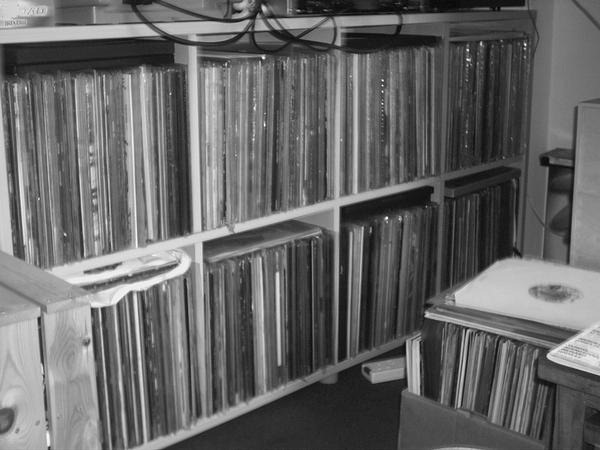
I’m aware of the issues of storage, perhaps more than most. 1,500 or so LPs and 12” singles, 600 7” singles and in excess of 2,000 CDs are a real bastard to house in a two-bed terraced property, and to move when it comes to relocation. But at least I know where my money’s gone and what I need to insure. Picking up a storage device no bigger than an audiocassette knowing that it contains not only my entire music collection, but also music to the value of something in the region of £30,000 is almost inconceivable. The same is true of a virtual library. The fact that a fire tearing through the house would – or could – have the same effect regardless of my choice of ‘file’ type is really beside the point.

It’s curious to note how times have changed: time was when an extensive library of books and an expansive record collection were perceived as accomplishments. They inspired respect, even awe. Now, the owners of large volumes of material possessions are considered to be simply behind the times, information dinosaurs plodding a Luddite land of clutter that’s cumbersome and difficult to navigate. Why would anyone want a 10-volume encyclopaedia when mankind’s entire learnings can be obtained on-line via Wikipedia (or other sites if more specialist knowledge is required, but why would you want that, really, unless you’re a real nerd)? In fact, what’s the point of a space-hogging PC base unit and monitor when you can have everything you need on a tablet? A music collection and library that not only occupies considerable space, but cost a fortune and took a lifetime to accumulate seems entirely redundant beside a small, flat piece of digital kit that costs around £300 and can be transported anywhere. And I suppose if you’re happy or able to accept a life of precarity, instability, endless mobility, that’s fine, but it’s not for me.

In fact, for many, owning music seems superfluous when you can stream it all via Spotify. It frees up funds to purchasing other ephemeralities and experiences. Again, the idea of a life recorded on Facebook is one that doesn’t appeal to me. The public nature of the medium aside, I struggle with the concept of a reliance on something that may disappear at any time. If there’s one thing we’ve learned in our world of rapid development is that technology attains obsolescence at an evermore speedy rate. There was a time, believe it or not, when the 8-track, the cassette and the videotape were all cutting edge. Betamax, laserdisc and minidisc were all the future, yet despite the qualities these media offered, early adopters were left out of pocket and out of style, not to mention out of the technology loop. CD was supposed to supersede both vinyl and the audiocasette – yet strangely, the MP3 killed both CD and tape while vinyl hangs in there, with a whole new wave of audiophiles sustaining a market that previously didn’t exist. I digress: the point is that Facebook could be next year’s MySpace, and a life on line is only a transient representation of real life: it’s a history that can not only be easily misrepresented and misappropriated, but one that could even more easily be erased. Obviously, nothing’s forever, but the physical – especially if backed up, duplicated somehow – has a greater capacity to be futureproof than anything that relies purely on the intangible (but then I find the idea of playing a virtual guitar while playing at being in a virtual band equally abhorrent and not just a little strange Step away from the console, pick up a real instrument, learn to play and form a proper fucking band if you have any interest in Rock Stardom!).

I’m not doing technology down as such – at all, in fact – but can you imagine future generations, instead of looking through albums and biscuit tins of family photos and shoeboxes of postcards and correspondence, gluing themselves to a screen and reminiscing about the day that prompted that romantic email, the wonderful day out to the coast captured magnificently in 6 megapixel digital colour, or even the idea of returning to that book you so loved in college and forwarding your friend or child the Kindle download to read and share the wonder? In all of the streamlining, the decluttering, something has been lost. An on-line playlist is not a direct or equal substitute for a lovingly-compiled mix-tape with lovingly-written, hand-scribbled notes on a piece of paper torn from an exercise book and inserted, tightly-folded, into the plastic case. If, as Marshall McLuhan suggested, the medium is the message, what sort of message is a medium that’s so theoretical say about our times and its users?

The bottom line is that if I’m spending money on something, I want something to show for it. I’m not suggesting that it needs to be big to justify the expense, but in a world where so little is fixed, stable, reliable, there’s a lot to be said for keeping it real as a means of keeping it grounded, and as a way of keeping it accessible in the future.


Vinyl


100_0044


And if you’re loving my work, there’s more of the same (only different) at Christophernosnibor.co.uk.

Compare and Contrast: The Fall (again) vs Pavement

If Mark E Smith’s words were to be believed, every band sounds like The Fall in some way, shape or form. Every act from the last thirty years has ripped them off, apparently, such is the enormity of his band’s influence. Seminal as they are, this is patently untrue, but Pavement acknowledged their debt to the band, with the track from their debut album Slanted and Enchanted being more of a tribute than a rip-off.

So as much as a case of compare and contrast, this post’s about enjoying two cracking tunes for the price (and chords) of one.


And if you’re loving my work, there’s more of the same (only different) at Christophernosnibor.co.uk

Lost in Music: Christopher Nosnibor’s Picks of 2011

I could wax lyrical about what an exciting year it’s been for music (if you look in the right places), or ramble on about how, having been exposed to so much new music and having attended an insane number of live shows in the last 12 months, that it’s hard to remember it all, and it would all be true. But it’s also rather redundant.

Similarly, I could give a brief two-line summary of each of the items in these lists, but I’d only be repeating myself, given that I’ve posted reviews for everything here. In fact,. I’ve posted in excess of 400 reviews since the year started. Most of them can be found at Whisperin’ and Hollerin’, but there are others scattered here an there across the Internet, notably at Music Emissions and here on my blog.

Suffice it to say that rather than being designed to impress with my ultra-cool or right-on selections, these lists are entirely personal based on what’s stuck with me or impressed or excited me during 2011 – which is why the albums that will make all of the other lists, such as those by Wild Beasts and Kasabian, both of which I panned, aren’t here.

Gigs are listed in chronological order; albums are in no order whatsoever. I couldn’t really pick a favourite, and they’re all great.


Gigs of the Year

Tears of Ishtar / The Falling Spikes – Fibbers, York, 19th February 2011

British Wildlife Festival VI – Brudenell Social Club / Royal Park Cellars, Leeds, 5th March 2011

Interpol – O2 Academy, Leeds, 22nd March 2011

TV Smith & the Valentines – The Duchess, York, 23rd March 2011

Earth – The Well, Leeds, 1st April 2011

Hawk Eyes / Castrovalva / Blacklisters / Dolphins – The Brudenell Social Club, Leeds, 22nd April

Rolo Tomassi – The Well, Leeds – 11th May 2011

Unsane – Brudenell Social Club, Leeds, 11th July 2011

Melvins – Leeds Irish Centre – 2nd November 2011

The Twilight Sad – The Duchess, York, 20th November 2011


Bubbling under: The Primitives / The Duke Spirit / Club Smith / Alvin Purple / Honeytone Cody / Viewer / Her Name is Calla


Albums of the Year

Amplifier – The Octopus

Cold in Berlin – Give Me Walls

Take a Worm for a Walk Week – TAWFAWW

Earth – Angels of Darkness, Demons of Light 1

Gay For Johnny Depp – What Doesn’t Kill You, Eventually Will Kill You

Scumbag Philosopher – It Means Nothing So It Means Nothing

We Are Enfant Terrible – Explicit Pictures

OvO – Cor Cordium

Dark Captain – Dead Legs and Alibis

Mika Vainio – Life (… It Eats You Up)


Bubbling Under: far too many to mention!


l_6800219e0d5c452ea179984c6b3b8698


And if you’re loving my work, there’s more of the same (only different) at Christophernosnibor.co.uk

The Changing Face of Consumerism VIII: State of Independence, or, All’s Well at The Inkwell

The seven ‘Changing Face of Consumerism’ articles I ran on MySpace in 2008 and 2008 all shared a common theme, namely lamenting the sad decline of the real – both in media and commodity, with ‘reality’ television being a pisspoor ersatz approximation of any reality I’ve ever known, and ‘real’ shopping experiences being slowly subsumed by the virtual marketplace.

Don’t get me wrong, I’m all for progress, and have long been a big fan of on-line shopping, being one who doesn’t cope well with crowds or endless hours of pavement-pounding in search of goods, but by the same token, I’m a strong advocate of consumer choice. Despite what the global marketplace on-line tells us, we as consumers do not have infinite choice, not least of all because while some niche outlets fare well on-line, many have gone to the wall because the same kind of corporate giants that slowly erased all of the small independent stores from the high streets of each and every town have steamrollered the little on-line traders out.

As city centres everywhere become identikit clones of anywheresville, so our sense of location becomes diminished: the only thing to differentiate, say, Leeds from Lincoln, isn’t the choice of shops, but the size of each branch, and after a mooch round M&S, Boots, Game and HMV, stopping for a uniform coffee in a Starbucks or Costa before going on to… well, it doesn’t matter. I mean it really doesn’t matter where you are, the experience is pretty much the same. Fine, so you know what you’re going to get, but the experience of discovering a little specialist shop tucked away somewhere is radically different and appeals to a whole range of senses. However hard Amazon try to replicate the browsing experience of specialist independent book and record stores with features like ‘look inside’ and the song snippets you can listen to, in addition to the list of recommendations based on what you’re looking at and what other shoppers have also purchased or viewed that functions as a mimesis of the friendly and enthusiastic guy behind the counter who just loves his books or music and knows everything there is to know, like a living, walking encyclopedia, it just isn’t the same. There’s no substitute for browsing.

And so it was that I was practically skipping when The Inkwell opened in York a few weeks ago. A little shop stocking secondhand books, records (with a few selected new titles), CDs and cards, it’s the kind of shop you used to drop into, rummage around and find something wonderful you didn’t even know you wanted. The owner, Paul Lowman, is clearly an unashamed enthusiast first and a businessman second, and while such a venture is the kind that will never make him rich, and would make many lenders and entrepreneurs alike squirm in discomfort, it’s a shopper’s delight. Perhaps not surprisingly, The Inkwell is aimed at a niche market (by which I mean discerning shoppers: Paul’s philosophy is according to the website, “COOL STUFF FOR ALL!” Popular Culture is about democracy – inclusivity, not exclusivity) specialising as it does in books on music, film and pop culture, with sections on the Beat Generation, Art, Philosophy and a noteworthy – not to mention impressive – selection of pulp paperbacks, all in remarkably good condition (yet reasonably priced, with titles marked up at between six and ten quid).

The vinyl, too, is all in great nick, and the range, though limited, is all about quality and catering to a particular kind of discerning alt/hipster customer. There’s no mainstream pap to be found on the racks: instead, there are sections devoted to Garage, Psych, 90s Indie, Spoken Word / Comedy, and even Burlesque. Yes, if you want the kitsch sleaze of yesteryear, then the range of sexploitation titles in both audio and written media is exceptional.

It’s a tiny little place, made all the more cramped by there being a pair of school desks in the middle of the room, upon which a choice of books are casually laid. It’s all about the browsing experience (they serve coffee too), and an eclectic mix of music is spun – at high volume, and all on vinyl, naturally – on the turntable in the corner by the counter. Of course, it’s simply one’s man’s vision, one man’s obsession made manifest… but what’s wrong with that? But equally, why should a shop such as this succeed in a climate where major chains are going to the wall? The answer, I believe, is simple. In attempting to appeal to everyone, the major chains ultimately cater for no-one. In aiming to cover a vast market based on some kind of assumed generic average consumer and broad populism, the chains become Xerox copies of one another: reliable, perhaps, but ultimately forgettable and wholly impersonal. A shop like The Inkwell isn’t about conquering the world or trying to cater to all tastes: it knows its market and knows it well – because by being the shop its owner wants it to be, it’s catering for like-minded individuals (there’s that word again!). It’s unique in every way, and every item in stock is essentially a one-off. It has the personal touch and is memorable. And that’s why it has a better than average chance of success.

So, on the opening day I left with a brand new hardback copy of Brion Gysin: Dream Machine (a bargain at a tenner given that it retails at £25), a read but respectable copy of The Dark Stuff by Nick Kent (£3) and a vinyl LP – a copy of Fade Out by Loop, again in top condition (EX as Record Collector would have it), for a fiver.

I returned this week and was pleased to see some of the stock had gone and new stuff had taken its place, meaning I was able to add a copy of the original 1971 Olympia Press edition of S.C.U.M. Manifesto by Valerie Solanas to my library. The tenner asking price was more than fair, especially given the condition.

Does The Inkwell represent the vanguard of the counter-revolution in the world of retail? Perhaps not, but I’d like to think that other independent stores will begin to pop up, not just in York, but in every city, and soon. It’s unlikely that this is how the economic situation will be recovered, but being able to rifle some good books and records in a pleasant environment certainly makes these dark times a lot more bearable.

The Inkwell Online is cool – www.ink-well.co.uk – but not nearly as cool as being there.


Inkwell


And if you’re loving my work, there’s more of the same (only different) at Christophernosnibor.co.uk

Too Busy to Blog!

For many writers – both accomplished and aspiring – a common obstacle to productivity is inspiration. Most people run dry at some point. It’s not a brag when I say that this isn’t a problem for me: no, my real problem is time. There simply isn’t enough, and there are only so many ways to stretch it.

Over the past few years, a fair few people have asked me how I manage to maintain my output, how I find the time. The answer has always been that I make time, and type quickly. But then, every now and again, it becomes insustainable, and when it does, something’s gotta give.

I didn’t set out to become a music writer: it was something I once dreamed off, made a few stabs at and did on a very part-time and voluntary basis for a couple of local and regional papers back in the early 90s before giving it up. My applications to music papers for paid work had been unsuccessful, to the extent that none of them had even bothered to reject me, and I decided it was simply too competitive for me, a person who’s not particularly competitive by nature. Moreover, not given to being all that outgoing, and steadfastly refusing to suck up or otherwise ingratiate myself, I decided music journalism wasn’t the career for me. I was 25, working full time and studying at the same time, and in my spare time, attempting to carve out a novel. I was going to be a proper writer!

It took another five years to get my first book, Bad Houses out into the world, and the novel I had been working on, Exiled in Domestic Life, along with its sequel, Rusty Bullet Wounds, remains languishing, unpublished. Still, a lot’s happened since then, and while I have received some help and support – not to mention invaluable exposure – from people who I’ve encountered along the way, my weekly blog on MySpace did contribute considerably to whatever readership I achieved.

People are always going on about the importance of maintaining a blog as a means of building and maintaining one’s profile, and at the time, it seemed that they were right, but when the MySpace community dissolved before my eyes, so the hits to my blog plummeted. Rebuilding a readership from scratch just felt like too much effort for questionable reward, and by this time I had begun reviewing for Whisperin’ and Hollerin’, something I had fallen into quite by accident, but it felt good to be reviewing again. It had been noticeable that the reviews I had posted on my blog had been the least successful by miles, receiving half the hits of my rants. Having a proper outlet for the reviews was an extremely positive thing, and besides, it meant that even if I wasn’t being paid, I was getting free CDs and entry to gigs – plus being able to say that I was a writer for a recognised site meant I was able to approach PR companies directly and have them add me to their mailing lists. This meant even more freeness.

At present, I’m managing to review approximately half of the stuff I get sent, and given that I’m kicking out an average of one to two reviews per day, you can get an idea of just how much the reviewing gig’s grown in the last couple of years. But I don’t want to be known simply as a music writer: I do still write fiction, after all, and have some pretty hefty projects in the works, with the story ‘Corrupted from Memory’ which appears in the new Paraphilia anthology A Dream of Stone being the first of a new wave of fairly dense pieces penned recently.

Then there are the interviews. I’d be daft to turn down the chances I’ve had to meet up with various bands, or to conduct email interviews with Malcolm McNeill and JG Thirlwell. They’re once in a lifetime opportunities. None of them came about because of my blogging, though, and finding the bile to spew out a weekly rant in a blog just wasn’t something I had in me.

The discipline of maintaining a regular blog is healthy for a writer, primarily because it’s so easy to procrastinate, defer and postpone: a commitment to produce a piece each day or week can be a great motivator and can provide the impetus to knuckle down to writing and attempt something new. By the same token, it can all too easily become an obstacle to producing anything else, with the main work becoming sidelined by the thing that’s supposedly a mode of liberation and promotion. Moreover, in churning out pieces on not only a regular but a frequent basis, it’s easy for the quality of output to suffer and to find yourself saying the same thing. If it gets boring to write, it’s going to be equally boring to read: if and when that moment arrives, it’s time to quit.

I had other reasons to quit, or at least cut back though: well, something had to give. I’m no longer studying, but am still working full-time and then some. I can’t not: there are bills to pay, and very few writers actually get to make a living from it. Besides, getting to teach English Literature to undergraduates, albeit on a part-time basis, is often rewarding, but make no mistake, it’s hard work, especially in conjunction with holding down another job at the same time. So how do I find the time to write? Make time, and type fast, of course. But without blogging, at least as often. Has it damaged my readership? No, I don’t think so, and while I receive more hits to my site via searches for ‘Christopher Nonsibor reviewer’ and Christopher Nosnibor Whisperin and Hollerin’, I still get the same number who arrive at my site having searched for ‘Christopher Nosnibor writer’ or for one of my books (more often than not THE PLAGIARST).

But then, I’ve recently found myself wondering if maintaining a blog is as important as it used to be – not just for me, but in general. I still read voraciously, but the number of blogs I read has diminished, and I instead prefer to read a small number irregularly, rather than a large number regularly, partly because many of the blogs I follow tailed off around the same time I allowed my blogging activity to become less of a feature of my writing output. Is the golden age of blogging over? Does it really matter? A world in which everyone has a blog is a cluttered one, but shouldn’t be mistaken for a well-informed one. Knowledge may well equal power to an extent, but with no shortage of blogs brimming with ill-informed opinions and even outright hateful propaganda receiving ample traffic, it would equally appear that misinformation is power, and besides, who cares about what you’re saying as long as you’re popular. The interest in celebrity blogs and Tweets remains unabated. Ok, so bloggers like myself (i.e. the authors of the blogs I like to read) are never going to be in competition with these ‘celebrity’ retards, and never were, but there comes a time when pissing in the wind stops being fun and simply becomes a thankless slog.

For me, the blog always served a dual function: to vent or to comment on the things I had no other outlet for doing so, and, if I’m honest as an indirect means of promotion. Now, I have other channels for both promotion and venting, and besides, I’ve come to the conclusion that the world only needs so many producers of culture and of comment, given that there are only so many consumers. Personally, I try to do both, but it’s hard to consume while producing. It’s simply impossible to read an article and write one at the same time. So, while I continue to work on the job of perfecting a clone or two to enable me to multitask more effectively, the blogs will remain on the back burner while I crack on with the real work…

And of you’re loving my work, there’s more of the same (only different) at Christophernosnibor.co.uk

A Dream of Stone (and Other Ghost Stories), edited by D M Mitchell and Dire Mccain is out now in the US through Paraphilia Books.

Compare and Contrast…. Sonic Youth vs The Wedding Present

It’s been a while since the last compare and contrast blog. Still, continuing this occasional series is one I only noticed relatively recently, and I find it hard to imagine that The Wedding Present’s ‘Go-Go Dancer’…


…wasn’t influenced just a little bit by Sonic Youth’s ‘Teenage Riot’:


Sadly, neither sound as good as I remember them.


And if you’re loving my work, there’s more of the same (only different) at Christophernosnibor.co.uk

Wynning! This is the Heart of Music… A Night off Listening to Mark Wynn’s ‘Stories, Rags and Stomps’ Album Launch

The Habit, the tiny bar venue in York that Mark Wynn plays often and has chosen for the launch of his new album attracts an odd melange of beatniks offbeats, hipsters, scenesters and hangers-on. With its artisan interiors and late-night opening, it has a distinctively cosmopolitan vibe, and I often find myself thinking of Henry Miller whenever I’m in there – and I like to go there every so often when I’m taking a night off, because I can sit or lean and blend into the background while someone or other – sometimes Mark, sometimes different people – play tunes, and I can enjoy a drink and watch and listen in on the ‘characters’, the cool kids and the wannabes, the has-beens, could have beens, never weres and never had a hope of beings. From a writing perspective, it’s a great place to go to simply observe.

It’s also, in many ways, representative of the way I see the music industry evolving – or devolving. As artists are rejecting the industry that rejected so many of them, they’re going cottage and taking things back to grass roots. The heart of music now doesn’t really lie in the big gigs and the major label multi-million selling albums. No, we’re entering a time when artists play day in day out to small audiences in intimate venues. They may eke a living and get paid a pocketful of change that they subsidise by flogging a few CDs on the night, and it’s a fucking hard slog, but existing at the opposite end of the spectrum from all the X-factor cal, it’s real-life, not reality TV. Without the cameras, the wardrobe, the production, the digitization and editing, playing up close and personal requires real talent and commitment.


Tonight, The Habit is more packed and buzzing than usual. In fact, it’s hard to get to the bar. The atmosphere’s a little different. It’s not full moon, but there’s definitely something in the air. Then comes a point two songs before the end of Mark Wynn’s set when the madness takes over. The drunken old fruit in the vulgar shirt who’s been busting moves all night knocks the mic stand – by no means for the first time. Mark pauses for a beat, moves the mic back so it’s positioned in front of his mouth and he launches into an improvised number ripping the piss out of the guy, who, it seems, is renowned for his tedious tales told in an inebriated state. Mark could be forgiven for being frustrated. His rant’s not overtly mean-spirited, though – it’s all in the delivery – and besides, it’s extremely funny, and I can’t help but be particularly amused when he riffs on how the old duffer resembles Henry Miller.

Y’see, Mark Wynn is a real one-off. There’s no doubting his musical skills, but in a world where there’s a singer/songwriter playing a mix of originals and covers, picking and strumming an acoustic guitar in every pub and on every street corner (especially in York), what makes Mark stand out is his apparent unwillingness to do just that. He’s a low-key and self-effacing kinda guy playing low-key, self-effacing kinda songs. His demeanour is slightly shuffling, shy and awkward seeming, and he has a tendency to play sets full of downbeat songs quietly. His between-song banter is characteristically mumbled, a little rambling, but it’s equalled by a deceptively sharp wit, and his unique brand of inverse showmanship is a welcome alternative to the big egos, the musos clamouring to be discovered.

Mark’s a genuine artist, relentlessly carting his battered guitar up and down the country on his endless ‘getting ignored in bars’ tour because that’s what he does. He’s a musician and he’s all about the music. He sings songs. Often sad or frustrated, but sometimes happy. and sometimes spinning yarns, a true troubadour, and the turnout for the launch of ‘Stories, Rags and Stomps’ (which he describes as ‘low-grade trash’) indicates that his work is appreciated.

After support slots from David Keegan and some other dude, and the rabble-rousing folksters Rat Catchers Mallets, who, er, roused plenty of rabble, Wynn’s set brings things down a notch. It’s no bad thing, however. He doesn’t actually play much material from the new album, as far as I can tell – although there are points where it’s so loud it’s difficult to tell what he’s playing – and instead plays a slew of unfamiliar material. It doesn’t matter. He plugs away, casually, affably, supping a pint and simply doing his thing. It’s what he does – and I hope he keeps on doing it.

The album’s pretty good, by the way, and costs less than a jacket potato or cheese toastie  at The Habit.


Mark Wynn Album Launch Flyer


Mark Wynn on Bandcamp: http://markwynn.bandcamp.com/


And if you’re loving my work, there’s more of the same (only different) at Christophernosnibor.co.uk


Compare and Contrast: Wire vs Red Lorry Yellow Lorry

Ok, so it’s broadly agreed that Wire have been immensely influential and are one of the few bands to have emerged from the punk scene to have been capable of producing genuinely clever and articulate songs. They’ve written a lot of seriously good tunes, too, so it’s small wonder that so many subsequent bands have ripped them off. I’ll be coming to Elastica later, but for now, here’s a compare and contrast with a song by Leeds band Red Lorry Yellow Lorry.

Formed in 1981, The Lorries are generally lumped in with the ’80s ‘goth’ scene on account of their geography and the fact that their original drummer,  Mick Brown, would subsequently leave to form The Mission (although whether or not they were strictly ‘goth’ is questionable, but that’s a whole other matter). Still, whether you consider RLYL goth or simply angry post punk, as I do, the vocal melody on the track ‘Hand on Heart’, from their 1985 debut album Talk About the Weather is undeniably similar to that of Wire’s ‘Reuters’ the first track on their classic 1977 LP Pink Flag.

Enjoy!


And if you’re loving my work, there’s more of the same (only different) at Christophernosnibor.co.uk