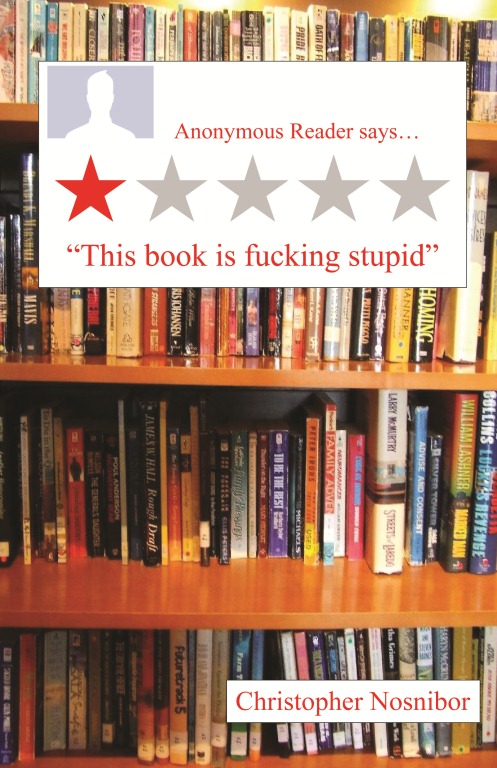
So the plan is now in place, and if it seems utterly cranky, then so much the better. While Clinicality Press will be publishing This Book is Fucking Stupid as a paperback later in the year, it will appear first on two different e-publishing platforms. The reasons for this are numerous, and not least of all financial. E-publishing is free and Clinicality have zero funds; any cash raised from the e-book editions will go directly into the production and marketing of the paperback. So far, so savvy. But here’s the rub: each edition will be different. This Book is Fucking Stupid is an incomplete project, and is designed as such, to be revised, expanded and reworked in order to exist beyond the prescribed confines of a ‘published novel’, wrapped up and clipped by the limitations of authorial and editorial constraints.
Bypassing the conventional process of republication by route of the first edition, revised edition, annotated edition, anniversary edition, scholarly edition, restored text, This Book is a continually evolving piece, it’s first e-publication intentionally abridged, with critical passages withheld for inclusion in the second, to be again expanded and subject to further supplements in the form of introductions, prefaces and a comprehensive index in the first print edition, which will also include further insertions that represent the critical and academic reception. These will all necessarily be engineered by the ‘author’, although each revision will represent a diminishment of the original author’s role and input, as his ‘own’ words and the story itself become diluted, accounting for a reducing proportion of the book’s total contents. The purpose of this exercise is to play out the way in which a text (d)evolves and changes complexion with each revision, translation, annotation, commentary. Even simple republications problematise the materiality of the text, with alternative pagination, typefaces, cover art, all contributing to a different reading experience between editions, a situation not resolved but in fact heightened by digital editions such as those designed for the Kindle, whereby the end user determines the format, the font size and thus the reading experience to a certain extent. Consciously or otherwise, readers respond to the physicality of a print edition of a text, ranging from the luxurious yet cumbersome large-format first edition hardback to the pocket-sized budget edition paperback on low-grade paper with the text in a small font, the lines packed tightly together. There’s a sense of the personal in a print edition, also, and it’s undeniable that one tends to feel and respond differently to a pristine first edition and a well-thumbed and rather battered trade paperback. These responses transcend the impositions of value and of commodity, yet these peripheral tangibles definitely colour the way readers engage with a text. Context is another extraneous factor; again, a scarce edition or clandestine publication provokes a different response from a mass-market edition that’s sold in the millions. The idea of a ‘restored’ edition or an ‘expanded’ edition connotes a sense of incompletion or correction, suggesting that previous editions were somehow ‘wrong’, that previous editors or publishers interfered with the writer’s work, either for the same of marketability, for social or political reasons, or simply because they had no respect, an overinflated ego or lacked any sense of competence.
Of course, history is full of revisions and ‘corrections’ – or perhaps more accurately, realignments, reconfigurations and reinterpretations, and this applies to not only literary history. The process of totalization, by which linear narrative and a continuum based on a sequence of events connected by cause and effect, is the very basis of the conception of history. Yet this almost universally accepted narrativisation is complete artifice, and linear sequentiality fails to account for simultaneity and disconnection. Nietszche was right: everything you believe to be true is a lie. To the point, there’s nothing that’s immutable, fixed, and to anchor a belief system on anything is simply an act of misguided (self)deception. The revised edition, the expanded edition, the annotated edition, these are all examples not of an enhanced reader experience, but of exploitation, and usually created without the author’s consent and, more often than not, following the author’s death. This Book is different. It may still be exploitative, but at least it’s open and honest about the fact, and all of the insertions, amendments, deletions, are made with the author’s knowledge. It also exists to highlight the cynical nature of the conventional process, the life of the book. This Book collapses all of that, trashes it, burns it, razes it to the ground.

And if you’re loving my work, there’s more of the same (only different) at Christophernosnibor.co.uk
 Christopher's Headspace