‘Pretentious and Dull’: Celebrating Ballard’s Lone Stars

Negative reviews have long been something of an obsession of mine. Having grown up reading Melody Maker and the NME in the late 80s and early 90s, it was the out-and-out slatings that I found made the most entertaining reads. In many ways, these reviews were a leading factor in my deciding I wanted to become a music journalist. For the first reviewing job I applied for, which happened to be at my local paper, I sent a deeply scathing review of a recent gig I’d attended, because I felt it provided the best means of demonstrating my flair for description and finding creative ways of saying the bands were shit.

I was elated when the section’s editor rang me to tell me I’d got the ‘job’ (I say ‘job’ as it was unpaid, an ongoing feature of my reviewing career which now spans the best part of twenty years). My elation was countered by no small degree of horror when he went on to tell me he loved my submission so much he was going to run it.

It was a vital lesson in writing, and at a relatively tender age (I was about 18), namely that if you’re going to write something, you have to be prepared for people to read it. The paper received a number of letters of complaint, the first review to have elicited such a reaction in its entire history.

Still, it wasn’t the first time my writing had received complaints. A couple of years previous, during the summer holidays, I had produced a newsletter of sorts, a parodic ‘gossip column’ type affair about people from my school. It went by the title of ‘The Parish News’, and I simply printed up and posted out copies to various friends and people I knew. Unfortunately, one (female) recipient shared initials with her mother, who opened the correspondence, and, taking offence at the references to her daughters breasts, decided to call the police about this ‘offensive’ publication. They turned up at the back door while I was cleaning the porch for pocket money, and delivered some stern words. They couldn’t tell me who’d complained, of course, but I spotted one of the, coppers was holding the envelope they’d been handed by the complainant and read the address, and made the simultaneous discovery that bobbies aren’t always the brightest. They also told me in no uncertain terms that I was to cease the publication of ‘The Parish News’ or anything similar. I gave them my word and they went on their way. I was a lot more careful with the distribution of the subsequent three issues of the quarterly A4 one-pager.

Since then, very little’s changed in many respects. I learned quickly to develop a thick skin when it came to comments regarding my work, and for every detractor there are many protractors, and besides, I’m of the opinion that it’s better to be slated than ignored – although that doesn’t stop me bailing in, feet first with all guns blazing when I receive a particularly feeble or otherwise irksome CD in the mail. It’s good to let off steam to flex my muscles that are primed for serving up vitriol, and I still believe the bad reviews are the best.

Unfortunately, many reviews on the Internet, be they reader reviews or fan reviews or little blogs or zines, are extremely poorly written, and the one-star reviews on Amazon, Goodreads, etc., are nowhere near of the standard of the scathing reviews penned by good journalists who possess wit, humour and an extensive vocabulary. It was this strain of review that was a key inspiration for This Book is Fucking Stupid, and long before I decided to write / assemble the book, I’d developed the habit of skipping straight to the one and two star reviews of books or CDs I was considering buying. Sometimes I’d find myself embarking – unintentionally – on extensive one-star journeys, reading all the terrible reviews of books I’d read or by authors I like. And really, most of them are truly terrible. Invariably, it’s abundantly clear that the reviewer is only semi-literate, and needless to say they’ve generally missed the point of the book completely.

I’ve recently been on something of a Ballard trip, and it’s perhaps not surprising that despite the glowing critical reception his works have received, many ‘everyday’ readers have been less impressed. tvpunter’s comments on Amazon.co.uk concerning High Rise – a book I found powerful and quite affecting – are in many ways typical:

1.0 out of 5 stars WE-1984-, 8 May 2011

By tvpunter

This review is from: High-Rise (Paperback)

That kind of novel that potrays the middle classes in turmoil as oppossed to the state controling the masses..a metaphor for today in 2011..did’t work for me.

Clearly, spelling ‘dos’t’ work for him either, and reviews like this reveal more about the reviewer’s deficiencies than the shortcomings of the book. The point is, I’m aware that Ballard is guilty of the occasional lumpy sentence and sometimes the action scenes are so hastily sketched it’s difficult to discern precisely what’s happened. Consider these features endearing, small imperfection that are essential to the unique style of Ballard’s writing. Therefore, while not all of his books have had the same effect on me as The Atrocity Exhibition, I nevertheless find myself marvelling at the way in which he constructs his narratives, and I’ve not once – thus far – found a Ballard book to be ‘disappointing’ – unlike Thomas Hunter of Banbury:

1.0 out of 5 stars Disappointing, 11 Nov 2011

By Thomas Hunter (Banbury, UK)

This review is from: Super-Cannes (Paperback)

This book started so well, painting a great picture of a realistic brave new world on the French Riviera, and setting up an intrigue that promised to blossonm into an exciting mystery. But then it all went wrong as implausibility piled on top of implausibility. JGB thought he was building tension but instead he was building incredulity, finishing off with a pathetic ending that made me think the whole experience had been a waste. My first Ballard and probably my last.

The one thing that’s always struck me about Ballard is his ability to signpost the future. The London Riots of August 2011 immediately brought to mind High Rise and Millennium People. But the trouble with writing the near future is that for many, it will seem far-fetched and improbable, in much the same way Smellgrovia finds aspects of Kingdom Come ‘silly’.

1.0 out of 5 stars Pale Imitation, 21 May 2007

By Smellgrovia (Blackheath, London)

This review is from: Kingdom Come (Hardcover)

I am a huge Ballard fan and so am sorry to say that I really did not enjoy this. I agree with other reviewers in feeling that Ballard has done this so much better in other novels such as Cocaine Nights. I thought the shopping mall run riot was silly at best, and I just could not get involved with the characters or plot. By the end I was skim reading just to finish the damn thing – never a good sign.

2.0 out of 5 stars gratuitous, 17 Nov 2010

By biskit

This review is from: High-Rise (Paperback)

i knew this book was supposed to be alarming, thought provoking etc., but i didn’t bank on the feeling of impatience and horror. never one to abandon a book half way, i kept on through gritted teeth. I have since passed dwellings that have made me think of this book, but that can be its only legacy. a fear that the hell within this book could become reality is what makes one read on, but beware the same is true for other stories of the horror genre. this is not a convincing tale, people going to work as normal and then setting up war zones in their own block of flats? i dont think so!

We live in silly times. I suspect many inhabitants of inner city areas would liken their tower blocks to war zones. Many considered 1984 absurd in its day, and no one got Nova Express, yet these books are now very much reflections of the society in which we now live. It’s a pity the authors weren’t around to witness recent events – or perhaps it’s a blessing. Sometimes, it’s not pleasant to find you were right all along.

I wrote This Book is Fucking Stupid as a means of addressing the dichotomy that runs through the whole field of reviewing as it’s emerged in recent years. Readers rarely seem to agree with critics, yet purchase books on the strength of the reviews its received – and then complain, feeling that they’ve been in some way misled by the critic’s positive assessment of any given text.

1.0 out of 5 stars One for the Daily Mail readers, 28 July 2008

By Bryan (Newcastle)

This review is from: Millennium People: Novel (Paperback)

If it’s a satire, it’s lacking wit, insight and humour, and if it’s not satire it betrays a staggering naivete. Characters are poorly drawn, but even in their one-dimensional state manage to be either wholly unsympathetic or downright offensive, and the world they inhabit is one seen by the most blinkered Daily Mail reader, where school fees are an important economic indicator, and the death of Jill Dando can shake the country. (The inclusion of a version of the Dando murder is so bizarre it’s almost funny, but not quite enough). The point of the book, such as it is, is facile – professionals have a function in society – but by presenting their closed world as the entirety of society, and not giving us any shade, or any tension, against their short-sightedness, the book’s never going to work unless you can actually sympathise with their views. And if you can, then I pity you. There’s also a nearly quaint 1960s radical feel – the giveaway line for me was a reference to a ‘shared lover’ – the uneasy balance between permissiveness and misogyny bringing the bearded conservatism of 60s student to mind. (The idea of overpriviledged revolutionaries obviously chimes with the theme of the book, but I don’t think that’s a deliberate echo).
There are some nice prose flourishes, but a handfull through the book, which mostly reads somewhere between plodding and clunky, while the dialogue is risible. If I’d not read some early Ballard, I’d say his editor hadn’t paid attention to an esteemed author’s manuscript.
Overall the book is a re-tread of High Rise, and suffers that book’s problem of a fundamental misanthropy based on a wilful acknowledgement only of the most venal side of humanity, that expressed in the broadsheets and world cinema of the London middle class. That could work if it was sufficiently stylised (and much as I disliked High Rise, it nearly worked through the conceit of staying within one building), but this wants to operate within a real world, but completely fails to acknowledge one exists.
If you like your writing dull, your authors solipsistic, and your themes akin to being battered over the head with a rolled Telegraph, then fill your boots on this one, but otherwise, there’s nothing to see.

Another key aspect of This Book was recycling. In these times of austerity and while green issues remain to the fore, I’m still the keen advocate of recycling I was a decade or more ago. I was raised to waste not, want not, and I’ve spent most of my writing career working to this ethos. Just as William Burroughs cut up Naked Lunch to create much of what would subsequently become the Nova trilogy, so a large proportion of the material that became THE PLAGIARIST and From Destinations Set began life as a novella entitled Destroying the Balance. This novella became my ‘word hoard’ so to speak, and I decided it was a more than fitting text to recut, re-edit and reconfigure in order to produce This Book. And why not? By reworking a pre-existing text, I’m joining a lineage of great authors who did precisely the same. Of course, not all readers appreciate what could be considered formulaic plotting, although no-one seems to complain that the bulk of crime, horror or romance novels all follow the dame formula.

1.0 out of 5 stars A waste of time and effort…, 4 Oct 2001

By deborah.daley@marshallcavendish.co.uk (London, UK)

This review is from: Super-Cannes (Paperback)

I bought this book as I was going on holiday and needed something to read. It was a haste decision based on the rave reviews and the fact that this book had won an award. I did not find this book to be exciting, tense, thrilling, visionary, etc. This story of a man tracing the footsteps of another man’s killing spree is written in such a way that I wasn’t immersed in the story – I didn’t care about any of the characters, the plot was unbelieveable, long winded and consisted of twists that I had been guessed early on. It was only when I got to page 371 that I felt the story had some real feeling or was exciting – this isn’t a good sign in a novel.

Another thing was that there were too many poetic terms for describing things throughout the story. This is a talent of Mr Ballard’s that he utilised to the nth degree. I challenge any potential reader to open a page in this book and read – you’ll see that it’s difficult to keep track…

Why is this author praised as some kind of genius? Reading the synopsis of his other books it looks suspiciously like he rewrites the same story over and over again – perhaps he is a genius…

There is of course a fine line between genius and insanity, and if dumb is the new smart and the rewriting of the same story over and over again is the height of creativity, then This Book is Fucking Stupid is the very definition of a work of genius. What’s more, I’ve long said that plot’s overrated, and while a substantial number of truly important works of literature dispense with plot completely (again, The Atrocity Exhibition, Naked Lunch are obvious leading examples), while others relegate plot to a secondary or even tertiary position (I’m thinking instinctively of Alain Robbe-Grillet’s work here, although again, there are many others) but of course what I really mean by this is that a truly great book needs a lot more to it than plot, and readers who read for plot alone are missing out on vast portions of the experience reading can provide. How often does plot as of and in itself make a reader pause for thought to assess their own lives, beliefs and the world around them? Still, even a good plot is wasted if the readership’s incapable of following it without it being spelled out. Perhaps more complex novels should come with plot-line summaries, and, better yet, a diagram with the key events in sequential order, just to make sure no-one gets lost along the way.

1.0 out of 5 stars Pretentious and dull, 24 Mar 2008

By A. Auburn (Cambridgeshire, England)

This review is from: Millennium People: Novel (Paperback)

This is among the worst books Ive ever read. I couldnt follow the plot,and the language was over pretentious and unexciting. I have heard alot about J.G. Ballard but he is highly overrated and dull.

Ultimately, any writer has to accept that they’re not going to please everyone, and in fact, few would want to. I’ve made my decision: I’m going all out for the one-stars. I want to produce an entire oeuvre of ‘worst books ever’ than crush my soul churning out potboiling bollocks about knights or espionage. Let’s face it, the paperback fiction chart is grim and endlessly samey. Where’s the variety? Where’s the writing that challenges the reader and the status quo? I’d rather sit with Ballard in the ‘pretentious and dull’ corner of the literary world than be adored by the masses who loaf around on the beach reading Shopaholic or dross by Dan Brown. Stupid? Career suicide? Perhaps, but then so’s the idea of writing to become rich or famous. Fame and fortune are even more overrated than plot, but again, you’d have to venture off the bestseller list and read something other than celebrity autobiographies to find that out.


J.G.-Ballard-at-home-in-1-002

The late, great J G Ballard and his untidy bookcase

And if you’re loving my work, there’s more of the same (only different) at Christophernosnibor.co.uk
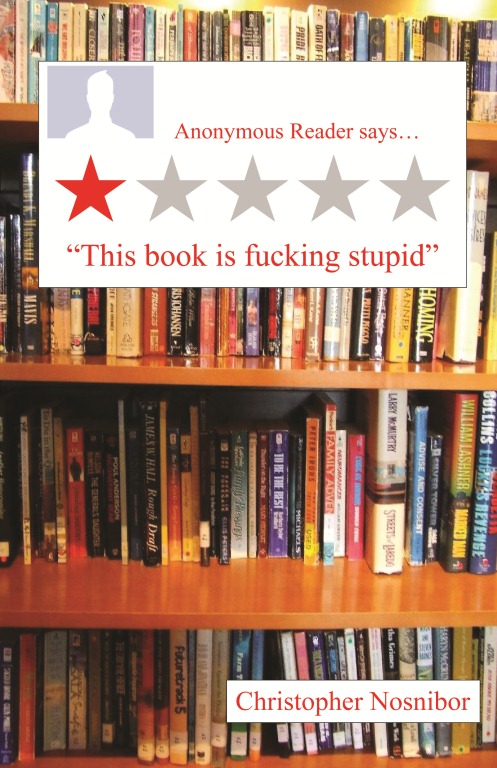

So the Plan is Now in Place… and it’s Fucking Stupid

So the plan is now in place, and if it seems utterly cranky, then so much the better. While Clinicality Press will be publishing This Book is Fucking Stupid as a paperback later in the year, it will appear first on two different e-publishing platforms. The reasons for this are numerous, and not least of all financial. E-publishing is free and Clinicality have zero funds; any cash raised from the e-book editions will go directly into the production and marketing of the paperback. So far, so savvy. But here’s the rub: each edition will be different. This Book is Fucking Stupid is an incomplete project, and is designed as such, to be revised, expanded and reworked in order to exist beyond the prescribed confines of a ‘published novel’, wrapped up and clipped by the limitations of authorial and editorial constraints.

Bypassing the conventional process of republication by route of the first edition, revised edition, annotated edition, anniversary edition, scholarly edition, restored text, This Book is a continually evolving piece, it’s first e-publication intentionally abridged, with critical passages withheld for inclusion in the second, to be again expanded and subject to further supplements in the form of introductions, prefaces and a comprehensive index in the first print edition, which will also include further insertions that represent the critical and academic reception. These will all necessarily be engineered by the ‘author’, although each revision will represent a diminishment of the original author’s role and input, as his ‘own’ words and the story itself become diluted, accounting for a reducing proportion of the book’s total contents. The purpose of this exercise is to play out the way in which a text (d)evolves and changes complexion with each revision, translation, annotation, commentary. Even simple republications problematise the materiality of the text, with alternative pagination, typefaces, cover art, all contributing to a different reading experience between editions, a situation not resolved but in fact heightened by digital editions such as those designed for the Kindle, whereby the end user determines the format, the font size and thus the reading experience to a certain extent. Consciously or otherwise, readers respond to the physicality of a print edition of a text, ranging from the luxurious yet cumbersome large-format first edition hardback to the pocket-sized budget edition paperback on low-grade paper with the text in a small font, the lines packed tightly together. There’s a sense of the personal in a print edition, also, and it’s undeniable that one tends to feel and respond differently to a pristine first edition and a well-thumbed and rather battered trade paperback. These responses transcend the impositions of value and of commodity, yet these peripheral tangibles definitely colour the way readers engage with a text. Context is another extraneous factor; again, a scarce edition or clandestine publication provokes a different response from a mass-market edition that’s sold in the millions. The idea of a ‘restored’ edition or an ‘expanded’ edition connotes a sense of incompletion or correction, suggesting that previous editions were somehow ‘wrong’, that previous editors or publishers interfered with the writer’s work, either for the same of marketability, for social or political reasons, or simply because they had no respect, an overinflated ego or lacked any sense of competence.

Of course, history is full of revisions and ‘corrections’ – or perhaps more accurately, realignments, reconfigurations and reinterpretations, and this applies to not only literary history. The process of totalization, by which linear narrative and a continuum based on a sequence of events connected by cause and effect, is the very basis of the conception of history. Yet this almost universally accepted narrativisation is complete artifice, and linear sequentiality fails to account for simultaneity and disconnection. Nietszche was right: everything you believe to be true is a lie. To the point, there’s nothing that’s immutable, fixed, and to anchor a belief system on anything is simply an act of misguided (self)deception.  The revised edition, the expanded edition, the annotated edition, these are all examples not of an enhanced reader experience, but of exploitation, and usually created without the author’s consent and, more often than not, following the author’s death. This Book is different. It may still be exploitative, but at least it’s open and honest about the fact, and all of the insertions, amendments, deletions, are made with the author’s knowledge. It also exists to highlight the cynical nature of the conventional process, the life of the book. This Book collapses all of that, trashes it, burns it, razes it to the ground.

TBIFS Cover 2 copy

And if you’re loving my work, there’s more of the same (only different) at Christophernosnibor.co.uk

Christopher Nosnibor Banned from Social Network.. for Networking

Back in the MySpace days, when I was refusing to sign up to Facebook before peer pressure and a mass exodus meant I had to move in order to maintain my virtual profile and contact with many of the people who I’d met but who had since migrated, there used to be a running joke about Facebook that centred around the absurd premise of only networking with people you already know.

Having accumulated over 1,300 ‘friends’ (who probably are electric) since setting up my account, it’s probably fairly obvious that I’ve exchanged friend requests with a lot of people I’ve never met, never heard of and know nothing about. I do, however, tend to share a number of mutual friends with these ‘strangers’, more often than not on account of common interests and publishing.

Sometimes, I may not be actively seeking friends to add, but will fire off the odd friend request because, well, because Facebook tells me to. Granted, I’m entirely responsible for my own actions, but the feature whereby Facebook suggests friends is undeniably a less than subtle form of suggestion. Now, I’ll concede that it does list these suggestions under ‘people you may know’, but when you’ve got a significant number of mutual friends who move in the same circles, then you’re into ‘friend of a friend’ territory in a rapidly diminishing virtual world.

Still, to cut a short story shorter, it would seem that one of my requestees decided they didn’t know me and didn’t want to and told Facebook as much. Consequently, I received a notice informing me I was banned from sending any friend requests for a week, and furthermore, I was required to revisit the terms and conditions and tick a box on a declaration stating that I wouldn’t send friend requests to anyone I didn’t know, ever again. I was given the option to cancel all of my outstanding friend requests, or just those sent to users with whom I have ‘few’ friends in common, which was generous, but note the use of the word ‘few’ – not ‘no’. What qualifies as ‘few’? it’s all relative, surely. If a person only has 10 friends and five are mutual, it’s relatively many, but few in real terms. I know, I’m intentionally missing the point to an extent.

Moreover, it’s not that I don’t appreciate the irritation and antagonism serial spammers cause, or the threat to personal security the scamming spammers represent, but I nevertheless find this suspension approach absurd, because it’s not hard to distinguish between a human who’s a heavy user and a spambot.

Can you imagine the same scenario playing out in the real world: for example, delegates milling around at a conference not speaking to one another or introducing themselves to others? Shuffling up to the buffet and not speaking to someone because they don’t already know one another is hardly networking, is it? Or imagine a freshers’ week at university where no-one strikes up a conversation with someone just because they look interesting or they’re wearing a particular band T-shirt or whatever, because they don’t share an arbitrary number of common friends already. It’s unfeasible, and life simply isn’t like that. Social networking isn’t like inviting random strangers into your house just because they knock at your door: the clue’s in the name.

So is this an indicator that despite what Facebook claims to be, and despite the fact we’re supposedly living in a shrinking world with a wider society, what we’re actually doing is growing more insular, more fearful of ‘strangers’ and spending our time indoors not meeting new people, preferring instead to only associate in virtual life with people we know in real life? This would also suggest that social networking is, in fact, the precise opposite of what its name implies, and it would be more accurate to describe it as anti-social not-networking. Staying may well be the new going out, but forgive me for wanting to get out more while I’m staying in.


facebook-logo

Farcebook: absurd ‘guidelines’


And if you’re loving my work, This Books is Fucking Stupid is published on April 1st.

I’m in good company….

The following review is something I found on-line while working on my forthcoming novel., This Book is Fucking Stupid. It’s a review of Hemingway’s classic The Garden of Eden.


I give up.

This book is fucking stupid. There is no story at all. It’s all a bunch of sleeping and eating in France while nothing actually happens. Envy and sex. That’s it. A woman has a mental breakdown and Hemingway obviousy had some rampant sexual fantasies. Now that I know what happens… Catherine loses her mind because she’s jealous of David’s attention to writing…she’s a rich little psycho who wants to be showered in attention constantly. She gets increasingly jealous of his masculinity and she admires it so much that she keeps getting her fucking hair cut more and more and it says online that she even got tailored pants and picked up a chick with whom she had a lesbian affair with. Then she lets David sleep with her too. They’re like some sick happy triangle. Oh my god, really? That’s it? A whole fucking novel for that? My god, the first stage of her psychotic episode seriously took up like a third of the book. Maybe when this was written it was groundbreaking and mind bending so I could be looking at it with completely the wrong mindset and judgmental eyes. I just found it to be such a drag. For me, right now, in 2011 at least. I feel like that was such a waste of life, lol I’m sorry. Wow. Just WOW. Like I said it’s probably a lot more amazing in the context of the time. It took the dude fifteen years to finish. I read the summary on the book and thought it was boring, I should’ve just put it back on the shelf. I guess I wanted a taste of how it was written and how everything played out but I found a lot of babbling, broken scenes with a lot of pointless fluff, a lot of “and”s and a character I really dislike who talks too fucking much and needs counseling. I’m a little disappointed. I should just stick to Poe. There’s always a twist, and if there’s not it at least gets you thinking and stimulates the senses. And Emerson. God, this book made me feel so stir crazy. Crazy. Town. Let me out.


hemingway

Hemingway: Who are you calling stupid?


And if you’re loving my work, there’s more of the same (only different) at Christophernosnibor.co.uk

They were cunts in school and are still cunts now….

Job-hopping was, historically, considered to be a bad thing. A job was for life, and anyone who had a CV that consisted of an endless catalogue of short-term contracts was perceived as either being unable to stick at anything, or incapable of obtaining anything more than seasonal or temporary work – usually menial, low-grade employment that was undemanding and required minimal intellect or, worse still, the kind of person who made a habit of getting themselves sacked. Times have changed. Some people actually choose to flit between jobs and call it ‘freelancing’. Others have short-term work forced upon them, and it’s no longer simply the blue-collar types. Offices and ‘contact centres’ (call centres to those who live outside of the corporate environment) are bursting at the seams with temporary staff and staff on fixed-term contracts – to the extent that many large companies actually employ very few staff directly. While the hourly rate for a temp may be higher on paper, subtracting the cost of benefits such as staff pension and sick pay and it’s easy to see why companies do it, although the benefits are immeasurably in their favour over those of the employee. Many of these temporary staff are educated to degree level, yet are still unable to secure permanent contracts. Even in positions that require higher qualifications and levels of experience, the situation is the same: universities are employing teaching fellows on a basis of a semester at a time, for one or two hours of teaching a week.

Again, there is an immense disparity between the idea of job-hopping as a lifestyle choice and the common reality for those who find themselves forced into a life of what Ivor Southwood refers to in his book Non-Stop Inertia as ‘job precarity’. It isn’t fun. And yet recruitment agencies and those who enjoy the ‘freelancing’ lifestyle (usually the kind of people who get head-hunted and land a short-term contract of a year or two in highly-paid executive roles) all emphasise the empowering nature of the ‘freedom’ this approach to employment affords the individual. For those who lack the comfort of a financial buffer and the capacity to earn large sums in short periods of time, the uncertainty and lack of stability that arises from short-term employment contracts is is anything but liberating, and every bit as depressing as being stuck in the same dead-end job for a decade or more.

The endless quest for a new contract and the endless stream of rejections the endless applications elicit is just as soul-crushing as knowing that your life is slowly slipping by while you sit in the same office churning out the same meaningless shit each dull day. At least that unfulfilling rut pays the bills, ensures the rent gets paid and affords the kind of security that comes will a pension, sick pay and all the rest. As a job-hopping freelancer, you are not your own boss: you’re a slave to the quest for the next thing and the search for a new boss to fuck you and discard you along with all the short-term contract trash not worthy of a permanent contract.

Still, surely no employment can be as depressing as Friends Reunited, arguably the first social networking site – if re-establishing contact with people you already know qualifies as ‘networking’. More often than not, people lose contact for a reason: the friends who are worth keeping, you make the effort to maintain contact with, and the effort is mutual. If you want to feel old, look up your old schoolmates. Check out their photos and see how their youthful looks have faded as they’ve grown fat,old, bald and saggy. Read their profiles and see how happy they are with their pathetic lots as they plough through life unquestioningly, aspiring to nothing more than a fortnight in Spain to provide a change of scenery from the 9-5 which, though monotonous, is the pinnacle of their capabilities, and as they like their colleagues and are able to leave their 2.4 children with their parents or grandparents while they go for a few drinks down the pub on a Friday night, it’s no cause for complaint. The ‘successful’ ones are no better really: leaving behind their small-town roots and making for the big smoke after graduation, they’re rich, jet-setting and love their Autumn skiing trips, mini-breaks to Paris and Rome and will have seen the world long before they retire at 50, but none of this changes the fact that they were cunts in school and are still cunts now.

friends-reunited-08

Friends Reunited: keeping track of a bunch of cunts you never liked in the first place

The desire to rebuild bridges with people you were never friends with in the first place is simply a manifestation of the anxiety of ageing, the fear of losing one’s youth and all ties with it. Never mind that you hated school and were bullied mercilessly: you were young and had your whole life ahead of you. Rather than face the fact that you’re halfway through your time on the planet, it’s infinitely preferable to delude yourself that on reflection, school wasn’t that bad, in fact it was good fun. But however hard you work on kidding yourself, however much you force yourself and everyone to swallow the lie that you were cool in school, the bullying was just banter and that you didn’t spend those years lonely, depressed and yearning for something, anything, that would take you out of that hateful environment, every once in a while something will trigger a rush of recollection and it will all come screaming back at you. Sometimes, you can’t help but yield to those pangs of curiosity, when something random makes you remember a name, a face, an occasion and it drags you back like an undertow and you wonder what that person, those people are doing now. And before you know it, you’re trawling Friends Reunited or Facebook. You can’t help yourself, it’s a morbid fascination that makes you recoil in horror at that ageing face, that flabby beer gut, those sagging tits you lusted over when they were pert and teenage and hadn’t been ravaged by three screaming brats by three different fathers, none of whom is the current husband, hanging off them but you still go on through those family snaps, the pictures of the works nights out, the hen night for that slapper who laughed at you when you said ‘crotches’ when you meant ‘groynes’ in geography class. You can still hear that honking sound that ended with a snort and your blood boils with repressed anger even though it was almost a full fifteen years ago now. And that’s why you try not to think about it, because when the recollections resurface, the old wounds open up and you find yourself staring into the gaping gash straight into your fear-filled soul that’s been shrivelled by a decade of corporate dehumanisation. You need to snap out of it, now.


And if you’re loving my work, there’s more of the same (only different) at Christophernosnibor.co.uk

On a Grohl: The Best of Foo

The Foo Fighters have become something of a recurring theme in my writing, for a number of reasons. I will confess that I did find their debut disappointing, although it’s only as time has passed and their career has progressed that my dislike of the band – Dave Grohl in particular – has really solidified. There was a time in 2005 when it was impossible to escape the strains – and I use the word intentionally and fully aware of all of its connotations – of ‘The Best of You’. Not having a digital radio at the time, I found myself often stuck with Radio 1, where Chris Moyles would play it relentlessly. Fine, he’s a commercial DJ and a slave to the playlist almost as much as to his appetite and ego, which are of comparable size. But at the time, Zane Lowe represented just about the best – by which I suppose I mean the only – real conduit to new alternative music. However, it was around this time that the playlists of the supposedly alternative Lowe, who was growing increasingly irritating in his excessively exuberant links and evermore sycophantic interviews with artists, began to overlap with the mainstream daytime shows to a considerable extent. Were alternative bands taking over the mainstream? No, the alternative being represented was becoming increasingly commercial and narrow in scope.


article-1043198-01D18C39000004B0-695_468x469

Zane Lowe: Bumlicking Cockend

The Foo Fighters – a major force in the charts, especially following ‘The Best of You’ and the attendant album, In Your Honour – were not an alternative act. In fact, the crime was worse than that: they were the acceptable face of rock, the ‘rock’ band it was ok for people who don’t like rock to like. The very worst type of corporate rock is surely the rock the suit digs and references when trying to make like they’re hip. In my own experience, I’ve heard it said on more than one occasion that ‘The Foos Rock’. The line always seems to emit from the mouths of people who wouldn’t know rock if it hit them round the head and knocked them unconscious. Arguably, it’s impossible for any band which has songs converted to ringtones to be alternative, and certainly, if an act’s getting played every morning for a month on Chris Moyles’ breakfast show, it ain’t alternative. While I’ve never actually heard a Foo Fighters ringtone, I’m sure they exist and are favoured by the least ‘rock’ people you’re likely to meet.

Moyles

Chris Moyles: the saviour of Radio 1 or just an egotistical fat cunt who loves the sound of his own voice?

Yet the Foo Fighters retained credibility with the true rock crowd because of Grohl’s credentials in terms of his previous output. Now, as a drummer, I have to confess respect, even admiration, and his contribution to the recordings of other bands is also noteworthy: Killing Joke’s eponymous 2003 album would not have been half the album it was without his powerhouse percussion, for example.

Anyway, while some authors have imbued characters they intend to portray negatively with, for example, physical defects or deformities as a reflection of their defective personalities or deformed morality, I bestow mine with questionable musical tastes – at least as far as I’m concerned. Ben’s liking of the Foo Fighters correspond with his conflicting nature, namely the conformist battling with his rebellious streak. In Ben’s case, it’s a more complex issue than his inner rebel struggling to find an outlet against the conformist he’s become in order to fulfil the function he has assumed. Moreover, he’s a conformist at heart who has a fear of anything that disrupts the comfort of conformity; any rebellion he exhibits is as artificial as the happiness he presents to the outside world, because he knows that a dash of rebellion, of non-conformity, is cool. Fearful of going too far, and not really having a taste for anything too far beyond the ordinary, The Foo Fighters are emblematic of ‘safe’ rebellion, the musical equivalent of, say, a henna tattoo.

23629a

Foo Fighters, with the nicest man in rock, Bee Gee tribute artist Dave Grohl


And if you’re loving my work, there’s more of the same (only different) at Christophernosnibor.co.uk

Overheard Dialogue: When the Context Isn’t All

I’m not one for catchprases, by and large, although I suppose I do have a few, one of which is ‘the context is all’. I think it’s a handy line to wheel out when the occasion calls for it, even if I don’t necessarily agree with it. That I don’t always hold the opinions I express is something that some people seem to find problematic, but that’s a whole other issue. Anyway, one thing I really enjoy and collect avidly, is overheard dialogue. Some of it I’ve managed to use in my writing, although much of it I simply cannot imagine incorporating in a million years.

Perhaps perversely, it’s this unusability that appeals to me when it comes to overhearing fragments of other people’s conversation. Being fragmentary, the exchanges are received without any context, and often I’ll find myself wondering what possible context could ably and appropriately frame them. I find this game an amusing distraction when the mood takes.

Of course, sometimes, overheard snippets don’t need a context or are perfectly self-contained, and don’t require any kind of ponderance. They’re gems in themselves, and even if they can’t be used as material, they exemplify the absurdity of life. Take, for example, the two conversations I happened to overhear pieces of on Saturday night, on my way to and from the pub. It was a cold night, and snow had fallen heavily and was lying around four inches deep. A general quietness had descended as most had chosen to remain indoors, save for a crazy few – and myself.

The latter conversation was, by all accounts, grim, and pure Jeremy Kyle. A drunken not-quite couple of indeterminate age (somewhere between late thirties and early fiftes) were loudly parting company in the street. By which I mean they were involved in a lengthy slanging match. Both were equally vocal, with the woman informing the man that he was a ‘fucking scumbag’ and that she was going to report him for rape. ‘You’re gonna get ten years fer rape’, she told him – and half the neighbourhood, repeatedly.

‘You’re not worth a wank!’ he retorted. ‘And don’t try phoning me neither.’

‘’Ave you nicked my fuckin’ phone? You’re a fucking scumbag, a rapist and a thief!’ she hollered. By this point, a railway track divided the pair. Yet still they continued.

‘Aye, fuck off. So are you coming round later?’

Ok, so perhaps I might be able to use that at some point, and the context is more or less self-explanatory and doesn’t require a great deal of imagination. It is, after all, a pretty mundane scenario, sadly.

Conversely, the altogether briefer exchange I overheard on the way out was of an entirely different nature, and was a prime example of dialogue that one simply could not make up. In the driving snow, two voices came from behind me.

‘I’m freezing,’ moaned the female voice.

‘I’m not,’ replied the male voice bluntly.

As the pair of them cycled past, he more or less dressed for the weather, she without so much as a coat and the waistband of her CK undergarment riding high above her jeans, she called to him, ‘Yeah, but you’re wearing, like, three pairs of jackets!’

No wonder he wasn’t feeling the cold.


bike_chav

A chav on a bike, before it snowed. He’s nice and warm. Must be all those tracksuit tops and the comfort of having a baseball bat tucked subtly inside his clothing.


And if you’re loving my work, there’s more of the same (only different) at Christophernosnibor.co.uk

Who Are You Calling Stupid?

It’s probably fair to say I’m better known as a music reviewer than anything else. That isn’t to say I’m at all ‘well known’, but everything’s relative. The fact is that my ‘bread and butter’ writing emerges in the form of music reviews. This is primarily on account of the fact that I always wanted to be a music journalist and my first published pieces were reviews which appeared in local and regional inkies in the early 90s when I was in my late teens and early twenties and now I’m living the dream of getting more free music than I can listen to. I might not actually be getting paid, but that’s rather beside the point. I’m doing something I enjoy, which is something very few people can say with absolute sincerity, and consequently it seems daft to stop. Nevertheless, I’m also a writer of fiction, and have had stories published here, there and, well, perhaps not everywhere, but I’ve also written a handful of books, to varying degrees of success. Again, success is a most subjective word, and again, everything’s relative.

My current project, which should emerge into the public sphere in the Summer, is entitled This Book is Fucking Stupid. It’s a surefire hit: of that I’m convinced. Of course, I’ve been equally convinced with previous works, but am at the same time aware that none of my work has even the remotest mainstream appeal.

My most successful book to date – by which I mean the one that’s sold the most copies – is THE PLAGIARIST, a book inspired by William S. Burroughs and Kenji Siratori. Sitting somewhere between Nova Express and Blood Electric, the book was billed as ‘a riot of experimentation’ and reflected my preoccupations with time, space, the limitations of conventional linear narrative and issues of ownership, copyright and ‘originality’. These same preoccupations provided the foundations for From Destinations Set, which explored the possibilities of presenting simultaneously occurring events and pushed the formal style of some of John Giorno’s poems to an extreme within a more overtly narrative context.

This left me with the question ‘what next?’ It isn’t that I won’t or don’t ‘do’ linear narrative, because I do, but it’s impossible to shake the feeling that I need to be pushing in new directions and to challenge myself and the conventions of ‘the novel’.

Inspiration hit around Christmas. Stewart Home had just posted a blog on the reader reviews of his books on the Goodreads website. One of the reviews of his novel 69 Things to Do With a Dead Princess proclaimed ‘this book is fucking stupid’. Now, sidestepping the samples of the atrocious fiction this ‘reviewer’ had available, I found myself further considering the difficult space that exists between author and reviewer that not only this review, penned by an ‘author’ highlighted, but which provides a core element of the novel in question. However, before these thoughts had begun to evolve in any tangible sense, I posted a comment that ‘this book is fucking stupid’ would make a great title for a book. Stewart posted a reply in agreement, saying ‘let’s see who can write it first!’

It doesn’t take much to get me going when the planets are correctly aligned, and while this may not have been a genuine challenge, I elected to set the writing of this very book as a challenge to myself, and the idea very soon fell together. I’d already written a novella that was languishing on my hard-drive. Destroying the Balance had been kicked out during an intensive spell immediately after I’d completed THE PLAGIARIST. Having completed it, I had felt it lacked something, being all too conventional, and so shortly after began chopping it up and rewriting the text to produce From Destinations Set, which rendered the positions of the two characters more explicitly separate and distinct. Although I was pleased with the result, if not the reception, which was the review equivalent of tumbleweeds blowing through the last one-horse town before the eternal Nowheresville desert, I felt that there was still something to be done with Destroying the Balance.

Like a number of works written around 2008-2009 – including ‘Corrupted from Memory’ which began life as a novella before being trimmed down to 17,000 words for publication in the Paraphilia Books Dream of Stone anthology late on in 2011 – Destroying the Balance took its title from a Joy Division song, namely ‘Passover’ from the second album Closer. It seemed fitting for a story that was centred around the uptight and carefully managed life of a suburban thirty something on the brink of a premature midlife crisis, given that the full lyric is ‘This is the crisis I knew had to come /Destroying the balance I’d kept’.

So, despite having used the text as the basis of From Destinations Set, I could still see scope for another radical overhaul within the context of what I had in mind, namely a book that was the absolute extreme of postmodern information overload and experimental, but in a different way from the books I had produced previously. After all, it’s very easy to write oneself into a cul-de-sac, and also to become stuck in a rut – not to mention becoming typecast as an author of inaccessible or difficult works of limited appeal. I was therefore conscious of a strong need to reign in the wild experimentalism of THE PLAGIARIST in order to repackage the dilemmas of the Postmodern Condition in a more broadly accessible format.

As with all of my works to date, the result is, in many respects, an abject failure. Yet this failure is equally a measure of success. While segments continue to circulate amongst reviewers and to be touted to periodicals to largely negative responses, the final version of the book continues to expand, and the project’s incorporation of all of the pre-release responses – the more negative the better – means that the book is creating its own anti-cult. This is precisely the inversion of all things – from literary tropes to the commodification of literature – that I had aspired to. Put simply, the whole purpose of This Book was (and I intentionally speak of it in the past tense despite the fact it remains to be completed) one of self-negation.

The premise of the avant-garde was to destroy all that preceded in order to create anew, and subsequently, postmodernism has devoted considerable time and energy proclaiming the death of practically everything. My objective was to create a work that killed postmodernism by beating it at its own game and producing a text that was entirely self-collapsing, and, more importantly, self-contained. Postmodern criticism has (arguably, contentiously) written itself into a self-negating web of endlessly cyclical (self-)analysis, while postmodern novels have taken self-reflexivity to a point that seemingly cannot be exceeded. And that was precisely my plan: This Book needed to not only contain everything that had and could be said about it, but to preemptively comment on it.

This book will eat itself. There really is no success like failure.


And if you’re loving my work, there’s more of the same (only different) at Christophernosnibor.co.uk


The Novel is Under Threat….

For some time now, the status of the novel has been under threat, not just from technological developments like the Kindle, but from self-suffocation and overanalysis. In attempting to break free of the shackles of conventions, authors of contemporary fiction have pushed the novel to breaking point. Readers of modern literary fiction can often find themselves baffled by bewildering texts, devoid of plot or characterization, so-called novels that aren’t really novels and aren’t clear about what they are. Sometimes, it seems as though even the writers don’t know. So desperate are they to create something new and exciting, they’ve lost sight of why most people read books in the first place, and end up creating some weird and horrible mish-mash of documentary and memoir along with social commentary and whatever else comes to hand, all in convoluted plots about writing the book you’re reading that disappear into thin air midway through. These are the most frustrating sorts of books – and they’re not really novels, and to market them as such seems disingenuous.

Book reviewers in the press and on-line tend to be no help, and if anything compound the problem. Most of them are wannabe writers themselves, and use their reviews to show off their writing skills. And of course, they wouldn’t want to lose face by admitting they didn’t like a book that’s supposed to be clever, or, that the unthinkable happened and they didn’t get it. So the parade of books dressed in the emperor’s new clothes continues. For my money, the reviews posted on-line on Amazon and Goodreads by real readers who aren’t pretentious and who don’t have opinions that are clouded by self-interest are far more reliable and more easy to read too.

Then there’s academia. Academic writing makes the guff the reviewers spew out look positively straightforward. The analysis gets so bogged down in theory and the minutiae that all relation to the book that’s under discussion is lost. The prevalent style of academic writing seems designed primarily to obfuscate any trace of logical, linear argument, and for no other reason than to bewilder mere mortals with the density of language that says little more than ‘look how clever I am’. The emperor threw these clothes out a long time ago when they became threadbare and unfashionable. Stuck in its ivory tower with its head up its superior, self-satisfied ass, academia has failed to realise that the game’s up.


It’s for this reason that a recent crop of pseudo-intellectual smart-arse writers who think they’re ahead of the game by combining elements of criticism and commentary within their ‘novels’ – and I use the term loosely given the negligible semblance of plot and the general absence of characters you can believe in, let alone identify with – really are fulfilling their own prophecies regarding the death of the novel by spewing out such atrociously smug, self-indulgent, meaningless drivel. I mean, if you’re going to kill the novel, atrocious dross like these self-referential treatises are bound to do the trick. And, quel surprise, marginal as these authors may be, they’re getting noticed and building up cult followings because the critics are lavishing their abysmal turgid texts with gushing praise and their bands of cronies corralled together via social networking sites – first of all MySpace, and now Facebook – are on hand with sycophantic applause.


Nosnibor’s latest novel – the ironically (or perhaps appropriately) titled This Book is Fucking Stupid – is probably the worst offender of all the books I’ve seen to date. The story is bland and bot very well written with really dull characters who go nowhere, and it’s largely buried beneath endless pages of insertions, including reviews, academic criticism and lengthy passages of pointless commentary from the author. Some of these begin like memoir, and look like they might offer some useful insight into the mind of the writer, but they invariably descend into rants or a platform for something else, and the reader is left none the wiser as to his motivations. Consequently, I ended up with the opinion that the author is even more delusional and moronic than I had thought before, and any interest I may have had in him as a person had completely dissipated. I sincerely hope I never find myself stuck in a lift with this tedious, self-interested egotist who hides having precisely nothing to say behind endless layers of artifice and façade. The most pointless and pathetic attempt at a novel you’re likely to read. If you can honestly say you find something good about this book and can find the ‘point’ to it, you’re smarter than me. Or, more likely, you’re a pretentious asshole and you’re just pretending.


And if you’re loving my work, there’s more of the same (only different) at christophernosnibor.co.uk


The Changing Face of Consumerism XI: Back Down on the Street, or, Going for Bust

So a mere matter of days after my last piece on the struggling high street, I woke up this morning to more news of high street stores experiencing a drop in like-for-like sales in comparison to the same time last year, with HMV delivering particularly disappointing figures marked by sales being down 8.2% in December 2010. It is disappointing, too. Of the bigger chain music stores, I always preferred HMV (although Andy’s records had the edge for a while both in terms of pricing and range). First and foremost, they carried a broader selection with less mainstream releases sitting alongside the chart material. And, while a tad pricey, their range of back-catalogue titles was far superior to Overprice / Virgin.

But rather than work to their strengths and make a virtue of their difference, HMV followed the template of its competitors and having killed off the (albeit limited) vinyl section in favour of calendars and games, continued over a lengthy period of time to reduce the music stock – to make room for more games, DVDs and gadgetry. When the music occupies the smallest portion of a music retailer’s floor space, you have to ask questions. HMV’s struggling is an example of how diversification can be counterproductive, and rather than appealing to a broader customer base, can serve to alienate the one already established. How can a music retailer seriously expect to compete in other markets already dominated by specialists. More often than not, gamers will head to somewhere like Game for games, just as you’d probably go to a clothes shop for clothes, a bookstore for books, an electrical store for electrical goods – unless, of course, they go to the supermarket for the whole lot. After a while, I stopped asking questions and also stopped going in, because each time I did I found myself leaving empty-handed and frustrated because they never had the title I was after in stock. I’d invariably end up purchasing my music on-line because I couldn’t source it anywhere else.

I don’t for a second mean to suggest that I’m responsible for HMV’s declining sales (and I certainly played no part La Senza, the purveyors of slinky lingerie, being called into administration with a loss of 1,300 jobs, prompting headlines such as ‘Lingerie firm goes bust’ etc.), but while my musical tastes may be ‘minority’, there are many other minorities just like me, and collectively, they represent a substantial market.

As mentioned in passing in my previous piece, it’s not just music that I have problems tracking down, and it’s not always obscure items I struggle to find in shops either. As if to prove the point, only this week I decided I wanted to get a desk lamp. As my desk also happens to be the dining table and space is of a premium, I figured a desk lamp that clamps onto the shelves to the side of the table would be the best bet. But could I find one anywhere? Working out of time, my choices on a lunchtime were limited, but there is an Argos superstore and BHS Home Store (yes, British Home Stores Home Store) which specialises in goods for the, er, home, rather than home and clothing. A quarter of the store is given to a lighting department, but unless I wanted a lime-green desk-lamp with a regular base I was out of luck. That is, unless I wanted a ludicrously glitzy lamp shade with dangling glass bits all over it, which I most certainly didn’t. Argos carry a much more substantial range of desk lights, from bendy to angle-poise, but the only clamping ones are LED lamps, which just don’t give off enough light. I’d still need to put on the main ceiling light to see my screen, which defeats the purpose of a desk light I can angle in my corner without illuminating the whole room. Really, how hard can it be to find a simple item like a clamp-fitting desk lamp that takes a proper, regular bulb?

The answer is that it’s not hard at all. Five minutes on-line and I found I was spoiled for choice. Even so, on-line shopping is no substitute for real shopping as it’s often hard to get a sense of the precise dimensions or appearance of an item – you can’t ‘feel the quality’ from a description and photo, however detailed. Thankfully, it transpired that a local independent store I pass on my way through town after work had the best selection of all. Once again, hooray for the independents!


-clip-on-desk-lamp-black

A clip-on desk lamp, earlier today


And if you’re loving my work, there’s more of the same (only different) at Christophernosnibor.co.uk