The Changing Face of Consumerism X: Down on the Street

Only just a few days into January and already the sales reports from the high street are beginning to filter through for the run-up to Christmas. It’s difficult to imagine that anyone will be surprised by the fact that broadly, sales have been rather poor and substantially weaker than hoped, and that as a percentage of retail sales, online transactions account for a larger proportion than ever before.

Sky News report, ‘There is one factor common to the trading statements from Next and John Lewis – an increase in online sales that has propped up the overall results.’

The on-line article continues, ‘In the case of Next, it’s [sic] Directory service recorded a 16% increase between 2010 and 2011 for like-for-like sales. Sky News has been told that online sales account for roughly 90% of this figure. With regards to John Lewis, online sales for the five weeks to December 31, 2011, were 27.9% up on last year.’

Apart from exemplifying the kind of statistically-dense reporting that’s likely to bamboozle the average reader and providing a practical demonstration in the kind of journalism that uses a proliferation of numbers in lieu of meaningful analysis, what we are supposed to extrapolate from this is that the figures speak for themselves. Of course, this is patently untrue, because the figures, bald and devoid of context are in themselves virtually meaningless. The scant analysis offered by the unnamed reporter does little to shed any real light on the implications of the figures when they ask ‘What can we learn from this? Well essentially that we, as shoppers, are inherently lazy and becoming increasingly more so,’ adding ‘There is nothing wrong with that. If we can shop without leaving our desk or home then we are choosing to do so.’ Really? There’s a lot wrong with being inherently lazy, on so many levels, but of more importance here is the fact that shopping from one’s desk (something many employers would surely disapprove of, and which could constitute misuse / abuse of company systems) or home does not necessarily equate to being lazy. I would contend that lethargy has nothing to do with it, and that the laziness of consumers is nothing in comparison to the laziness of the journalists proffering such poorly-considered evaluations of the ‘facts’.

For starters, the article fails to take into account the fundamental fact that high-street (or out of town) shopping – real-life shopping – is hell. Never mind, as was mentioned in the BBC’s TV report, that the opening hours of high-street retail outlets are both limited and limiting, and that on-line shopping affords the convenience of 24/7 open hours, which are handy for those who work sociable hours (I say this because those work work anti-social hours aren’t stuck in an office or other place of work between the hours 9am and 5pm, when shops are open, and if you’ve ever tried to do any serious shopping within the confines of a lunch hour Monday to Friday, you’ll appreciate that it’s not only nigh on impossible, but more hellish than Beelzebub’s oven).

Discounting the Sartrean hell that is other people momentarily, there’s the fact that comparing the prices different retailers charge for the same item is considerably more straightforward and less time-consuming on-line than on foot. And of course, time is money, supposedly. Undoubtedly, that time is the most precious commodity an individual can have is part and parcel of the hectic technology-driven lifestyles that facilitate both on-line shopping and global commerce. If workers do spent time at their desks shopping on-line, it could be that they’re time-wasting skivers, but could just as readily be because they’re too busy to take a proper lunch break in which to hit the shops, which have probably relocated to an out-of-town shopping precinct.

According to the Sky article, ‘The trick for retailers is how best to facilitate that and how they combine an online store with their high street shops whilst keeping both profitable.’ No kidding. By making your presence as a business prominent via the most channels available, with particular emphasis on those where the most customers are, then you’ll fare better than if you don’t. The adage ‘Location, Location, Location’ still has merit, and applies to the virtual world too. As for keeping outlets profitable, that’s surely how business works, period.

Sky’s report concludes with the observation that ‘Both Next and John Lewis know their customer base well and play to it with success’ (fine, except according to the figures, Next’s overall sales are only fractionally up, and its high street sales have dropped dramatically, a point that provided the focus of The Guardian’s reporting of the same information, with Zoe Wood writing, ‘Analysts estimated that like-for-like sales in Next stores fell more than 5% in the last two months of the year, resulting in a worse than expected 2.7% decline for the six months to 24 December. That weakness was offset by a strong performance at home shopping arm Directory, where sales jumped nearly 17%. Together the divisions delivered growth of 3.1% which was in line with guidance given to analysts in November’).

The reporter ends their piece by opining that ‘Retail is Darwinian, the survival of the fittest. Success and survival comes to those who change and adapt. The old adage is the true: the customer is always right.’ This is blatantly untrue, and blindly propagates the myth that markets are consumer driven. As I have bemoaned variously, I feel largely uncatered for as a consumer. It’s not even the obscure items, that I would expect having difficulty with, that present the biggest problems. If I want something unusual, there are niche stores – granted, usually on-line – that stock them. I’m talking about specific books, records, storage solutions, brand footwear at prices I’m willing to afford (£95 for a pair of DM Chelsea boots is obscene however you look at it) homebrewing equipment and other such items. But try finding something simple, like decent oven mitts, a ceiling-mounting light for the bathroom designed to work with a fitting that runs in conjunction with the wiring for an extractor fan, jam jars, etc., and you’ll probably struggle. I can’t be the only one seeking these items, and can therefore only conclude that others make do with whatever alternatives and close matches are readily available. How does this indicate a market tailored to the consumer?

Moreover, if I find myself making an increasing number of purchases on-line because I frequently return from town empty-handed, having been unable to find the specific item I was searching for, how is that an example of consumer lethargy? Again, by failing to cater for my needs, the high-street stores have failed their (potential) customers and driven them on-line. If retail is Darwinian, surely the survivors are the ones that stock the items that consumers actually want. After all, it’s only possible to convince people that they want what they get and that they don’t know what they want until they see it up to a point. If I need a new stylus for my turntable, it won’t do to tell me that vinyl’s outmoded and that I should get myself an iPod and docking station instead, and similarly, if the styli in stock aren’t compatible with my turntable, I won’t be buying one – or a new turntable for that matter, at least for as long as there are other stockists who carry compatible styli. It’s really not that hard.

High-street shopping is tiring and laborious. Some people love it and will spend days trailing round shops trying on shoes and clothes and all the rest. Yet even those than enjoy such shopping expeditions will often make their purchases on-line, not through lethargy but because of the price. No-one with half a brain is going to buy an item in one place they can purchase for a third less elsewhere, especially when they know it’s the item they want having already tried it on or out. On-line stores don’t have the overheads of physical stores: fact. They don’t have to pay out-front assistants, cleaners, heating, lighting, or, most significantly, rent on the floorspace. This is precisely why Amazon can undercut Waterstone’s and HMV so dramatically (and why HMV, with their Channel Islands based tax-loophole savvy on-line arm can undercut its own physical stores, a retail model also known as shooting oneself in the foot). Of course people are going to go and buy their goods on line for less. It’s simple economics.

Another piece of simple economics is that anything that isn’t growth is considered recession, but to expect endless growth is unrealistic. Sure, the world’s population may be continually expanding, but that doesn’t mean they all want to buy the same products. Certain markets have limited potential for expansion, even mainstream mass markets. Therefore, to declare ‘flat’ sales or lower than projected growth a complete disaster seems unreasonable. Yet many companies will lay off large numbers of their workforce in light of such ‘disappointing’ results, and blame the recession while contributing to it and exacerbating the problem further.

But perhaps the biggest major omission in these reports is that people aren’t spending because they simply don’t have the money. There’s a global financial crisis going on. The fact that the figures for Christmas 2011 correspond with those for 2008, only with the decreases in overall sales and the erring toward on-line sales more dramatic, reminds us that we’re still in a slump. The words ‘recession’ and ‘depression’ still hang over financial reports like a black cloud. Look at the most recent unemployment figures: they’re still on the up, not just in Britain, but in the US – and the US economy is the global economy.

Context counts, then, and against a backdrop of financial uncertainty, rising inflation, etc., etc., people are spending less money because they have less money. It’s interesting to note that these reports appear on the same day that homelessness charity Shelter made public the findings of a survey they had recently conducted, which revealed that one in seven Britons has turned to credit such as a payday loan or unauthorised overdraft to help cover their rent or mortgage in the last year. Surely this is all the evidence required to establish the reason behind reduced spending. I’ll say it again: people simply haven’t got the money. But then, perhaps they never did have the money. The difference now is that neither do the banks, and so they’re not lending it out. And if people can’t get credit, then they can’t spend the money they don’t have on things they don’t need. Better to spend the money they don’t have on the things they do need, like accommodation. It’s a slippery slope, of course, and where it ends is anyone’s guess. But then, that’s what economists do….


High Street_1581_18891412_0_0_12664_300


And if you’re loving my work, there’s more of the same (only different) at Christophernosnibor.co.uk
The Changing Face of Consumerism IX – Real, Real, Real

Just as the nature of consumerism has changed dramatically during the course of the last decade – not to mention the last half-century – so the nature of industry has also metamorphasised. In so-called ‘developing’ countries (it’s a questionable term. Technological advances could be seen as development, but an exponential increase in fossil fuel consumption and an insatiable need for unsustainable resource is rather akin to ‘developing’ a 40-a-day smoking habit coupled with some heavy drinking), Industrialisation has caught on, dragging them into the global marketplace. By this, of course, it simply means that large corporations can circumvent domestic legislation in favour of giving workers rights and exploit an fiscally impoverished workforce even more ruthlessly. Driving costs down is good for business, as it increases profits, and the shareholders and the City love that.

As more manufacturing has been ‘outsourced’ to developing countries, the nature of employment in the ‘developed’ countries has moved toward tertiary service industries. Collar colours aside, the most fundamental difference between service and manufacturing industries is the tangibility or physicality of the product. The closest you’ll get to seeing or holding your insurance or shares, for example, is in the form of a certificate or other printed document. When you think about it, these objects which represent the thing in itself but are not in actuality the thing in itself – i.e. the signifier to the signified – you’re buying a concept more than an actual product. Of course, this is simply how money works: the ten-pound note in your wallet is not actual money, but a physical symbol of money. The balance in your bank, if you’re fortunate enough to be in the black, does not mean there’s really £500 that you own just sitting there. This is common knowledge, but it’s hard to separate the concept from the reality. You do not have any real money. No-one ever sees ‘the money’. Tom Cruise could yell till he’s blue in the face, he’s never going to be shown the actual money, just more printed paper that promises to pay the bearer a designated sum on demand. But try making that demand and all you’re likely to get another sign or representation.

We live in a virtual world. In his writing on ‘The Political Unconscious’, Frederic Jameson theorises that one feature of postmodernity is a reality that is infinitely deferred. This theory is now the reality as we exist in our virtual worlds projecting ersatz avatar versions of ourselves into the ether. It becomes impossible to distinguish the real from reflection, not only for others, but for ourselves. Do we become the identities we project, or do they become our real-life selves when the layers of the onion that is the multi-faceted personality are peeled back one by one?

On a personal level, my real-life self and virtual self are indeed separate but given to occasional and significant crossover. And so it is that we both like music and books with a passion, but struggle to get to grips with the modern trend for downloading. It’s ok: Deleuze and Guatarri convinced me I’m ok because a schizophrenic mindset is the only sane response to the postmodern, late-capitalist society I find myself in.

Stumbling around the house trying to avoid the partially organised and rather precarious stacks of CDs and books in the office and groaning each time I try to accommodate a new purchase onto the shelf or rack, I can completely understand why people would want to declutter, to reduce their lives. Yet try as I might, I find myself unable to separate the intangible – the music or the words – from the tangible, the physical – the record or CD or the book.

Nevertheless, I like my intangibles to present a physical form. The way I respond as a reader to words contained in the books I read is a complex process, which, while admittedly develop through conditioning and personal experience, is nevertheless intertwined with the act of reading. An audiobook may contain exactly the same words, but will not cause me to react in the same way. On a purely personal feel, the act of reading also entails the turning of the page, the look, feel and smell of the book. The quality of the paper, however poor, the print, the formatting, the cover, while peripheral, are all integral to varying degrees in combining to create the experience as a whole. Even the process of sourcing books is a part of the relationship I have with it: memories are made in the locating of a book in a little secondhand shop while on holiday just as much as they are of recalling where I was when I read the book, and how I was feeling at the time.

The same is true of music and many other objects – objects that now clutter my home, but collectively tell a version of the story of my life. This isn’t to suggest in any way that I am my possessions, or that my possessions own me and not vice versa. Nor would I really describe myself as a materialist in the conventional sense.

Perhaps it’s my age, but I want to feel as though I’m actually buying something when I part with my money. Yes, I know that in reality that it’s the production – the recording, the creative process – that is where the bulk of the cost actually lies. The physical object – the CD or the book – coat pence each to manufacture. A CD may cost in the region of 49 pence to produce, but paying the artist a wage of some descrption, that allows them to eat while they record the album, for which it’s necessary to hire (and pay for) a studio, engineer., etc., soon becomes a substantial expense, and one that must be recouped – usually before the artists gets paid, too. Then there are the designers, the PR people, and all the rest. So, the difference in production cost between a CD and an M3 version of an album comes down to the medium. However, this is only partly true: depending on the size of the manufacturing run, the cost of producing a CD is in fact negligible, and the same is true of a book. Yet as a consumer, I don’t really care about these matters: it feels like the difference is a yawning chasm that spans half the universe.

It’s not just the sound quality (I know the sound of Mp3 files has improved enormously in the last few years, but even if an MP3 isn’t compressed to fuck, it’s still inferior to the digital spectrum we were once sold as being the glory of the CD, which in turn lacked the vibrance and depth of vinyl. Forget clarity, that clinical crispness strips something from the recording that can’t be substituted or compensated, and the MP3 is the CD’s poor cousin, lacking the physical presence and lyric booklet in much the same way that a virtually turning page is not, however hard it might pretend to be, a fair substitute for an actual page.

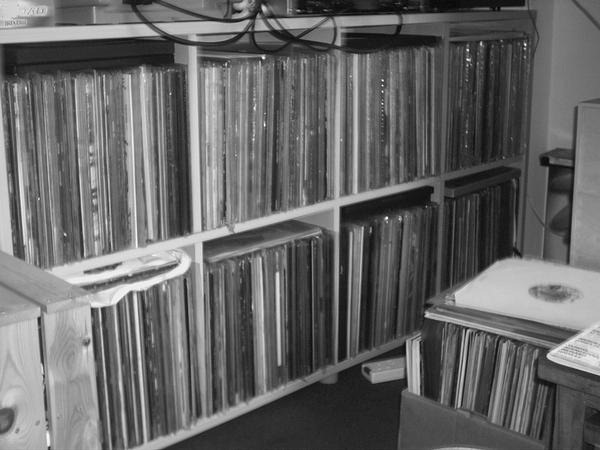
I’m aware of the issues of storage, perhaps more than most. 1,500 or so LPs and 12” singles, 600 7” singles and in excess of 2,000 CDs are a real bastard to house in a two-bed terraced property, and to move when it comes to relocation. But at least I know where my money’s gone and what I need to insure. Picking up a storage device no bigger than an audiocassette knowing that it contains not only my entire music collection, but also music to the value of something in the region of £30,000 is almost inconceivable. The same is true of a virtual library. The fact that a fire tearing through the house would – or could – have the same effect regardless of my choice of ‘file’ type is really beside the point.

It’s curious to note how times have changed: time was when an extensive library of books and an expansive record collection were perceived as accomplishments. They inspired respect, even awe. Now, the owners of large volumes of material possessions are considered to be simply behind the times, information dinosaurs plodding a Luddite land of clutter that’s cumbersome and difficult to navigate. Why would anyone want a 10-volume encyclopaedia when mankind’s entire learnings can be obtained on-line via Wikipedia (or other sites if more specialist knowledge is required, but why would you want that, really, unless you’re a real nerd)? In fact, what’s the point of a space-hogging PC base unit and monitor when you can have everything you need on a tablet? A music collection and library that not only occupies considerable space, but cost a fortune and took a lifetime to accumulate seems entirely redundant beside a small, flat piece of digital kit that costs around £300 and can be transported anywhere. And I suppose if you’re happy or able to accept a life of precarity, instability, endless mobility, that’s fine, but it’s not for me.

In fact, for many, owning music seems superfluous when you can stream it all via Spotify. It frees up funds to purchasing other ephemeralities and experiences. Again, the idea of a life recorded on Facebook is one that doesn’t appeal to me. The public nature of the medium aside, I struggle with the concept of a reliance on something that may disappear at any time. If there’s one thing we’ve learned in our world of rapid development is that technology attains obsolescence at an evermore speedy rate. There was a time, believe it or not, when the 8-track, the cassette and the videotape were all cutting edge. Betamax, laserdisc and minidisc were all the future, yet despite the qualities these media offered, early adopters were left out of pocket and out of style, not to mention out of the technology loop. CD was supposed to supersede both vinyl and the audiocasette – yet strangely, the MP3 killed both CD and tape while vinyl hangs in there, with a whole new wave of audiophiles sustaining a market that previously didn’t exist. I digress: the point is that Facebook could be next year’s MySpace, and a life on line is only a transient representation of real life: it’s a history that can not only be easily misrepresented and misappropriated, but one that could even more easily be erased. Obviously, nothing’s forever, but the physical – especially if backed up, duplicated somehow – has a greater capacity to be futureproof than anything that relies purely on the intangible (but then I find the idea of playing a virtual guitar while playing at being in a virtual band equally abhorrent and not just a little strange Step away from the console, pick up a real instrument, learn to play and form a proper fucking band if you have any interest in Rock Stardom!).

I’m not doing technology down as such – at all, in fact – but can you imagine future generations, instead of looking through albums and biscuit tins of family photos and shoeboxes of postcards and correspondence, gluing themselves to a screen and reminiscing about the day that prompted that romantic email, the wonderful day out to the coast captured magnificently in 6 megapixel digital colour, or even the idea of returning to that book you so loved in college and forwarding your friend or child the Kindle download to read and share the wonder? In all of the streamlining, the decluttering, something has been lost. An on-line playlist is not a direct or equal substitute for a lovingly-compiled mix-tape with lovingly-written, hand-scribbled notes on a piece of paper torn from an exercise book and inserted, tightly-folded, into the plastic case. If, as Marshall McLuhan suggested, the medium is the message, what sort of message is a medium that’s so theoretical say about our times and its users?

The bottom line is that if I’m spending money on something, I want something to show for it. I’m not suggesting that it needs to be big to justify the expense, but in a world where so little is fixed, stable, reliable, there’s a lot to be said for keeping it real as a means of keeping it grounded, and as a way of keeping it accessible in the future.


Vinyl


100_0044


And if you’re loving my work, there’s more of the same (only different) at Christophernosnibor.co.uk.

Sales Fever! Looking Back on Christmases Past

I spent a large chunk of my day today at an out-of-town retail park, where I parted with a small fortune. It was hell on earth, but needs just: I’d been planning to sort myself a new laptop, printer and external hard-drive (I’ve learned – and re-learned – the hard way the importance of backing up all of my work) for months and had been stalling (and saving) for the sales because, being on a budget wanted to make my money go further. And so it was I returned home with an ASUS X53U, an HP Photosmart 6510 and a Samsung hard-drive that measures roughly the size of my wallet and has a whole Terabyte capacity, plus various other non-computing related items for the house.

Needless to say, it was a relief to get home again, and having reserved most of my items on-line in advance, the excursion kept the trudging and legwork and general pain to a minimum. But while out I was acutely aware of just how many people are out there raiding the sales just because goods are discounted, a point reinforced by endless footage n television. Haven’t people got anything better to do, and why do they feel the need to spend money just because? The justification that a £200 jacket had 50% off doesn’t wash – or dry-clean – when considering the flipside of the equation, namely that there’s still 50% on. The last I heard, we were in the middle of a financial crisis. Are people really still dim enough to max out their credit cards just because they can’t resist a ‘bargain’? It would appear they are.

So once again I was reminded that people are idiots, and of the adage that a fool and his money are soon parted. I was also reminded of a blog I posted back in the MySpace days, which I found on my old (and now full to capacity) 300G hard-drive. It may have been posted on this day in 2007, but most of the points still stand, and it’s somehow comforting to observe how little I’ve changed my position. I like to be consistent (although I have taken time off work this year)….


Sales Fever! (2007)


The fact I haven’t been present on-line for the last couple of days shouldn’t be misinterpreted that I was busy wholeheartedly embracing the traditional Christmas rituals. I don’t absolutely hate everything about Christmas, and for me, it’s a good opportunity to spend a couple of days not straining my eyes in front of the PC and to actually have something approximating a rest.
 
Still, because I don’t consider Christmas to be quite as big a deal as many, and don’t consider it a reason to go on a month-long bender with everyone I’ve ever met, and don’t feel the need to eat my own body weight in poultry and pork, I didn’t feel the need to book the days between Christmas and New Year off work. Being at the office – a place I abhor with a passion – is always more bearable when there’s no work, no phone calls and no other staff in to drive me to distraction with their inane waffle.
 

Business as usual it isn’t. and while I’ve been able to potter around without distraction and amuse myself by switching the contents of people’s drawers and so on, I’ve also given a thought to those thousands of people who work in the retail sector. As I’m writing this on January 27th, I’m quite relieved to be hiding out in an office: I learned from Breakfast on BBC1 that today was expected to be the busiest shopping day of the year. And the footage I saw of the queues and the rucks on Boxing day were disturbing enough. It raised a few issues, not least of all the question ‘why?’ I mean, after a month of intensive shopping, why would anyone want to go shopping through choice? It’s insane. We’re a nation in financial crisis, in case no-one had noticed. But then, it’s this inherent greed and an inability to say ‘no’ – or to be seen to be unable to keep up with the pack – that’s got us here in the first place.
 

But irrespective of whether or not we (collectively) can afford to splurge, one would think that the last thing anyone would want to do after a period of intensive shopping in the run-up to Christmas is go shopping. I mean, it’s hell. It’s not so much a jungle out there as it is total war. There was an item on Breakfast in which some ‘fashion guru’ was giving tips on how to succeed in the sales, revealing a handbag full of energy-giving drinks and snacks (‘bananas are great for energy…’) and advising that in order to grab that must-have bargain, if you need to kick or punch, then so be it. To condone or promote such behaviour is beyond me. It’s not a loaf of bread in the middle of a famine, it’s a fucking handbag. Let’s get things in perspective here.

Despite my general disregard for many of the traditional aspects of Christmas, this eagerness to hit the shops on Boxing day or the day after is concerning. One issue is the fact that people seem to expect shops to be open all the time, and we do appear to be very slowly heading the American way, toward a 24-day society. The demand is for convenience, and that demand is coming to be supplied. And why not? Well, it’s all very well to demand, and to receive supply, but what of those who are required to deliver that supply? I’m talking primarily about those in retail here, of course, because 24-hour shopping requires 24-hour staffing of shops, but there’s inevitably a knock-on effect. We already have 24-hour / overnight couriers and so on… and where’s it going to end? And 24-hour is one thing, but what about 365-day-a-year?

Time was when everything closed on Sundays and Bank Holidays. Now, banks are about the only things closed on Bank Holidays (well, the clue’s in the name). A friend of mine said “they’ll have us working on Christmas day soon, mark my words.” Now, he’s a cynical old goat, but I think he may have a point. And similarly, the synchronicity of Christmas and the exchange of gifts may actually become a thing of the past the way things are going.

Consider the facts: the January sales now start on Boxing day. December 27th is the biggest shopping day of the year. Many take unwanted gifts back and exchange them for things they ‘really’ want in the sale, and I’ve heard a number of people say they’re waiting till the sales for their presents. So it’s not that much of a stretch to see, 10 years hence, people going shopping on Christmas day when the sales start, perhaps having a slap-up meal in the evening, and exchanging gifts on New Year’s eve, with New Year’s day remaining the only day the shops are closed because half of the population’s too hungover to go shopping. Of course, the reaction to this may eventually be to put the sales back to January again, and dog knows what kind of mayhem or rioting may ensue as a consequence.

The trouble is, the people who are at the head of the queues, who will punch and kick and trample to get their bargains and are demanding most vocally to be supplied appear to the, somewhat ironically, the same people who most rigidly adhere to the notion of a ‘traditional’ Christmas – extended family round for dry turkey and Aunt Bessie’s roast potatoes, followed by falling asleep in a cloud of flatulence in front of Eastenders, before re-enacting Eastenders with a major drunken barney of their own over something petty but that will prevent the different factions within the family from speaking to one another until the same time next year.

I’m not defending Christmas as a religious holiday of course, but given that I’m of the opinion that people should hibernate during the winter months, do think that in terms of maintaining a work/life balance, the demand for everything on tap at all times there should be some time off.

So I’m keeping out of it (I’ve quite enough handbags already, thank you). But alas, I may not be able to avoid the sales entirely. Whereas I usually receive more calendars than I have rooms in the house, this year I didn’t receive a single calendar. Ok, so I’ll buy my own. I just hope I’m not too late and won’t have to end up with a Russell Brand picture calendar.


And if you’re loving my work, there’s more of the same (only different) at christophernosnibor.co.uk


2011: A Year in Books

When I’m not busy writing, there’s nothing I like more than immersing myself in a good book. In fact, just as I’d describe myself as a compulsive writer, so I’d also describe myself as a compulsive reader. At times, it’s something that can prove to be something of a curse, as I’ll find myself distracted by any text within – or even just beyond – my range of focus. For his reason, rolling news channels can really test me, especially if the screen’s behind the head of someone who’s talking to me.

As a rule, I’m rather a ‘glass half empty’ sort of person, but this year, having found myself required to spend more time travelling to and from places of work (albeit for the same desultory pay-packet), I elected to make the best of a bad situation and use the time in transit to squeeze in a spot of light – and not so light – reading. Here’s a list of the texts I managed to plough through. A handful were re-reads, others were texts I’d stalled on previously and decided to attempt again (successfully this time) and others had been lurking on my shelf for some time. While I enjoyed some more than others, they all had their merits and enriched my life in some way during the last 12 months, and as such, I would happily recommend every last one of them.

Jarrett Kobek – HOE #999

Dennis Lehane – Shutter Island

JG Ballard – The Drowned World

Gary Cummiskey & Eva Kowalska (eds) – Who Was Sinclair Beiles?

James Wells – Hack

Alain Robbe-Grillet – The Erasers

Bill Drummond – $20,000

Chuck Palahniuk – Diary

Frank Kermode – Modern Essays

Mary Beach – Electric Banana

Carl Weissner – The Braille Film

Katrina Palmer – The Dark Object

JG Ballard – High Rise

Stewart Home – Memphis Underground

John Wyndham – The Day of the Triffids

Edward S. Robinson – Shift Linguals: Cut-Up Narratives from William S. Burroughs to the Present

Raymond Chandler – The High Window

Alain Robbe-Grillet – Jealousy

Ed McBain – Sadie When She Died

RG Johnson – American Scrap-Dragon

Mike Meraz – Black-Listed Thoughts

Mark Merlis – American Studies

JG Ballard – The Complete Short Stories Vol. 2

Plato – The Symposium

Roland Barthes – Mythologies

JG Ballard – The Day of Creation

Michel Foucault – Language, Counter-Memory, Practice

Kathy Acker – Bodies of Work

Mark Fisher – Capitalist Realism: Is There No Alternative?

Michel Foucault – The Will To Knowledge 1: The History of Sexuality

JG Ballard – The Atrocity Exhibition

Robert Lort (ed) – Azimute: Critical Essays on Deleuze and Guattari

Chuck Palahniuk – Lullabye

Shakespeare – The Tempest

Stewart Home – Blood Rites of the Bourgeoisie

Nick Kent – The Dark Stuff

Valerie Solanas – S.C.U.M. Manifesto

Ivor Southwood – Non-Stop Inertia


Inertia


And if you’re loving my work, there’s more of the same (only different) at Christophernosnibor.co.uk

Compare and Contrast: The Fall (again) vs Pavement

If Mark E Smith’s words were to be believed, every band sounds like The Fall in some way, shape or form. Every act from the last thirty years has ripped them off, apparently, such is the enormity of his band’s influence. Seminal as they are, this is patently untrue, but Pavement acknowledged their debt to the band, with the track from their debut album Slanted and Enchanted being more of a tribute than a rip-off.

So as much as a case of compare and contrast, this post’s about enjoying two cracking tunes for the price (and chords) of one.


And if you’re loving my work, there’s more of the same (only different) at Christophernosnibor.co.uk

Lost in Music: Christopher Nosnibor’s Picks of 2011

I could wax lyrical about what an exciting year it’s been for music (if you look in the right places), or ramble on about how, having been exposed to so much new music and having attended an insane number of live shows in the last 12 months, that it’s hard to remember it all, and it would all be true. But it’s also rather redundant.

Similarly, I could give a brief two-line summary of each of the items in these lists, but I’d only be repeating myself, given that I’ve posted reviews for everything here. In fact,. I’ve posted in excess of 400 reviews since the year started. Most of them can be found at Whisperin’ and Hollerin’, but there are others scattered here an there across the Internet, notably at Music Emissions and here on my blog.

Suffice it to say that rather than being designed to impress with my ultra-cool or right-on selections, these lists are entirely personal based on what’s stuck with me or impressed or excited me during 2011 – which is why the albums that will make all of the other lists, such as those by Wild Beasts and Kasabian, both of which I panned, aren’t here.

Gigs are listed in chronological order; albums are in no order whatsoever. I couldn’t really pick a favourite, and they’re all great.


Gigs of the Year

Tears of Ishtar / The Falling Spikes – Fibbers, York, 19th February 2011

British Wildlife Festival VI – Brudenell Social Club / Royal Park Cellars, Leeds, 5th March 2011

Interpol – O2 Academy, Leeds, 22nd March 2011

TV Smith & the Valentines – The Duchess, York, 23rd March 2011

Earth – The Well, Leeds, 1st April 2011

Hawk Eyes / Castrovalva / Blacklisters / Dolphins – The Brudenell Social Club, Leeds, 22nd April

Rolo Tomassi – The Well, Leeds – 11th May 2011

Unsane – Brudenell Social Club, Leeds, 11th July 2011

Melvins – Leeds Irish Centre – 2nd November 2011

The Twilight Sad – The Duchess, York, 20th November 2011


Bubbling under: The Primitives / The Duke Spirit / Club Smith / Alvin Purple / Honeytone Cody / Viewer / Her Name is Calla


Albums of the Year

Amplifier – The Octopus

Cold in Berlin – Give Me Walls

Take a Worm for a Walk Week – TAWFAWW

Earth – Angels of Darkness, Demons of Light 1

Gay For Johnny Depp – What Doesn’t Kill You, Eventually Will Kill You

Scumbag Philosopher – It Means Nothing So It Means Nothing

We Are Enfant Terrible – Explicit Pictures

OvO – Cor Cordium

Dark Captain – Dead Legs and Alibis

Mika Vainio – Life (… It Eats You Up)


Bubbling Under: far too many to mention!


l_6800219e0d5c452ea179984c6b3b8698


And if you’re loving my work, there’s more of the same (only different) at Christophernosnibor.co.uk
Reflection of the Television: The Best House is Where the Heart is….

It’s broadly accepted that daytime television is trash. As a student, I recall mornings spent in front of ‘Supermarket Sweep’ and ‘This Morning with Richard and Judy’, shivering in my cold, damp student digs and being vaguely aware of my brain and muscle tissue slowly withering. So to clog cyberspace with an article bemoaning the depressing vacuity of daytime television would be about as vital as announcing excitedly that the earth is round.

Nevertheless, these things gnaw away at a person’s insides. At least back then daytime television made an attempt to be entertaining, and to be original (albeit often within the comparatively limited scope of the quiz or game show format), and the producers did make an effort to find suitably flamboyant hosts, however tango-tanned and inane. But as is the postmodern malaise, the acceptance that we have reached the end of originality – and what’s more, originality is too expensive to develop when quick profits for minimal outlay are the order of the day – has permeated every aspect of our culture.

And so it is that having moved on from game and quiz shows to so-called ‘reality’-based shows, daytime television has descended further still into an endless slurry of its own recycled making.

Not so long ago I was complaining about the low-grade ‘antiques’ show ‘Secret Dealers’ where there was nothing remotely secret about any of it while the so-called ‘experts’ trawled round the home of a member of the public and made offers on their belongings so they could then sell them on for their won profit. Being an amalgamation of various other programs based around people flogging off all of their worldly possessions for some cold hard cash they could use to ‘treat the grandkids’ or ‘go on a cruise, a holiday of a lifetime’ or something equally ephemeral that’s hardly a substitute for the family heirlooms.

I recently stumbled upon the latest stripped-down to moronic basics rehash of a tried and tested formula in the form of ‘May the Best House Win’. Basically, it’s a remake of ‘Come Dine With me’, the show where strangers spend a week taking turns to host a dinner party on which the other contestants score the host’s even out of ten and the winner – i.e. the one with the highest score – wins a grand (a large chunk of which they’ve already spent on lavish food and wine in order to impress their guests). ‘May the Best House Win’ follows the same format, only without the dinner party. Or the social interaction. This means that the contestants troop round one another’s houses, like some open-house viewing, neb round and criticise their choice of wallpaper and carpet, making inane critical comments like ‘for me, lampshades is a thing of the past’ before giving a mark out of ten for said abode. This is repeated for all of the competing homes and the house that scores the highest wins its owner some cash.

And that’s it.

It’s like ‘Through the Keyhole’ without any of the mystery or the celebrity allure. And it’s simply a means of justifying some misguided snobbery about individual and subjective tastes. All of the contestants mark their opponents down because it’s in their own best interests to do so, justifying their scores of four and five with remarks like ‘it’s ok, but it’s not really to my taste’ (which is only to be expected because it’s someone else’s home and not yours), but with the subtext that they are in fact supremely jealous that their opponent has a billiards room and private cinema that pisses all over their 52” plasma hung over the wood burner in the recently knocked-through living room. The winners invariably have large homes decked out to ‘high-end’ specification that’s all about style over function.

Instead of ‘who would live in a house like this?’ the question is more a case of ‘who would apply to appear on a show like this?’ Everyday people, of course – everyday people with a bit more cash who want to nose around other peoples’ homes and show their own off on national television. Strange that none of the houses look anything like my bog-standard two-bedroom mid-terrace, for example. Well, no, it’s not really. ‘Average’ simply won’t do: how will that impress anyone? It’s all about the ‘wow factor’. Besides, ‘stuff’ just isn’t done (where the hell do these people put their possessions?). But then, no-one’s going to sign up just to be subjected to ‘Look at all those unsightly records and books… and that bulky hi-fi. They should just get rid of it all, get a Kindle and rip it all to MP3, then the music can be piped into every room with some hidden speakers through an i-Pod docking station… A PC? How retro! So last century. Completely impractical, though, so bulky. You need an i-Pad…’ It’s all about nondescript colours and clean lines, about having a living space that resembles any 5-star hotel around the globe. Size matters.

Just as magazines ranging from Real Homes to Tatler aren’t really about sharing design tips, so ‘May the Best House Win’ adds a competitive element to vulgar vanity. But hey, it keeps the nation passive and numbs the nation’s unemployed, preventing them from rioting or otherwise expressing their discontent at the appalling state of things, while at the same time giving them something to aspire to. And if they can’t get off their arses, get well-paid jobs and ultimately achieve all the trappings of status in order to get their fifteen minutes of fame, well, there’s always ‘Jeremy Kyle’.

And if you’re loving my work, there’s more of the same (only different) at Christophernosnibor.co.uk

No Win in Winter: Taking Leave of the Compulsory Festive Fun

Being the kind of writer who doesn’t sell enough books or writing to cover the bills, I find myself forced to take on regular work in order to stay afloat. Sometimes I’m fortunate enough to find work that utilizes my literary and / or academic skills, but not always. Sometimes, I find myself juggling multiple posts, because, well, needs must.

One feature of office work around this time of year is the inaugural Christmas party. More often than not, that’s parties, with departmental nights out, team nights out, and any half-arsed excuse for people to hit the boozer at lunchtime or immediately after knocking off early.

I’ve always avoided these events like the plague. I have attended one or two during the course of my working life, and have usually felt compelled to make my excuses and leave just as things are warming up, i.e. before someone punches me in the face, makes a serious tit of themselves, gets us kicked out or pukes over their – or my – shoes. As a consequence, the worst I’ve had to endure on my return to work is mild abuse for being a killjoy or a lightweight, and while I’m most certainly no lightweight (I simply happen to know my limit and stick to it rather than letting things get out of hand), I guess I’m happy to wear the ‘killjoy’ hat if by ‘killjoy’ it’s meant ‘person who gets out before it gets too crazy’. In fact, leaving the rest of them to have their fun at whatever cost to themselves rather than nagging them not to behave like imbeciles is surely the opposite of killjoyism, but I digress.

So it was that on Friday I found myself on the bus back into town in the company of a friend of mine and some of his colleagues. They were going out for a meal, but before that, some drinks. It was 4pm. I, on the other hand, was going to pick up some milk, go home, cook for my family and get down to some writing and various other pressing things.

Disembarking, we parted ways and bid one another farewell, and I was momentarily resentful of my fiend’s active social life and the fact he has connections with enough social and work-related groupings to see him out doing Christmas-related socialising at least two nights a week throughout the whole month of December, in contrast to me, who declined the one crappy offer I did get, because, well, it would have been hell. So what’s my problem? Well, for starters, just because I don’t want to spend insane amounts of cash on crap nights out in loud bars in the company of tossers who can’t handle their drink or their emotions, it doesn’t mean I don’t want to participate in the faux revelry and put-on camaraderie – but I would like to socialise with the people I likie in places I like. The trouble is, all of my friends are busy, for the most part spending insane amounts of cash on crap nights out in loud bars in the company of tossers who can’t handle their drink or their emotions. So, if you can’t beat ‘em… No, fuck it, even if I was invited, I wouldn’t join ‘em. So call me bitter and awkward if you like and see if I care.

As I carved my way through the crowded city centre, packed with Christmas-shopping tourists, gaggles of students not long out of school or college, and early doors workers descending on the hostelries and eateries to begin their merrymaking, I felt the tension rising within me. I could barely move it was so crowded, and while I’m no agoraphobe, I do find crowded places – other than gigs – stressful environments.

It didn’t take long to dawn on me that while I enjoy socialising and would broadly jump at the opportunity to sample the range of seasonal ales on offer, I can only enjoy myself in the right environment and in the right company. Works nights out invariably mean being pressed into close proximity with the crets you work with and despise all day every day: why the hell would anyone want to prolong the experience? Add to that the fact the setting are always lowest-common-denominator mass-market pubs and chain restaurants that offer group discounts on cheap and cheerful (microwaved) food, and my resentment of my friend dissipated rapidly.

It wouldn’t be me with a raging hangover and gaping hole in my finances the following morning, even if he did succeed in avoiding any of the kind of embarrassing situations that would see him all over Facebook and publicly humiliated by half the globe before he’d even woken up, and subsequently derided mercilessly for the next three months by all and sundry. Yeah, I’m happy to stay in, sup a few bottles of homebrew and enjoy a quieter night in. The pubs can wait until January, when I can go and sit on my own with a pint and read a book in peace. Ahh… cheers!


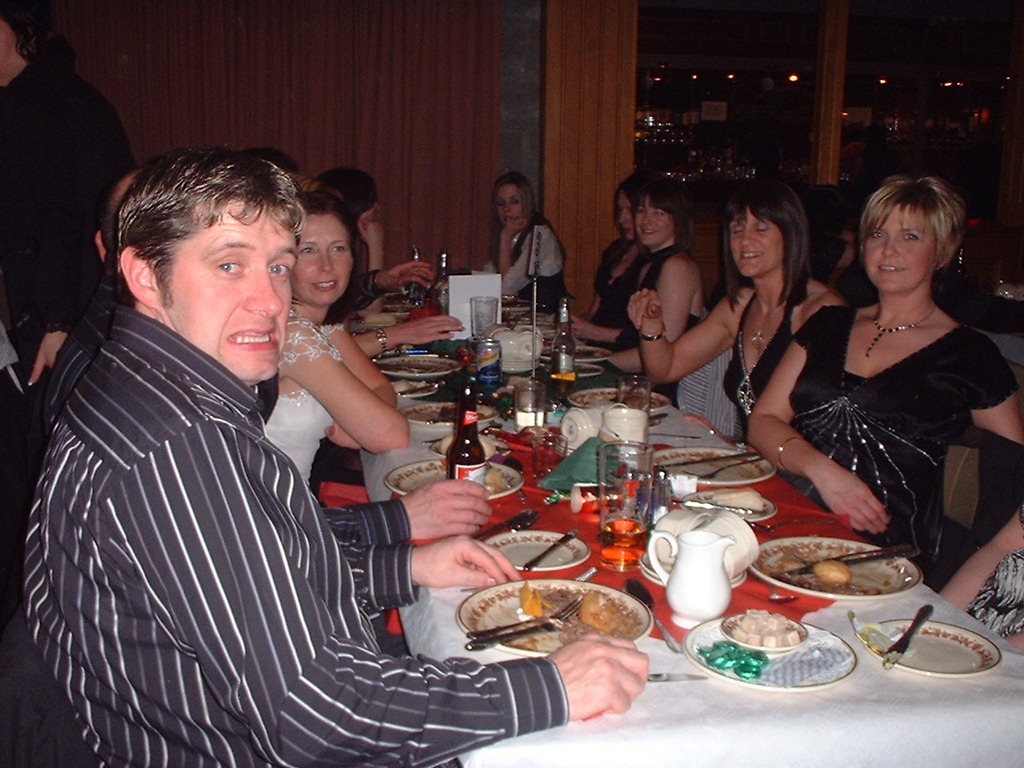
Christmas Night Out

Above: some people having a blast at a Christmas meal. Don’t you wish you were them? Image courtesy of the Internet.

And if you’ve loving my work, there’s more of the same (only different) at Christophernosnibor.co.uk

The Changing Face of Consumerism VIII: State of Independence, or, All’s Well at The Inkwell

The seven ‘Changing Face of Consumerism’ articles I ran on MySpace in 2008 and 2008 all shared a common theme, namely lamenting the sad decline of the real – both in media and commodity, with ‘reality’ television being a pisspoor ersatz approximation of any reality I’ve ever known, and ‘real’ shopping experiences being slowly subsumed by the virtual marketplace.

Don’t get me wrong, I’m all for progress, and have long been a big fan of on-line shopping, being one who doesn’t cope well with crowds or endless hours of pavement-pounding in search of goods, but by the same token, I’m a strong advocate of consumer choice. Despite what the global marketplace on-line tells us, we as consumers do not have infinite choice, not least of all because while some niche outlets fare well on-line, many have gone to the wall because the same kind of corporate giants that slowly erased all of the small independent stores from the high streets of each and every town have steamrollered the little on-line traders out.

As city centres everywhere become identikit clones of anywheresville, so our sense of location becomes diminished: the only thing to differentiate, say, Leeds from Lincoln, isn’t the choice of shops, but the size of each branch, and after a mooch round M&S, Boots, Game and HMV, stopping for a uniform coffee in a Starbucks or Costa before going on to… well, it doesn’t matter. I mean it really doesn’t matter where you are, the experience is pretty much the same. Fine, so you know what you’re going to get, but the experience of discovering a little specialist shop tucked away somewhere is radically different and appeals to a whole range of senses. However hard Amazon try to replicate the browsing experience of specialist independent book and record stores with features like ‘look inside’ and the song snippets you can listen to, in addition to the list of recommendations based on what you’re looking at and what other shoppers have also purchased or viewed that functions as a mimesis of the friendly and enthusiastic guy behind the counter who just loves his books or music and knows everything there is to know, like a living, walking encyclopedia, it just isn’t the same. There’s no substitute for browsing.

And so it was that I was practically skipping when The Inkwell opened in York a few weeks ago. A little shop stocking secondhand books, records (with a few selected new titles), CDs and cards, it’s the kind of shop you used to drop into, rummage around and find something wonderful you didn’t even know you wanted. The owner, Paul Lowman, is clearly an unashamed enthusiast first and a businessman second, and while such a venture is the kind that will never make him rich, and would make many lenders and entrepreneurs alike squirm in discomfort, it’s a shopper’s delight. Perhaps not surprisingly, The Inkwell is aimed at a niche market (by which I mean discerning shoppers: Paul’s philosophy is according to the website, “COOL STUFF FOR ALL!” Popular Culture is about democracy – inclusivity, not exclusivity) specialising as it does in books on music, film and pop culture, with sections on the Beat Generation, Art, Philosophy and a noteworthy – not to mention impressive – selection of pulp paperbacks, all in remarkably good condition (yet reasonably priced, with titles marked up at between six and ten quid).

The vinyl, too, is all in great nick, and the range, though limited, is all about quality and catering to a particular kind of discerning alt/hipster customer. There’s no mainstream pap to be found on the racks: instead, there are sections devoted to Garage, Psych, 90s Indie, Spoken Word / Comedy, and even Burlesque. Yes, if you want the kitsch sleaze of yesteryear, then the range of sexploitation titles in both audio and written media is exceptional.

It’s a tiny little place, made all the more cramped by there being a pair of school desks in the middle of the room, upon which a choice of books are casually laid. It’s all about the browsing experience (they serve coffee too), and an eclectic mix of music is spun – at high volume, and all on vinyl, naturally – on the turntable in the corner by the counter. Of course, it’s simply one’s man’s vision, one man’s obsession made manifest… but what’s wrong with that? But equally, why should a shop such as this succeed in a climate where major chains are going to the wall? The answer, I believe, is simple. In attempting to appeal to everyone, the major chains ultimately cater for no-one. In aiming to cover a vast market based on some kind of assumed generic average consumer and broad populism, the chains become Xerox copies of one another: reliable, perhaps, but ultimately forgettable and wholly impersonal. A shop like The Inkwell isn’t about conquering the world or trying to cater to all tastes: it knows its market and knows it well – because by being the shop its owner wants it to be, it’s catering for like-minded individuals (there’s that word again!). It’s unique in every way, and every item in stock is essentially a one-off. It has the personal touch and is memorable. And that’s why it has a better than average chance of success.

So, on the opening day I left with a brand new hardback copy of Brion Gysin: Dream Machine (a bargain at a tenner given that it retails at £25), a read but respectable copy of The Dark Stuff by Nick Kent (£3) and a vinyl LP – a copy of Fade Out by Loop, again in top condition (EX as Record Collector would have it), for a fiver.

I returned this week and was pleased to see some of the stock had gone and new stuff had taken its place, meaning I was able to add a copy of the original 1971 Olympia Press edition of S.C.U.M. Manifesto by Valerie Solanas to my library. The tenner asking price was more than fair, especially given the condition.

Does The Inkwell represent the vanguard of the counter-revolution in the world of retail? Perhaps not, but I’d like to think that other independent stores will begin to pop up, not just in York, but in every city, and soon. It’s unlikely that this is how the economic situation will be recovered, but being able to rifle some good books and records in a pleasant environment certainly makes these dark times a lot more bearable.

The Inkwell Online is cool – www.ink-well.co.uk – but not nearly as cool as being there.


Inkwell


And if you’re loving my work, there’s more of the same (only different) at Christophernosnibor.co.uk

Too Busy to Blog!

For many writers – both accomplished and aspiring – a common obstacle to productivity is inspiration. Most people run dry at some point. It’s not a brag when I say that this isn’t a problem for me: no, my real problem is time. There simply isn’t enough, and there are only so many ways to stretch it.

Over the past few years, a fair few people have asked me how I manage to maintain my output, how I find the time. The answer has always been that I make time, and type quickly. But then, every now and again, it becomes insustainable, and when it does, something’s gotta give.

I didn’t set out to become a music writer: it was something I once dreamed off, made a few stabs at and did on a very part-time and voluntary basis for a couple of local and regional papers back in the early 90s before giving it up. My applications to music papers for paid work had been unsuccessful, to the extent that none of them had even bothered to reject me, and I decided it was simply too competitive for me, a person who’s not particularly competitive by nature. Moreover, not given to being all that outgoing, and steadfastly refusing to suck up or otherwise ingratiate myself, I decided music journalism wasn’t the career for me. I was 25, working full time and studying at the same time, and in my spare time, attempting to carve out a novel. I was going to be a proper writer!

It took another five years to get my first book, Bad Houses out into the world, and the novel I had been working on, Exiled in Domestic Life, along with its sequel, Rusty Bullet Wounds, remains languishing, unpublished. Still, a lot’s happened since then, and while I have received some help and support – not to mention invaluable exposure – from people who I’ve encountered along the way, my weekly blog on MySpace did contribute considerably to whatever readership I achieved.

People are always going on about the importance of maintaining a blog as a means of building and maintaining one’s profile, and at the time, it seemed that they were right, but when the MySpace community dissolved before my eyes, so the hits to my blog plummeted. Rebuilding a readership from scratch just felt like too much effort for questionable reward, and by this time I had begun reviewing for Whisperin’ and Hollerin’, something I had fallen into quite by accident, but it felt good to be reviewing again. It had been noticeable that the reviews I had posted on my blog had been the least successful by miles, receiving half the hits of my rants. Having a proper outlet for the reviews was an extremely positive thing, and besides, it meant that even if I wasn’t being paid, I was getting free CDs and entry to gigs – plus being able to say that I was a writer for a recognised site meant I was able to approach PR companies directly and have them add me to their mailing lists. This meant even more freeness.

At present, I’m managing to review approximately half of the stuff I get sent, and given that I’m kicking out an average of one to two reviews per day, you can get an idea of just how much the reviewing gig’s grown in the last couple of years. But I don’t want to be known simply as a music writer: I do still write fiction, after all, and have some pretty hefty projects in the works, with the story ‘Corrupted from Memory’ which appears in the new Paraphilia anthology A Dream of Stone being the first of a new wave of fairly dense pieces penned recently.

Then there are the interviews. I’d be daft to turn down the chances I’ve had to meet up with various bands, or to conduct email interviews with Malcolm McNeill and JG Thirlwell. They’re once in a lifetime opportunities. None of them came about because of my blogging, though, and finding the bile to spew out a weekly rant in a blog just wasn’t something I had in me.

The discipline of maintaining a regular blog is healthy for a writer, primarily because it’s so easy to procrastinate, defer and postpone: a commitment to produce a piece each day or week can be a great motivator and can provide the impetus to knuckle down to writing and attempt something new. By the same token, it can all too easily become an obstacle to producing anything else, with the main work becoming sidelined by the thing that’s supposedly a mode of liberation and promotion. Moreover, in churning out pieces on not only a regular but a frequent basis, it’s easy for the quality of output to suffer and to find yourself saying the same thing. If it gets boring to write, it’s going to be equally boring to read: if and when that moment arrives, it’s time to quit.

I had other reasons to quit, or at least cut back though: well, something had to give. I’m no longer studying, but am still working full-time and then some. I can’t not: there are bills to pay, and very few writers actually get to make a living from it. Besides, getting to teach English Literature to undergraduates, albeit on a part-time basis, is often rewarding, but make no mistake, it’s hard work, especially in conjunction with holding down another job at the same time. So how do I find the time to write? Make time, and type fast, of course. But without blogging, at least as often. Has it damaged my readership? No, I don’t think so, and while I receive more hits to my site via searches for ‘Christopher Nonsibor reviewer’ and Christopher Nosnibor Whisperin and Hollerin’, I still get the same number who arrive at my site having searched for ‘Christopher Nosnibor writer’ or for one of my books (more often than not THE PLAGIARST).

But then, I’ve recently found myself wondering if maintaining a blog is as important as it used to be – not just for me, but in general. I still read voraciously, but the number of blogs I read has diminished, and I instead prefer to read a small number irregularly, rather than a large number regularly, partly because many of the blogs I follow tailed off around the same time I allowed my blogging activity to become less of a feature of my writing output. Is the golden age of blogging over? Does it really matter? A world in which everyone has a blog is a cluttered one, but shouldn’t be mistaken for a well-informed one. Knowledge may well equal power to an extent, but with no shortage of blogs brimming with ill-informed opinions and even outright hateful propaganda receiving ample traffic, it would equally appear that misinformation is power, and besides, who cares about what you’re saying as long as you’re popular. The interest in celebrity blogs and Tweets remains unabated. Ok, so bloggers like myself (i.e. the authors of the blogs I like to read) are never going to be in competition with these ‘celebrity’ retards, and never were, but there comes a time when pissing in the wind stops being fun and simply becomes a thankless slog.

For me, the blog always served a dual function: to vent or to comment on the things I had no other outlet for doing so, and, if I’m honest as an indirect means of promotion. Now, I have other channels for both promotion and venting, and besides, I’ve come to the conclusion that the world only needs so many producers of culture and of comment, given that there are only so many consumers. Personally, I try to do both, but it’s hard to consume while producing. It’s simply impossible to read an article and write one at the same time. So, while I continue to work on the job of perfecting a clone or two to enable me to multitask more effectively, the blogs will remain on the back burner while I crack on with the real work…

And of you’re loving my work, there’s more of the same (only different) at Christophernosnibor.co.uk

A Dream of Stone (and Other Ghost Stories), edited by D M Mitchell and Dire Mccain is out now in the US through Paraphilia Books.