Rage On the Road

They turn up in their cable-knit sweaters and cord trousers to nod amicably to observations about hedgerows in spring. They quaff half-pints of session ale and continental lager, red wine and soft drinks ‘because it’s a school night’ even though half of them are retired. They chat amiably about this and that, this and that, thus and that, primarily who has a book launch event coming up, who’s event they went to and whatever beautifully-crafted collection they’ve just read. It was recommended by so-and so, and so-and-so other did a simply delightful job of the artwork and so-and-so else gave their apologies but had recently had an accident or injury or was otherwise incapacitated or engaged… The poetry set. The ageing, the mumsy, the middle class pseudo-sophisticates… the middlebrow, nicey-nicey, bland-as-fuck head-in-the-sand dinner-party chatterers who think a mild swipe at Cameron set to an acoustic rendition of some 60s pop hit qualifies as edgy, pithy and political…

I don’t sit comfortably with the poetry set. Nevertheless, I occasionally raid their spoken word nights as an uninvited guest. Sometimes, I’m invited to perform, too.

The momentum of the Rage Monologues may not have gathered quite the pace I’d hoped for in the last couple of months, but April’s calendar so far looks rather like this:

April 23rd – Nevermind, York (5-7pm)

April 25th – Basement, York (7:30pm start)

Expect rage. Expect to see me die. Slowly and painfully. Get in touch via Facebook / Twitter / whatever if you’d like me to come and spill fiery venom at your event. Will rant for beer.

All the Rage

I’m not really one for New Year’s Resolutions. Similarly, I’m not one for anything that’s ‘trending’ or could otherwise be considered conventional. As such, I’m weary of the general approach to writing / publishing / performing, even in the lower echelons of the industry. in other words, the deal whereby one writes a book, reads excerpts at various events and spoken word nights, flogs said book, and goes off to write another.

I’m no fan of Jack Kerouac’s writing, which I find tedious and indulgent, but I very much admire the fact he elected to read from an unpublished work, with notes from his as-yet unpublished work-in-progress tucked inside the pages of his breakthrough novel, On The Road, just when he was breaking big. For 2015, I’ve elected to break the cycle of reading from published works, and shall instead be focusing on a work-in progress, that’s geared not toward publication, but performance: The Rage Monologues. There’s theory behind the method, but I’ll return to that later, in another post.

As such, I don’t have any major publishing plans this year, and will instead be taking The Rage Monologues on the road. Many of these performances will be guerrilla works, delivered at spoken word nights to unsuspecting audiences, although planned dates will be posted here in advance.

Be warned, however: The Rage Monologues are seriously nasty and not for wimps. Here’s a taste.


Planned performances to date are as follows:

Platform Thirsk, Little 3, Platform St, Thirsk, 7th March 2015. 7:00pm (7:30 start)

Speakers’ Corner, Golden Ball, Cromwell Road, York. 11th March 2014. 7:30pm (8pm start)

Nevermind, 8-10 Stonebow House, York, 19th March 2015 5-7pm


And if you’re loving my work, there’s more of the same (only different) at Christophernosnibor.co.uk

Christopher Nosnibor’s Guide to Being a Music Reviewer – Part Four

Knowledge is power, or so it’s said. In the music industry, there’s a sort of consensus that it’s now what you know but who you know, and while knowing the right people for bagging the best gigs and high profile interviews can help, gaining the respect of readers is more about what you know. People who read reviews – and a lot of music fans dismiss reviews as pointless, and consider reviewers to be pond-life – expect reviewers to be knowledgeable about music. It’s not such an unreasonable expectation.

After all, you’d expect anyone in any other profession to be suitably qualified and / or experienced. Granted, music reviewing isn’t on a par with being a medic or lab technician, but if someone’s job – paid or otherwise – is to impart critical judgement, you want to believe they have a background that means they understand context. While there are plenty of bozos down the pub spouting shit about football who haven’t got the first clue, anyone who writes a sports column or appears on TV or radio as a pundit has to have more than a pretty face or good speaking voice.

Of course, what ‘qualifies’ someone to be a music critic is pretty vague, but ultimately it’s about the hours put in listening to music and learning about bands and styles – including the ones you have no interest in, including the ones you hate. I make no bones that I’m no fan of The Beatles, but have a rudimentary knowledge of their career path, and know what they sound like and so on.

If anything, I think my own personal knowledge is more extensive than most. I’m a cultural sponge, and still keep half an ear to the chart shit that flops out of the R1 playlist and another on the half-arsed emo cack Kerrang! pass off as rock so much of the time. Because I’m curious. Because I consider it my duty to stay informed. I can’t criticise something I’ve never heard. Which means I’ve tortured myself with Katy Perry and Miley fucking Cyrus in the name of music journalism.

But people have unreasonable expectations. They expect you, as a music writer, to have heard every album, ever. And to remember every song, by title. And in sequence, on every album. They’ll whinge that their favourite album of the year isn’t on your list. It might be great, but you haven’t heard it. The fact you’ve listened to and reviewed over 500 albums in the last 12 months counts for nothing if you haven’t heard and raved about X, Y or Z, which 6 Music and the NME loved. Meanwhile, people in the office who love generic mass-market indie bands and who think The Cribs are off the beaten track and worship Paul Weller, and scenesters who go out to be seen at all the local shows while they talk through every act will be amazed you haven’t heard of their favourite new local band who have only played three shows but are amazing and are already getting quite a buzz around them. That, or the fact Tom Robinson played them and I haven’t a clue who they are… They were on the front of the NME! Kerrang! Featured them last week! They played the local pub last month…. The fact I don’t know who they are, and certainly don’t know their every song makes me the most pointless asinine excuse for a music journalist on the planet. I don’t deserve all these CD and downloads or free gig passes. I should just give up and get back to watching Never Mind the Buzzcocks right now.


Indie

Some generic indie kids, yesterday. Your opinion as a music reviewer isn’t worth shit if you’ve not heard – and raved about – their friend’s self-released cassette, limited to six copies.

2014: A Year in Books

This is categorically not a list of my ‘best books’ of 2014. Very few of the titles I’ve read in the last 12 months were even published this year. This is simply a list of what I’ve read with no judgement implied (although I strongly maintain life;s too short to read crap books, so by default they’re all pretty good).

With my day-job having moved to a different office, I’m fortunate and grateful that I no longer spend an hour a day on public transport. The downside is that the half hour trip each way to and from work was time I spent reading up to the end of June and consequently, I’ve done rather less reading this year than I would have liked.

These are the books I’ve read, which have informed and entertained me this year, and some will have no doubt had an influence – conscious or otherwise – on my writing.

Ben Jeffery – Anti-Matter: Michel Houellebecq and Depressive Realism

Raymond Chandler – Farewell, My Lovely

Jonny Glynn – The Seven Days of Peter Crumb

Ian Rankin – The Naming of the Dead

Henry Sutton – Kids’ Stuff

Aifric Campbell – On the Floor

Gavin Lambert – The Goodbye People

JG Ballard – The Drought

Douglas Coupland – Generation X

Paolo Sorrentino – Everybody’s Right

Samuel Beckett – Three Novels: Molloy / Malone Dies / The Unnamable

Various – Clinical, Brutal 2: Incisive Writing with Guts

Philip Roth – Portnoy’s Complaint

Mickey Spillane – Mike Hammer Omnibus Vol 1: I, The Jury / My Gun is Quick / Vengeance is Mine

Lisa Dabrowski – Dr Sadistic’s House of Whorrors

Martin Crimp – Attempts on Her Life

Chuck Palahniuk – Damned

Malcolm Mc Neill – Reflux

Charlie Wells – Fags and Lager

Beau Rice – Tex

Stewart Home – The 9 Lives of Ray The Cat Jones

Stuart Bateman – Grind

Jonathan Crary – 24/7: Late Capitalism and the Ends of Sleep


And if you’re loving my work, there’s more of the same (only different) at Christophernosnibor.co.uk

Christopher Nosnibor’s Guide to Working as a Music Reviewer – Part Three

No two ways about it, the 9-5 is a pain in the proverbial. No doubt if you’re an aspiring reviewer you’re resentful of the humdrum desk job, bar job, whatever, and who would blame you. Unfortunately, it’s the humdrum desk job, bar job, whatever that pays the bills.

I resent the humdrum desk job as much if not more than anyone, although it was while working my day-job that a not insignificant realisation hit. I’d landed the task of leading a group of colleagues through a session on letter-writing. These are people, adults, who write detailed letters to customers daily. It’s their job. I was shocked, and indeed appalled, to realise just how far back to basics I had to take things.

I found myself having to explain not only the possessive apostrophe, and the difference between affect and effect, but also the definition of a noun and a verb, singular and plural.

I expect the bulk of my readers will laugh or feel a wave of despondency. However, anyone who aspires to be the next Nick Kent and who’s stumbled upon this blog in the hope of finding advice or otherwise gleaning some tips for making it – whatever that may be – as a music reviewer, I will proffer the following: learn to write.

If their / they’re / there is beyond you, give up, immediately. Enjoy the music, but please don’t inflict your illiterate drivel on others.

Similarly, if you’re reading this and have no idea who Nick Kent is, you don’t have a hope. Writing about music requires a knowledge of music, and ideally, a knowledge of music journalism. This is true in almost any field of critique. Yes, it’s all about opinion, but your opinion only has weight if you can qualify if with some kind of evidence. No-one’s going to respect your opinion if you don’t know shit.

Word ends in

And if you’re loving my work, there’s more of the same (only different) at Christophernosnibor.co.uk

Christopher Nosnibor’s Guide to Working as a Music Reviewer – Part Two

We live in a visually-orientated culture. Pictures are more immediate than words. And yet I still don’t get the idea of reviewing a gig in pictures alone. The images convey so little of the experience, and besides, after a while, people with guitars or standing behind synths all start to very much resemble one another.

Similarly, I don’t get the whole deal with people posting photos of their food on social media sites, but did recently suggest that my refusal to subscribe to this trend was proving an obstacle to my achieving mainstream popularity.

So I figured I should document my day – yesterday – in images. Of food. It seems vaguely apposite, as I was assigned to review Black Bananas at the Brudenell in Leeds last night.

I got up a bit before 7am having squeezed in about 6 hours sleep, dressed, guzzled down a mug of tea and was out the door around 7:40. I breakfasted at my desk while wading through emails.


IMAG0073

Breakfast

I managed to nip out to grab a bite for lunch, again consumed at my desk.


IMAG0074

Lunch

After work, I legged it home, dropped my bag and changed my boots before heading straight back out for a train to Leeds. I had my evening meal in Foley’s on The Headrow before trekking out to the Brudenell.


IMAG0075

Dinner


I needn’t have rushed as the first act wasn’t on till around 8:30, but the beer was cheap and good and I always carry a paperback in my jacket pocket in case I find myself killing time.

The show was ultimately enjoyable, but I was aware of the train times and, being knackered, decided to slip out during the last song for the 11:16 train. This meant I had to run all the way from The Brudenell near Burley Park to the train station. Consequently, I was even more knackered but I arrived back in York in good time and arrived home around midnight.

Today, having woken up with heartburn and a head full of things I needed to do at work around 5am, I managed a full half hour lunch break, during which I managed to find a quiet pub and knock out the first 409 words of my review. I can’t very well call myself a writing machine if I don’t get on and write now, can I?


And if you’re loving my work, there’s more of the same (only different) at Christophernosnibor.co.uk

Christopher Nosnibor’s Guide to Working as a Music Reviewer – Part One

For those who think that working as a music reviewer is way cool and involves hanging with bands backstage and basking in free stuff and record company promo largesse, the average online music reviewer leads a very different existence. I’m not saying I’m representative of all or even most music reviewers, but as someone who’s been doing this thing for nigh on 20 years off and on, and has consistently turned in over 300 reviews a year since 2009, I do feel I’m at least qualified to report on my own experiences. Will this blog help aspiring reviewers? Probably not. Is it some kind of therapy session? I have no idea. It’s a blog. It is what it is.

When I started writing in earnest for Whisperin’ and Hollerin’ in November of 2008, I was thrilled to receive a Jiffy containing five or six CDs by artists I’d never heard of, and would never hear of again. I was actually off work with ‘flu when they landed, so I say, huddled in a blanket, streaming snot as I shivered and shook my way through a bunch of fairly bland albums, which I dutifully listened to a handful of times and did my best to give them a fair and honest but critically balanced and objective appraisal. It wasn’t easy, at least for all of them.

I started to receive offers of gigs to review in York and Leeds, too, my nominated / designated territory. Keen to get myself on the register, I took the first few that came up regardless. I wanted to prove myself, to get my name out, to show I was eager and willing, and able to critique anything. And so I did. I saw some ok bands, the majority of which I’ve since forgotten. I saw a fair few shit bands, too, but you gotta take the rough with the smooth, I figured.

Being a serious gig veteran (I started watching pub gigs and so on when I was 14 and saw my first big gig proper – The Mission at Sheffield City Hall – when I was 15) I wasn’t the sort to be swept away on the tide of excitement the inexperienced feel when presented with live music. I didn’t think ‘it’s live, therefore it’s amazing’ and was more than capable or retaining my critical faculties – and memory – even after a few pints.

It’s fair to say things rapidly snowballed.

Cut forward from 2008 to 2014 and I’d like to say the hard works paid off. In some respects it has, in that I now receive more free music than I can physically listen to, and manage to score many of the releases I’d have previously paid for for free. Similarly I can pick and choose the live shows I cover, and get to go and see bands I’d have historically paid for – or even missed because I couldn’t afford a tickets, although I still take punts, and I still review acts I’m either unfamiliar with or largely ambivalent to because I think covering them will help raise my profile.

I still don’t get paid for any of this and I still work the 9-5. Trying to do up a house and be a half-decent parent to a 3 year old with a full-time job is enough for most people. They’re pussies, or otherwise lacking ambition.

Tomorrow, I’ll be hauling myself from York to Leeds and out to the Brudenell Social Club after work to cover Black Bananas. I thought their most recent album was middling, a 6/10 but figure they might be entertaining as a live act. I’ll be going on my own, despite being offered a +1. Because I’m popular like that. I won’t hang out with the band. I’ll get back in around 2am and will be up less than five hours later for work. Because. Cool huh?


johnrobbdec

John Robb: music journalist, band front man and cool. The bastard.


And if you’re loving my work, there’s more of the same (only different) at Christophernosnibor.co.uk

Writing about Writing (Again): A Slap of Reality in a World of Fiction

On TV and in films, and even in many novels, writers are often – if not almost always – portrayed as high-profile media types, living the high-life, traversing here and there in sharp suits and fancy dresses, to interviews, readings, launches and high-profile media events. they’re inevitably best-sellers, and vaguely eccentric, and live in nice, even vaguely grand homes or apartments (if they’re American): they get stopped in the street (and, if you’re Castle, at crime scenes) by fans who simply love your books, live and breathe your characters and want to marry you., or at least have an affair.

Now, I’ll be the first to admit that the literary circles I move in are toward the lower end of the industry. By which, of course, I actually mean they exist outside of ‘the industry’. They work regular jobs, have families and chisel out their works in stolen hours late at night and early in the morning. They do it out of compulsion, a need to purge and splurge, rather than for the money. It almost goes without saying I count myself amongst these. Writing isn’t some hobby or light-relief pastime.

The writers I know and associate with are, believe it or not, more representative of writers than the popular portrayals of writers. With a few notable exceptions – Stephen King, JK Rowling, for example – writers tend to be fairly anonymous. Unlike actors, writers don’t get their faces splashed over huge billboards. Writers aren’t usually the most photogenic of people, which is often why they’re writers and not actors. Do you know what E.L. James looks like? Dan Brown? John Grisham? Jodi Picoult? Donna Tartt? Toby Litt? And these are ‘bestseller’ list authors, not the majority of people who constitute the world of publishing in all its guises.

It’s ironic that actors get paid megabucks for playing out the scenes laid out in the pages of books penned by anonymous writers, and earn significantly more for doing so, given that without the writers, the actors would have no scenes to perform. it’s all about having a face and an image that sells. ‘Game of Thrones’ author George R.R. Martin didn’t get rich posting selfies and posing for Vogue.

Fiction is often escapist: it doesn’t have to be fantasy or sci-fi to take the reader beyond the confines of their hum-drum daily existence. And so it may be that even writers who earn royalties of pence and cents may portray high-living celebrity writers in their works. I have no gripe about that, per se, other than the observation that it flies very much in the face of the first principle of writing, which is ‘write what you know.’ This doesn’t mean fantasy and science fiction are out by any stretch, so much as that it pays to at least research scenarios that exist beyond your knowledge, because a savvy reader can spot a bluffer. Research plus imagination is, of course, another matter entirely and can be the very essence of creative genius.

As such, I resist the urge to yell at the TV when ‘celebrity’ writers are portrayed. Of course, my initial thought is ‘when do these people get to do any writing, given the time they spend travelling around to premieres and being famous?’, but the answer is obvious – namely, the rest of the time. Because unlike the writers I know, they don’t work the 9-5, and their maids and the like take care of the kids while they swan round in the name of ‘research’.

Recent research suggests that the prospects of a writing career are pretty dismal if you’re looking to get rich, even if you do achieve a degree of fame: Prospects.ac.uk report that ‘The median earnings for professional writers (those who dedicate more than 50% of their time to writing) was only £11,000 in 2013, and only 11.5% of professional writers earned their incomes solely from writing.’ The Guardian reports that ‘The typical median income of all writers was even less: £4,000 in 2013, compared to £5,012 in real terms in 2005, and £8,810 in 2000.’

This is nowhere near a luxurious salary. It’s not even minimum wage. It’s certainly well below the £16,850 figure the Joseph Rowntree Foundation says is needed to achieve a minimum standard of living. It means that writers don’t live in palatial mansion-type homes, resplendent with antique furniture (unless they’ve inherited it) or plush penthouse apartments. They may have heaps of books on their shelves (the majority likely either purchased second hand or sent to them for review or in trade) but the chances are most writers don’t rise around brunchtime and slip on a silk bathrobe before a serving of eggs Benedict and then chip out a page or so while sipping sherry or 50-year old single malt in their resplendent superbly plush leather-upholstered chair at a Louis XIV desk in the prime spot in a mahogany-panelled library. No, writing is work: hard work, even for ‘successful’ authors. And given that in the region of 99% of all books published sell fewer than 100 copies, what hope is there fore the rest of us to break through to the major league?

The rest of us – the writers who can’t even qualify as ‘professional writers’ and who are obliged to work for a living and write on the side, in their spare time… well, what about us? We may be by and large fringe producers of culture, but collectively account for much of the vital undercurrent that breaks new ground and ultimately inspires the commercial mainstream. We’re the lifeblood. We stay up late, typing with our eye bags instead of our well-manicured fingers, using stolen moments to render those ideas that poke and prod and gnaw at us during the ours of the 9-5 into words that will ultimately purge us of the torment of drudgery.

Some, perhaps maybe many, harbour ambitions of the palatial mansion-type homes or plush penthouse apartment with a capacious library suite and luxurious office. Maybe they’ve bought the fictional representation of the author, like the office temp I worked with once – a guy in his early twenties who was convinced he could pen a novel that would become lauded as a literary masterpiece, after which he would never have to work again. I didn’t delight in shattering his illusions, and equally, I don’t delight in the author’s plight, because it’s my plight as much as the next minor-league author’s. This isn’t about highlighting that plight, either. It’s not a grumble and grouse about how artists don’t reap the rewards they deserve, but a meditation on the vast disparity between the fact and the fiction. And what beggars belief is that the fiction, as presented in the media, of the wealthy, famous and esteemed author, is propagated by authors at all levels. After all, ‘big’ films, TV dramas, series and the like are as likely to be penned by breakthrough authors, who are accustomed to the real world rather than the privileged world of the top flight. Where do they get these ideas from?

Is this the real life? Is this just fantasy? Caught in a landslide, no escape from reality. Open your eyes, look up to the skies and see… Originality is dead. Legend and myth isn’t the life of the author. You’re not Stephen King, you’re not Castle. This is not ‘Murder, She Wrote’. This is life. Now write it.
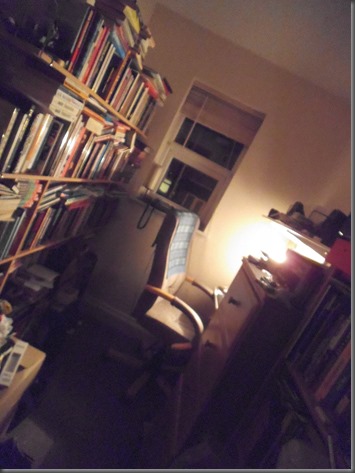
 

DSCF9246

Cramped, cluttered and anything but the image of a palatial literary person’s writing space…. the ‘office’ of part-time literary nonentity Christopher Nosnibor, today.


And if you’re loving my work, there’s more of the same (only different) at Christophernosnibor.co.uk.