Viewer / Bastard Structures / Beaumont Hannant – Bar Lane Studios Basement, York, 13th May 2011
The walk through town was hell as I cut my way through drunken weaving tossers in shiny suits and smashed bimbos who’d fled the races in search of more booze, food and amusement. The races might be good for the local economy, but that’s about it. As I headed up Mickelgate through the teaming hoards of plastered fuckwits, I encounter a familiar face. it’s the bearded eccentric techno wizard Tim Wright, one half of York techno should-be legends Viewer.
‘You’re going the wrong way,’ I tell him.
He explains that he needs food and is on a mission, so I wish him luck in his quest and continue onward to the venue. The Bar Lane Studios was, once upon a time, York’s Sony Centre, and I purchased my current stereo, including turntable, from there, back in 1998 or thereabouts. It’s now an art gallery and studio setup, beneath which there’s a basement that’s home to live music, theatre and more. At the door, there’s a cluster of people smoking and chatting, and there emerges a skinny guy with some wicked chops and a bad shirt. it’s AB Johnson, the other half of Viewer. He greets me, but can’t stop: he’s looking a bit vexed, and not without reason. He needs to find Tim to sort an issue with the projectors. Sometimes, there are things even a hundred yards of gaffer tape can’t handle.
I make my way down into the basement, a brilliant space for such an event. It’s a plain and solid rectangle, with bare-brick walls, flagstone floors and not a lot else besides a PA and a temporary bar with four different varieties of Roosters beer on pump. This definitely gets my vote, and by the time I’m halfway down a pint of the Mocha Stout at 4.7% ABV, I’m less concerned about the prospect of one of the projectors stuck to the ceiling falling on my head. There are a fair few people I’m acquainted with present, so I mingle and talk bollocks at them while superstar DJ Beaumont Hannant creates a pleasant ambience.
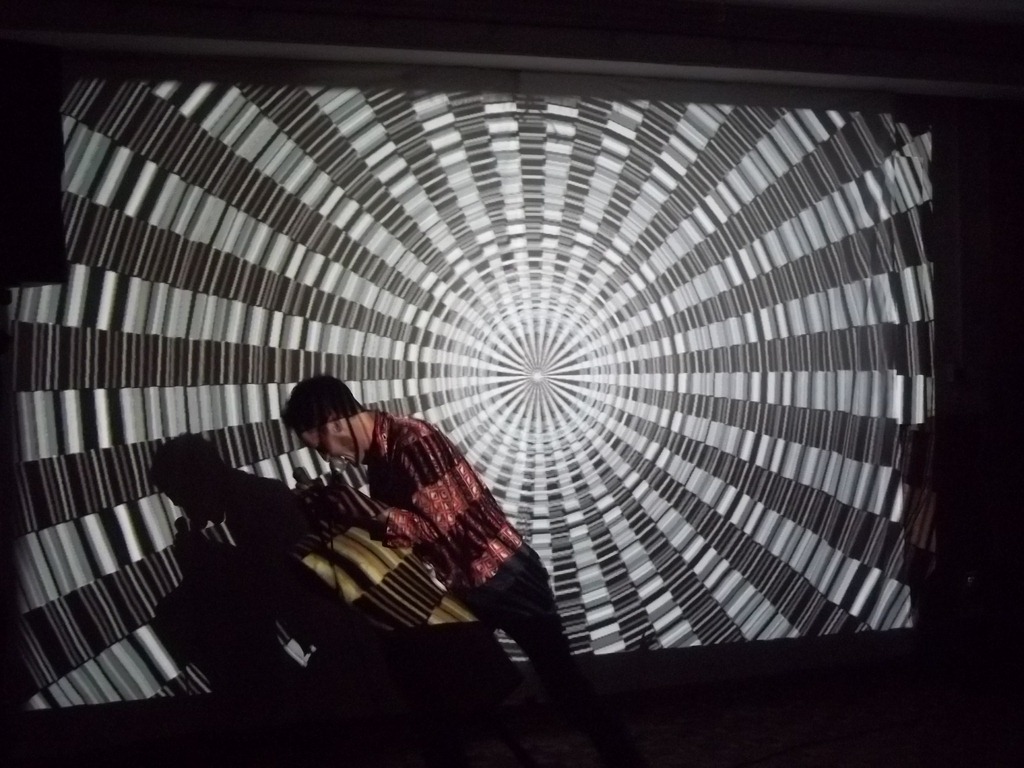
It’s around 9pm when Tim Wright and his collaborator Theo Burt take up their stations behind their laptops stage right and the venue is plunged into darkness for their Bastard Structures show. It’s not ambient, and nor is it entirely pleasant, and that’s a good thing. Put simply, this is multimedia art at its most absolute: the visuals drive the music, with the shifting shapes actually triggering the sounds, and it’s neatly arranged to alternate between pieces by each artist, interspersed with truly collaborative crossover pieces. Wright’s works are stark and brutal, Merzbow-like walls of noise and dark, penetrative frequencies assailing the aural receptors while harsh strobe effects and black and white images flicker scorch the retinas in the most abrasive, unforgiving fashion. Burt’s pieces contrast well, being lighter, playful even, easier on both eye and ear and more clearly designed for amusement, and the crossover pieces bring the two styles together to dizzying effect. A chap I know later remarked that he enjoyed ‘the fun ones’. Needless to say, I preferred the ones that inflicted pain on my senses and fucked with my head.
Time for another pint as I’m working my way down the bar and around the people I’m familiar with, and then Viewer are up. The projections – more brain-bending optical shapes that hypnotise in no time and completely suck you in – provide the perfect backdrop to the duo’s sassy, savvy brand of pulsating techno indie pop.
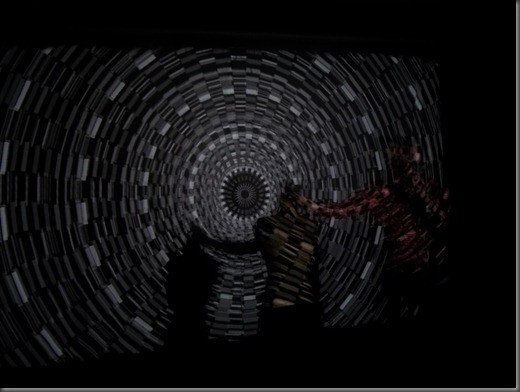
When I say that Viewer are cynical, I don’t mean calculated or contrived: the lyrics, penned by AB, to songs such as ‘Dumb it Down’, ‘White Noise’ and ‘Sunrise’ are sneering swipes at society, at conformity, at, well, take your pic. Johnson’s vocal style – which falls between Mark E. Smith, and, as another reviewer has suggested, Lou Reed – seems as much at odds with the music as his image and lyrics, and it’s precisely because of these contradictions that Viewer are such an interesting proposition. AB is also a great front man who looks entirely at home on stage – again, in complete contrast to Wright, who lurks in the shadows, hunched over his laptop and remains seated. He knows exactly what he’s doing, of course: namely controlling the thumping beats and solid basslines that provide the foil for Johnson’s quirky delivery and showmanship.

All the while the geometric patterns roll endlessly, searing their shapes into the retinas of the onlookers. It’s a groove alright, and by the time they closed the set with a reprise of ‘Suicide Girl’, my senses were tripping in overdrive.
Viewer – All the Pretty Young Things
Back up on street level, the world had gone mad, with the racegoing revellers wreaking drunken carnage in a shiny-suited remake of one of Hogarth’s scenes. Somehow, as I weaved through the inebriated shouts and squawks, the men standing in shop doorways pissing over their own snakeskin shoes, and the flashing blue lights of approaching police vans and ambulances, the unsettling juxtaposition of two very different sides of life on the same street seemed perfectly apt.
And if you’re loving my work, there’s more of the same (only different) at Christophernosnibor.co.uk

 Christopher's Headspace