THWACK! There’s Every Reason to be Afraid…..

On Friday 10th December, the King Ink guys will be launching issue 2 of one of the most exciting new zines around, I’m Afraid of Everyone. It features a new piece by yours truly, entitled ‘Blaming Bukowski.’ Precise, punchy and perverse, I’m pretty pleased with it.

There will be a launch event at the Python Gallery in Middlesbrough on the same night, stating at 7.00pm (and not 7:30 as previously stated). I shall be reading my piece, and more recent writings. As I don’t venture out often, this is something of a landmark occasion. It’s going to kick arse. So do get down / up if you can.

I’ll also have a selection of my published works for sale (or to trade in exchange for beer, as I attempt to launch my barter-based micro-economy).

More details are available here: http://www.facebook.com/profile.php?id=1524930503&v=wall#!/event.php?eid=170032709690882

…. And the Point Is…?

I’ve never really been big on computer games. When I was a child, there weren’t any. Not really. I was seven then the first Spectrums came onto the market, and no-one I knew had one. Home computing was simply not mass-market in the way it is today. My sister, five years my junior, got a second-hand one, and while I spent the occasional half hour playing flight simulation games, I much referred, well, most other activities. Reading, drawing, making things. I even used to play sports, despite being hopelessly crap at all of them. I liked being outdoors, although preferred quiet, indoor solo pursuits. So why didn’t gaming appeal? I suppose I couldn’t really see the point. It didn’t feed my imagination like reading, wasn’t productive like art.

I did, much later, while at university, discover the joys of Mario Kart, and purchased a second-hand N64. The other games that came with it, I didn’t dig. FIFA Soccer was really difficult to play, and Goldeneye gave me motion sickness. It didn’t help that I’d keep dropping my weapons and spend half the game bitchslapping my assailants.

I did also waste many hours playing Jimmy White’s Whirlwind Snooker and a game called Ascendancy in the mid-late nineties, particularly during a fortnight-long bout of very heavy flu. I couldn’t leave the house, had no energy, there was nothing on television and so I sat, in my dressing gown, playing computer games.

When I began writing seriously, I found that all of my spare time – and even time that wasn’t spare – and all of my energy was occupied with the outpouring and arrangement and rearrangement of words. I soon forgot about playing games on the computer. I had a better use for it, and it was impossible to do the two things at once. Gaming very soon struck me as a terrible waste of time: there was nothing remotely constructive about it, and ultimately, it was not particularly rewarding.

Sitting at work the last few weeks – well I have to pay the bills somehow – I’ve been bored half to death by a couple of guys who sit nearby, talking endlessly about computer games. Well, specifically, console games. Having both rushed out to purchase the latest version of FIFA Soccer, they’ve begun arriving at work and recounting the games they’ve played in the minutest of details. The sliding tackles, the headers, the goals, the fine tuning alterations they’ve made to their players strength, weight and agility ratings, comparing notes and exchanging advice on how to improve their rankings.

I couldn’t care less about football to begin with. Actually, that’s not true: if there’s one thing I care less about than football, it’s fantasy football leagues, and if there’s one thing I care less about than either of those things, it’s virtual football.

More recently, the morning’s topic of conversation was different. The two mind-numbingly obsessive gamers sounded like they’d taken a night off gaming to look at cars. For three hours straight they discussed the different dealerships they’d seen and what cars, makes and models they were each stocking. From the sound of it, they’d even test-driven a few cars, detailing to nth degree the BHP of each vehicle, the handling, the brakes, the overall performance, and what upgrades might be done to improve aspects of the performance. Christ, it was tedious, but a made a change from the usual gaming bollocks. Their moronism remained unchallenged as one bragged about taking a corner at 70mph, while the other boasted of pulling off a risky move to overtake (or ‘take over,’ as he put it) another vehicle. Dangers to society they may be, but at least they’d left the house. Or so I had thought, until I eventually discovered that they had both left work the night before and headed straight to purchase the eagerly-anticipated new version of Gran Turismo, released that very day, and had proceeded to stay up until after 2am playing the game, trying out the different cars.

Picking my jaw off the floor, I began to wrestle with the levels of pathetic non-existence these guys are clearly scaling on a nightly basis. They’re actually reasonably popular, and have more friends than I do. Friends who stop by their desks, email, phone and text them… usually to discuss football and gaming, but still. By contrast, I go out several nights a week, either with company or without, to pubs, gigs, comedy and spoken word events. Meanwhile, they stay in six nights a week, are ‘too busy’ for social networking because it interferes with their gaming and football watching. I contribute in my own small way to the world with my reviews, my writing and so on. And yet it’s rare for people to stop by my desk, email, phone or text me to discuss music or literature or the state of the world. I’m not actually complaining, but, well, how can this be?

More saliently, how can these people – who seemingly represent the majority, and are thus considered to be fully functional participants in society – not realise that their behaviours are unfeasibly sad? Do they not miss real life? Or even the interaction that social networking and on-line chat facilities afford, which can often provide a fair substitute, while offering the means of connecting with like-minded individuals who may not reside locally, or even in the same country? Surely these are not only more useful, but more exciting applications of technology? Or could it be that virtual life, as represented by gaming, has evolved to replicate the reality so well that reality, with its inconveniences and unpredictable elements, seems like a rather poor second?

This seems to be a very real possibility. For a start, one of the gaming buffs actually drives. I mean properly, a real car. He goes places in it. He then drives the same vehicle while playing ‘GT’, and apparently, it’s amazing how realistic the handling is. His virtual car is just like the real thing! Ok, but to me, that sounds very much like going home from work to play a game where I do my day job, only without getting paid for it.

In recent months, the ad breaks on television have been taken over by plugs for the latest Wii games and controls, the X-Box Kinect (what’s with the ridiculous spelling?) and the ‘brain training’ games for the Nintendo DS. All very commendable: they’re actually helping the nation to get fit and for idiots to sharpen up and be slightly less retarded, and even helping the elderly fend off Alzheimer’s by keeping their minds occupied. Brilliant! But aren’t they simply providing so-called ‘solutions’ to problems they perpetuated in the first instance? Much like McDonald’s adding healthy options to the menu, it’s a win-win situation for them, and while such steps could be seen as a positive move made as a response to the enormous backlash, they’re certainly not doing it because they’re philanthropically motivated.

Putting to one side for now the suggestion that these innovations are nothing to do with the nation’s wellbeing and are instead merely new ways of making vast quantities of money by tapping into the zeitgeist and the widespread paranoia concerning our collective health, there remains one glaringly obvious question: why? As in, why the need for all of these things that replicate that which already exists? So, there are puzzles and crosswords and Sudoku and the like on the DS, are there? Ok, so why the need for a digital version? The originals were perfectly adequate and have been around for a long time. When did you last hear someone on a train or sitting at a bus-stop complaining that the battery had run out on their pack of cards, or that the screen on their word-search had broken while in their pocket?

The same arguments are equally applicable to the Kindle. ‘But it’s just like a book! You can turn the pages just like a real book! And no trees died to make a Kindle!’ the device’s advocates proclaim with glee. A book is also like a real book. You can turn the pages of a book just like a real book, too. Because it is a real book. And once manufactured, a book requires no power and is a lot easier to reuse and recycle than a Kindle. There will be ancient, leather-bound tomes in existence centuries after the Kindle has been extinguished and superseded, we can be sure of that.

Some will no doubt accuse me of churlishness, and argue that I should be pleased that there are now devices in so many households that encourage fat kids to do aerobics, to run, jump, dance and swim. Ok, but whatever happened to actually doing real aerobics, running, dancing, swimming? Football, cricket… Look, I hate to put a damper on things, but it’s all just another fad. Rubik’s Cubes were great brain-trainers and Space Hoppers made people bounce around, and outside, too. Ok, so it was safe to go outside back in the 80s, before paedophiles had been invented, but really, where’s the perspective here? How can virtual sports, sports simulations, be as good on any level as real sports? I’m speaking as someone who hates sports, and was rubbish at sport as a child. But I still got out there, and I still walk between places now. It’s free, and it’s a way of incorporating exercise into my daily routine. Believe me, it’s not difficult. It makes a lot more sense than driving to the takeaway for my tea, then coming home to play a virtual cooking game, followed by a game where I can pretend to drive the same car I just got out of round a digital replica of real streets, before finally moving on to a game where I walk on the spot, encouraged by a digital replica of a real-life personal trainer or celebrity.

What’s next, I wonder? I can just about see the point of The Sims, but lately it’s all become a bit too, well, realistic in its detail. Your characters have to interact and go shopping to remain happy and healthy, and you need to empty the bins and so on. And then of course there’s Second Life, where you live out an alternative life in the virtual world. How far will it go? Will people experience virtual (or real) depression when they are made virtually redundant from their virtual jobs that are so realistic you feel like you really could be in the office, shuffling papers and taking calls from complaining customers? Having been virtually sacked, you lose contact with all of your virtual friends, run out of virtual money, fall behind on the virtual rent and find yourself on the virtual streets… you’re so down you’re contemplating suicide and accidentally kill your real self because you’ve lost the ability to differentiate.

Real life may be grim at times, but replicating it is surely the most pointless of all things. Whatever happened to using one’s leisure time constructively, productively, or even  indulging in a spot of escapism? After all, escapism doesn’t have to be mindless, and surely even mindless escapism has to be better than mindless realism and living in a mind-draining facsimile of real life.


And if you’re loving my work, there’s more of the same (only different) at Christophernosnibor.co.uk

Grand Designs and More

When I’m not reviewing music or cooking up works of fiction or blogging or watching bands or reading, I occasionally find the time for other activities. As I’ve designed one or two covers in the past, Stuart at Clinicality Press suggested that, having read through a couple of drafts of the forthcoming novel by James Wells, I might like to design the cover for Hack. And so I did. It might not be the finished article, it may not even appear on the published book, but here is it anyway.


Hack 1 copy


I also recently conducted an interview with London post-punk / No Wave band The Volitains for Whisperin’ and Hollerin’. You can read that here.


And if you’re loving my work, there’s more of the same (only different) at Christophernosnibor.co.uk.

No Success Like Failure: How Things Never Go To Plan

As a rule, I avoid making New Year’s resolutions. They’re usually impossible o keep and I get sick of people going on endlessly about how they’re going to go the gym or whatever, only to moan six weeks later that their plans went out the window before they’d even started. Me, if I’m going to do something, I’ll do it when I’m read and when the time is right. New Year is a bad time to start anything, on a number of levels. Moreover, if I’m going to do something, rather than making a big song and dance about it, I just shut up and get on with it. Then, if I don’t achieve my objective, no-one’s any the wiser and I save myself shame and embarrassment.

Next month sees the publication of issue 2 of I’m Afraid of Everyone, a cool, no-budget old-school zine.  The brainchild of a collective who go under the banner of King Ink, Issue 1 was dark, yet also darkly comical, a proper photocopy and staple job that goes against the tide of the slick digital publications and all the better for it. Issue 2 will feature a new piece of mine, entitled ‘Blaming Bukowski.’ Alongside this, I was asked for a few words abut what I’m afraid of. After some thought, I realised that my biggest fear is of failure. And yet I have failed. I fail often, an this year has been one endless failure for me.

Back in January, I vowed to publish less, even to blog less, and concentrate on longer pieces. As it’s nigh on impossible to write something substantial and maintain a level of output in the public domain at the same time, the plan was to sacrifice the latter in favour of the former. After I’d done the Clinical, Brutal thing, that was.

So January saw the publication of Clinical, Brutal… An Anthology of Writing With Guts, which has been doing pretty well. To promote the book, I conducted interviews with a number of the contributing authors. It was time-consuming but immensely rewarding. It also meant that articles with my name on kept appearing for the next two months.

While I may have continued into the summer without much by way of new fiction, I was kicking out music reviews like it was my day-job, and have now written and published some 325 of the things, while also blogging on MySpace most weeks and throwing the occasional article out in various other directions on-line. Some of those pieces have been requoted elsewhere, and done my profile no harm whatsoever, other than further spoil my plan to disappear for a while

In the last couple of months, after I stepped down from working for them for the foreseeable future, Clinicality Press have seen fit to publish my novella, From Destinations Set and a new collection of short stories, The Gimp. Ok, so they’ve emerged and remained under the radar for most so far, but that’s fine. I’m just happy they’re out there.

However, in a final self-defeating twist, I have recently begun to assail open mic nights and other such events with my presence and brief performances. Turns out I’m not terrible at it, but given my objective to operate as an ‘invisible’ author, I’m painfully aware that I’m breaking all of my own rules by doing this. I’ll be doing it again on December 10th. I’m Afraid of Everyone will be holding a launch night event for issue 2 at the Python Gallery in Middlesborough, and reading a selection of my latest writing. It’s good for business, and perhaps the heaviest promotion I’ve ever done, but given my aims for 2010, the price of any perceived success this may equate to is without doubt absolute failure.

I’m Afraid of Everyone’s on-line base is here: http://imafraidofeveryonemh.blogspot.com/

And if you’re loving my work, there’s more of the same (only different) at Christphernosnibor.co.uk.

WordPressing Issues: New Blog Location and Other Changes

Having previously devoted some time to to finding a blogging platform that offered reasonable visibility, extreme ease of use and could be readily – and again, easily, given my limited technical skills – fed into my website, I’ve spent the last year or more augmenting my MySpace blog with pieces posted on my Windows Live blog. It wasn’t great and the limitations on comments were frustrating, (i.e. you need an account to comment, and I learned that much of my traffic is ‘casual’ rather than ‘networked’ or repeat visitors), but it did the job.

LiveSpaces are to be shut down early in 2011: they’re merging with (or, more specifically, being replaced by) WordPress. That’s cool, not least of all because WordPress offers a much greater and more flexible functionality, and during the period in the run-up to the end of LiveSpaces, the option to migrate existing Live blogs onto WordPress blogs has made the transition relatively smooth.

I say relatively, because a lot of the formatting has been screwed up in the process: line spacing, font colour, font types… the old blog is now here on WordPress, and while the contents has made it unscathed, aesthetically, it’s a bit of a mess. It’s something I will be attending to, in due course. However, it’s not a top priority at this moment in time, and I need to get myself acquainted with the workings of WordPress, which may take some time and could well result in things looking worse before they look better.

Hey ho. I’m here, and if you’re reading this, so are you. Thanks for stopping by: please com again. And remember, there’s always more of the same (only different) at Christophernosnibor.co.uk.

Anti-Everything: A Blogger’s Dilemma

I greatly admire Kathy Acker’s writing, and I greatly admire the attitudes she espoused. I admire her writing because it’s exciting and unconventional and bursting with ideas. I admire her attitudes because she was antagonistic, awkward, challenging and non-conformist. Acceptance for Acker was extremely hard-won. I recently revisited an interview with her, in which she explained her early motivation:

“I took a lot of writing courses when I was in college… They were just torture… I reacted in this kind of this radical anti-authority stance, anti-right rules of writing. I started off by saying ‘no’ to everything. My whole identity as a writer was in saying ‘no’, in reacting. So in my first books I refused to rewrite. I wrote as fast as possible. I refused to have any consideration for proper grammar or proper syntax.”

It’s possible to react without being ‘reactionary,’ and Acker’s opposition to all things ‘establishment’, all things ‘conventional’ is something I’ve long been able to identify with. The establishment and the conventional frustrates me. The world frustrates me. I abhor the herd mentality, the misguided and broadly accepted notion that something must be good because it’s popular, the fact that so much ‘culture’ and so many ‘norms’ are simply accepted because that’s what the masses get fed by the various agents of dissemination. Our education system is flawed because it teaches people what to think, rather than how to think for themselves. Or, as Acker contended, “universities have peculiar transmission problems: they transmit stupidity.” It’s a pretty radical view, but it’s not difficult to see what she was driving at. 

As I’ve grown older, my views haven’t softened: I’ve simply found more evidence to substantiate them, and more cogent ways to articulate them. I’m frustrated at every turn, and as such, my writing, in all its forms, is writing of protest, it’s anti-something, if not absolutely anti-everything. Am I a nihilist? No, because I think that such negativity can be channelled for positive ends.

To return to a favourite analogy of mine, that of literature being the new rock ‘n’ roll, I find it irritating (you’ll probably be seeing the pattern by now) when bands plead with the audience to buy their CD at the merch stall between every song. Sure, plug it by all means, but ramming it down people’s throats is bad form. It’s overkill. It stops the set being about the music, and becomes a sales pitch. The set is an advertisement for the CD in itself. Do writers give readings and break after every page to ask the audience to please please please buy their book so they can get the bus home? Well, perhaps, but it’s rare in the extreme.

Writers do tend to be a lot less shameless by nature, to the extent that many come across as being quite apologetic. This can be similarly frustrating for audiences and people who meet them, for they seem shy, nervous or aloof. In the main, I’m no exception to this rule although I do try to speak confidently when reading in public.

This isn’t something I’ve done a great deal of. I have, so far, based a career on upping the anti, so to speak (yes, that’s wordplay, creative misprision, not a sign of limited literacy). I’ve refrained from using any mugshots on any social networking sites, and divulge very few personal details. I guard my privacy fiercely. I like to think it adds to the mystique, but it’s also a deliberate strategy. On one hand, it means my personal life remains just that, and on the other, it means I’m able to create a persona based around the invisible author. I’m the anti-author, if you like. I’ve done the anti-novel, in the form of THE PLAGIARIST, which is also a statement against originality, authorship and copyright. While producing music reviews ahead of release date, I’ve also written articles against music reviewing, and promoted the concept of retrospective reviewing as a means of combating the popular hyping processes. I’m against organised religion, I’m against CCTV and the countless infringements on personal freedoms. I’m against large corporations taking over the world and I’m against idiots cycling on the pavement. Yes, I’m pretty much anti-everything, to the extent that I’m quite averse to endlessly plugging my writing. Being anti-everything, I’m operating a strategy of anti-promotion.

After years of refusing to give public readings, I recently took a slot at an open mic night and read a couple of short stories, in the interests of (self) promotion. Only, I couldn’t bring myself to reiterate my name at the end of my performance, and I didn’t plug any of my books. Needless to say, I didn’t sell any.

Is this strategy of anti-promotion self-defeating? Perhaps. The trouble is, I get fed up of writers who post three blogs a week about their books, but never actually give anything away. Now, I have posted the odd snippet and link to my published works, but work on the premise that my blogs are separate from my fiction and other writing, and live in the hope that the blogs will pique the interest of readers sufficiently that they might feel compelled to investigate further. It works to an extent, but perhaps not as well as I would like. I’m so averse to plugging my work that many occasional readers probably won’t even realise I have books in print.

So, to redress this, for those who don’t know, I have a number of books out. Earlier this year, I edited Clinical, Brutal… An Anthology of Writing with Guts. It’s choc-full of brilliant works by some truly outstanding contemporary authors. A couple of months ago, Clinicality Press published my novella, From Destinations Set and a booklet, The Gimp. The former is conceivably one of the most progressive and innovative works of the last decade, while the latter is pure, unadulterated in your face (anti)literary filth. They’re all available from Clinicality Press at http://clinicalitypress.co.uk. Go buy ‘em.

(And yes, the title is a Mansun reference…)

And if you’re loving my work, there’s more of the same (only different) at Christophernosnibor.co.uk.

At long last… THE PLAGIARIST: THE MOVIE sees the light of day

In 2008 I ‘wrote’ a ‘novel’ entitled THE PLAGIARIST. It’s shifted a few units and received some positive reviews, no to mention some perplexed and baffled ones. I decided at the time, however, that words alone were not enough. This was a text (or assemblage of texts) that deserved, no, demanded to be taken into other dimensions. As there was already a very ‘multimedia’ feel to THE PLAGIARIST, I thought it would be fun to produce a film, and very soon the idea was in place: the film of the book. Of course, nothing’s that straightforward, and naturally, the idea of transposing a film that has no plot, no action, no narrative and no characters to speak of was always going to be problematic – perhaps even more so than a literal film version of Naked Lunch. These problems are placed in particularly sharp relief when the aspiring film-maker has no budget, no-film-making skills, no contacts and no real time to devote to such a project.

Nevertheless, I was set on doing it, because it felt right, and besides, I strongly believe that ubiquity is the key to global domination (yes, I also believe it’s possible to achieve underground world domination, and in the words of X-Factor winner Shayne Ward, that’s my goal). The objective of the film was therefore twofold: 1) to promote the book in a vaguely net-savvy, media-savvy sort of a way, as was fitting for the composite postmodernist work that is THE PLAGIARIST 2) to provide a companion piece to the book, while at the same time exploring the notion that a cut-up text is an ever-shifting, polymorphous collection of words and images on the page with no one fixed version or definitive article.

Having made the film, I posted a trailer on YouTube and elsewhere and made a big fuss about the whole thing, and attempted to find a way of launching the film properly at some reading event or somesuch. It wasn’t to be. A couple of possible avenues didn’t materialise, and I ran out of steam and enthusiasm, while still hoping some opportunity might present itself. It didn’t, and so 18 months after the trailer that advertising that THE PLAGIARIST: THE MOVIE was ‘coming soon,’ I decided it should be placed into the public domain. Leaving the thing languishing on my hard-drive seemed rather pointless, after all.

The title THE PLAGIARIST: THE MOVIE was, in fact, intended to be misleading. It’s not a film of the book. Or, it is, but in the sense that it includes some of the pieces of ‘narrative’ in the soundtrack. It’s perhaps more accurate to describe it as an audio-visual version of the book. It also fulfils the objective of having a physical and psychosensory effect. Try watching the last two minutes without feeling something – probably stress, discomfort, and a desire for the experience to end. Despite my limited abilities, no-budget software and the fact it was produced on a PC that was consigned to demolition shortly after the film’s completion due to its tendency to crash every few minutes, I’m pleased with the results, because, believe it or not, this is the film as it was conceived, and my lack of skills didn’t impinge on the realisation of my ‘creative’ vision. It’s supposed to hurt. Enjoy….


And if you’re loving my work, there’s more of the same (only different) at Christophernosnibor.co.uk.

Less is More: Judging a Book By Its Cover

From Destinations Set was a bitch to write. I set out to tackle the problem of presenting two separate yet interweaving simultaneous plots. It was something I had touched on before, in ‘Heading South’ and A Call for Submission. You could say that I was obsessed with simultaneity and pushing the limits of the dual narrative technique for a good year or more. I came up with the idea for From Destinations Set in the summer of 2007 as a submission to Bookworks’ Semina series, and knocked out around twenty pages and roughly planned the rest.

It made the 2008 shortlist in the Spring of that year. Realising that to produce anything like a complete working manuscript would take a lot of time and effort, I pushed on with putting some meat on the bones of the remainder. In the end it wasn’t commissioned (I can’t really grumble: the books that did come out are brilliant), but I was committed to seeing the project to completion. It was seriously hard work. Not so much the contents – although some of that was also extremely challenging – but the formatting. Having previously only produced short bursts of simultaneous narrative, inserted within the main body of the text within text boxes, for some reason I thought it would be a good idea to use the columns setting in Word (and I’m still running 97).

Given that the two stories were to run continuously in left and right columns, it meant I had to write both stories at the same time, and any additions / deletions in one narrative meant I had to match them, almost character for character, in the other.

I was explaining the arduous nature of the process to a friend over a few pints the other week, who asked why I’d not just written the stories separately and then pasted them into two columns in Excel. Now why didn’t I think of that?

So, having completed the manuscript, I touted it round a few publishers who looked like they might take such a brain-bendingly unconventional book, but without success. And so the manuscript languished: I had no desire – nor the technical know-how – to reformat it, and assumed that was that, until Stuart at Clinicality, who I’d mailed a copy of the story to, said he’d cracked it and wanted to publish.

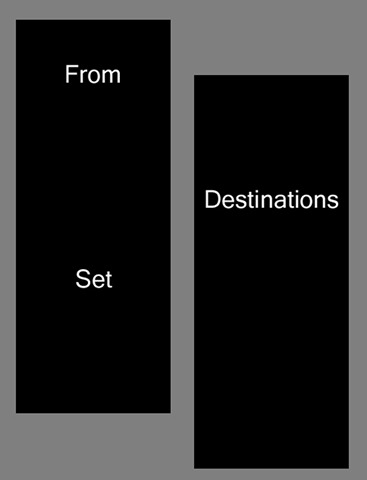
The cover design looks unlike anything my earlier work has been wrapped in, but I do rather like it. While I’m less than keen on minimalist art, as a cover design it’s undeniably striking, and also appropriate, not only to the contradictions of the narratives inside (penned in places in a rather minimalist style, while in others more expansively, and not necessarily confining either style to only one of the two stories), but also the challenges the visual aspects of the text present to the reader. The bold rectangles are very literal representations of the twin columns of the text, and serve as a reminder that Destinations is a very visual text. The placement of the words invites alternative readings: from set destinations, for example. How should the reader approach the physical task of reading the text? One story at a time, a page at a time, cross-column to create a real-time cut-up in the mind? Any and all of these are quite viable options. There are more than simply two stories, and more than two readings here.

To further the sense of variability, the pages in the printed version are unnumbered. As such, the text is complex enough, without the need for a busy or complex cover. Moreover, ‘modernism’ and ‘futurism’ are now historical, and the cover lends it something of a ‘vintage’ feel (I’m personally reminded of Breakthrough by Konstantin Raudive, published in 1971, a remarkable book in every way: http://www.colinsmythe.co.uk/books/brere.htm). Given that Destinations is in many ways concerned with he ‘future’ of narrative and issues of (dis)location in time / space, a cover that drew inspiration from retro representation of futures now past, seemed particularly appropriate. The book is both retro and of the future, and therefore not of any one time, or of any time other than that of its own making.

And in case you’re wondering, the title is a line from the song ‘Double Dare’ by Bauhaus, which is fitting not only because of the ‘double’ narrative, but because a key element of the stories is the sense of the characters’ actions being ‘steered.’ Ostensibly, someone else is writing – and rewriting – their scripts. As such, the writing process is a part of the story: but who is writing the writer? ‘Don’t back away just yet / From destinations set.’ As if they had any choice in the matter.

From Destinations Set is out on Clinicality Press on Monday 2nd August. Here are the opening pages by way of a taster:

http://christophernosnibor.co.uk/Documents/From%20Destinations%20Set%20-%20Section%201.pdf


Straight Down the Middle / Diminished Responsibility

Well, while I’m insanely busy on a couple of immense projects and the endless production of music reviews that mean blogs and short pieces will continue to be few and far between, Stuart’s been taking care of business at Clinicality. In fact, I’m essentially stepping down for the forseeable future and leaving the running – both the everyday stuff and the big decisions) to him. As such, Stuart’s going to be responsible for the forthcoming publications, and is also exploring new directions to expand the press’ outlets and raise its profile (without spending any money, which is perhaps as well as we haven’t got any).
It’s good news for me, as it means I can concentrate on the projects I’m committed to. What’s more, he’s going to be putting out a couple of new works that I wrote a while ago and then simply left, for various reasons. The first of these is my simultaneous narrative novella, From Destinations Set. Started as a piece to offer Bookworks as part of their Semina series, it made the 2008 shortlist but failed to get a commission. Nevertheless, having written a good chunk of it and planned out the rest, I finished it, then immediately gave up hope of publication after a strong of rejections and the realisation that I had no idea how the formatting could be made to work as a print conversion. I left the manuscript with Stuart, and one day, he figured it out and decided it should go out on Clinicality. I wasn’t going to argue… Anyway, here’s a link to a sample of the book:
http://christophernosnibor.co.uk/Documents/From%20Destinations%20Set%20-%20Section%201.pdf
…and below is the official line from Stuart via Clinicality.

Clinicality Press may be a small no-budget publisher, but that doesn’t mean we lack ambition or a roster of work that we have total faith in. To this end, we’re going all-out on bringing new titles to the market in the next six months, as well as exploring new avenues (for us) for the circulation of our existing titles.
As of next week, Christopher Nosnibor’s ground-shredding anti-novel, THE PLAGIARIST will be available for Amazon Kindle in the US, and we’re also now selling copies of the physical version directly through the ‘New and Used’ section of Amazon in the UK. We intend to expand the range of Clinicality publications available through both of these channels in the coming weeks and months.

In other Nosnibor-related news, we will be publishing his ‘lost’ novella, From Destinations Set on Monday, August 2nd. Extending the experimentation of THE PLAGIARIST, From Destinations Set was written in 2008 and adopts the ‘simultaneous narrative’ that Christopher first incorporated in ‘Heading South’ (published in Neonbeam 4) and which was also a feature of the extremely limited 2008 pamphlet A Call for Submission. From Destinations Set tells the stories of two very different people in simultaneous real-time, and is both challenging and cerebral while also pushing the parameters of narrative convention to tackle the eternal problem of time / space and linearity. From Destinations Set will be available as a hardback with dust jacket, intended primarily for the US market (but available as an import to other territories) and globally as a .PDF download at a significantly lower price.

We will be following this in September with a duo of hard-hitting booklets: The Gimp by Christopher Nosnibor (with an introduction by Lucius Rofocale) and Kicks by Vincent Clasper.

The year will be rounded off with the publication of a rollercoaster of a novel entitled

Hack by James Wells. A book about sex and drugs and rock ‘n’ roll, Hack comes on like John Niven’s Kill Your Friends if it had been written as a collaboration between Chuck Palanhiuk and Richard Blandford. Dymanic, perverse and musically obsessed, Hack has all the hallmarks of a contemporary classic. It will be available first as an ebook via Smashwords, and will be followed by a physical publication in 2011.
Promotion will be relatively low-key, due to financial limitations, but we’re committed to getting these quality works out there. Your support is always hugely appreciated, and if you like what we’re doing, spread the word!

You want more? Time and money permitting, there will be a second anthology, a follow-up to Clinical Brutal… An Anthology of Writing with Guts toward the end of 2011, as well as a second novel by Bill Thunder.


Keep watching for more updates.

A Weighty (and Measury) Subject: When the Customer Isn’t King

Earlier this week, I decided to spend my lunch hour in one of the local pubs near the office where I work, and get a spot of writing done. After a pint of Cropton Brewery’s Two Pints, I was on a roll. I was getting tight on time, and didn’t want to go fall asleep at my desk during the afternoon, so opted for a half. The blackboard behind the bar listed the ales priced by the pint. So, at £2.90 a pint, a half should be….
    ‘That’s £1.50 please.’
    Huh? I never was especially strong in mathematics, but I can manage basic mental arithmetic. I didn’t say anything, just handed over the money and returned to my writing. It wasn’t a big deal, after all. Just five measly pence, in fact.
    Back at work, I thought over it some more. And the more I thought, the more it irritated me. In the first instance, why should purchasing half of something cost more than half of the whole? Pubs purchase beer by the barrel (ok, by the firkin or kilderkin); it contains the same amount no matter how the divide it out in terms of units, and the contents will therefore realise the same amount at retail whether the beer is dispatched in whole or half pints, by my reckoning. Granted, a 5p mark-up on each half sold is neither here nor there when it’s a matter of a few drinks, and I understand that many pubs are struggling and need every sale they can get, and if that means an extra 5p here or there, then, well, ok. But… I can’t help but feel that responsible drinkers are being penalised. I mean, I get the deal with supermarkets selling smaller quantities of things at a higher price by weight: there’s the whole issue of shelf space and packaging costs… but a barrel’s the same size. Buying by weight – or volume – should mean that a smaller quantity doesn’t affect the retail price.
    I know this practice isn’t illegal, but it hardly seems consumer friendly, and, moreover, there is legislation in place that states that prices must be clearly displayed. By my reckoning, failing to clearly show on the price list that a half pint costs more than half the price of a pint – by only showing the price per pint – falls foul of this. Ok, so I’m a pedant. I don’t think this is necessarily a bad thing….
    The next day, on my way home from work, I called by a local greengrocer’s. I was giving myself a night off real cooking and was going to sling a frozen pizza in the oven. Given that the toppings on these things are so meagre, I like to add a few bits. I’m a vegetarian, and I like mushrooms, and in my opinion, no pizza is complete without come mushrooms on top. I didn’t want many, though, so just put a couple in a bag while the shopkeeper reorganised some of the other baskets of vegetables around the shop.
    I then placed the brown paper bag on the counter. And waited. Two minutes elapsed before she stopped rearranging the pears and came to the till.
    ‘What’s in there?’ she asked, picking up the bag.
    ‘Mushrooms,’ I told her.
    As if she didn’t believe me (what else would I have put in one of the paper bags that sit with the mushrooms? A (very small, light) kohlrabi? A light, spongy piece of ginger? Well, it’s possible: much of the produce in this shop is clearly several days old and a little past its freshest best. Something really expensive, like a whole heap of saffron or vanilla pods, that I was trying to sneak out cheaply under the guise of a couple of mushrooms?), she proceeded to unravel the bag and peer inside.
    ‘I can’t just sell you two mushrooms,’ she said. ‘I can’t do business like that.’
    As far as I could tell, she wasn’t doing much business at all. I was the only person in the shop, and it was half an hour before closing. She had a choice: stick the bag on the scales and sell me two mushrooms at the price the scales and her pricing dictated, or not, and have two more mushrooms sitting there, shrivelling away, overnight. She could take my money, or leave it. There are, after all, other greengrocers. I just try to support small independent businesses where I can, especially when they’re conveniently located. Plus, I prefer to but fresh produce loose and by weight, rather than buy a sackload more than I need (which invariably results in needless waste) and put more unnecessary packaging into landfill. 
The point of selling produce by weight is that the consumer is charged according to how much of something they buy (or how large it is); thus, three large onions cost more than three tiny onions. Presumably the retailer purchases produce from the wholesaler by weight, and prices said produce accordingly, in such a way as to make an proportional mark-up on the overall weight of the items they have purchased to then sell on.
    ‘Right.’ I was rather at a loss for words.
    ‘I just can’t,’ she said, tossing the paper bag disdainfully onto the scales. ‘You have to buy quarter of a pound.’
    Right. Just because something is priced by the quarter doesn’t mean it’s not possible to sell part quarters. More to the point, nowhere did it say ‘minimum quantity ¼ lb.’ or anything to that effect, in the way that many shops have a minimum card transaction, and on-line retailers have a minimum order value. However, there’s a reason for this. Potatoes, for example, are generally priced by the pound or kilogram: there’s nothing to say a consumer can’t purchase a half pound of spuds loose (and in season, a half-pound of potatoes will cost less than my two mushrooms… hell, a pound would!). If I wanted a chunk of ginger for a stir-fry, there’s no way I’d be buying more than a fraction of an ounce, around, say, 15 pence worth. I often go to the market on a Saturday and ask for a couple of medium onions, a couple of carrots, and, hell, I’ve even asked for half a dozen sprouts. The traders may smile at me or look at me in a strange or bemused fashion, but they always stick them on the scales then put them into my bag and charge according to the weight of those onions, carrots, sprouts.
    For the record, it isn’t as though I only ever go in and buy two mushrooms every now and again: I often stop in on my way home from work and spend a couple of quid or so, sometimes even five or six. I’ll concede it’s hardly big money, but the thing is, the products greengrocers sell aren’t exactly high value. As a consequence, they must obviously rely on a high volume of small sales rather than a smaller volume of larger ones. No-one goes into a greengrocers and spends thirty quid.
      It isn’t that I can’t see her point: tiny transactions are a pain. But unlike processing a credit card transaction for less than the amount the bank would charge to process it, my two piddly mushrooms weren’t costing her anything to process, and my being there wasn’t preventing anyone else from being served with a more lucrative purchase.
     ‘That’s 22p. But you’ll have to buy a quarter of a pound next time. It’s just not worth my while.’
     ‘Ok.’
     ‘D’you understand?’
     Not content with giving me grief, she had to patronise me too, to speak to me like I was retarded, just to complete the humiliation, just to make her point. I felt thoroughly chastised, and rather embarrassed. I was tempted to proffer the scenario that I might have been buying two very large mushrooms, weighing in at a quarter of a pound each (ok, it’s unlikely, but I’m thinking in purely hypothetical terms): what then? Or, as often happens, there are only a couple of mushrooms left in the box? I was similarly tempted to say ‘fuck you, you can keep your two lousy mushrooms, I’ll take my 22p and spend it in a store that wants it.’
     I didn’t, of course. I’m far too polite and respectful for that. Instead, I handed her the correct change, and hissed, ‘Yes,’ through clenched teeth.
Because she was right. She can’t do business like that. Certainly not with me, because I won’t be going back any time soon.
You see, the customer might no longer be king, but they do have choices. She hasn’t just lost herself another 22p in a few days; she’s lost all of my future custom, and over the years, it could add up. Irritate enough people, and the odd few pence or few quid lost son becomes a big chunk of the takings. So I’ve made my choice, and let’s see how the old bat likes them onions.


And if you’re loving my work, there’s more of the same (only different) at Christophernosnibor.co.uk