The Worker Part 1: I Don’t Like Mondays

A few years ago I blogged a story in 7 parts entitled ‘The Worker’, and each day’s post was written and posted on that day. The story subsequently appeared in the collection Postmodern Fragments: Writings on Work, Technology and Contemporary Living. To mark the publication of Postmodern Fragments on Kindle, I’m reposting ‘The Worker’ as originally conceived – only the first time around it began on Sunday, but the effect should be pretty much the same. Original typos have been maintained to preserve the integrity of the project.


The Worker pt. 1: I Don’t Like Mondays

The harsh buzz of the alarm sliced through the darkness and penetrated his dark place, his sleeping brain. He woke and was momentarily groggy before the realisation hits: Monday morning. 7:30. He hit the snooze button and buried his head in the pillow once more. Under the duvet, it was warm and comfortable and life was good. But the alarm persisted and he forced himself to vacate his haven.

He dressed, ate breakfast, brushed his hair, cleaned his teeth. He was running late, so no time for a shave today. 8:25 and he’s having to run to make the 8:30 bus: the bus-stop is an eight and a half minute walk but he can make it in half that at a run. He hates running, because he’s not fit – too much beer, too many cigarettes – and he hates arriving at work an exhausted ball of sweat. But he can’t be late, he’s been late too many times recently and his timekeeping has become an issue. He’s already on a first warning.

8:59 and he’s in the office, firing up his workstation, positioning his chair, the usual routine. The phone rang. He took the call, went through the scripted schpiel, dispensed some pointless information to the frustrated old goat at the other end of the line, updated the systems, shunted some papers around. Rinse and repeat. The phone rang. He took the call. Etc. Such is the daily grind of the 9-5. Why did he put up with it? Because there was nothing else. He needed to eat, to keep a roof over his head, pay the bills. It’s the white man’s burden alright.

Necessity is the mother of surrendering one’s dreams to grim reality. He was looking for a job and then he found a job, with prospects and benefits, so his interviewer, smug in his navy pinstripe suit and tan shoes had informed him. But it soon became apparent that the corporate ladder was all a con, and worse, a trap. A stop-gap job becomes a career.

The calls kept on coming and the papers kept on piling up, and while he was on the rota for taking his lunch hour from 12:30 to 13:30, he was stuck on a call with some irate customer and wasn’t able to get away until 12:50. But then, the phones were supposed to be manned by a certain number of staff – 10, equating to 50% of the team – at any given time, and the workshy heifer at the next desk was late back from her lunch.

He was getting hungry and struggled to contain his frustration. It was the same pretty much every day and the days had a tendency to run together, like watercolours on saturated paper. Another cup of rancid instant coffee as stagnant as his life, another plastic spoon, another whinging tosser, the hours passed into days passed into weeks passed into months passed into years, a wasted life, an accidental career. All the other jobs advertised locally were much of a muchness. No, the only way out was redundancy or retirement. Or death. He found it hard to rouse any sense of optimism. Too long in the rut, his spirit had been ground down and eventually crushed, all sense of hope extinguished. They owned him and he knew it.

Lunch: he nipped out to the sandwich shop at the top of the street, bought a nutritionally vapid chicken salad sandwich on flaccid white bread. The chicken was dry, anaemic, the salad wilted to fuck. Sluiced it down with a can of Coke. He could ill afford to dine this way as he was well in the red and pay-day was still a fortnight off, but he simply couldn’t find the motivation to prepare a packed lunch.

His truncated lunch hour – he had to be back by 13:00, and while some of his colleagues were capable of getting away with pulling epic skives and late sign-ins, he was neither comfortable with nor in a position to do the same – was over all too soon and he returned to his desk, signed back into his terminal and the onslaught, the grind continued. The influx of work – phone calls, emails, paper correspondence – demanding his attention was ceaseless. 5:30 seemed a long way off.

An hour later and his bladder was growing taught. He desperately needed to piss, but there was simply no respite. He was also tired, so tired. More cups of gut-rotting instant coffee was the only means available of fending off this terminal fatigue.

5:30 rolled around eventually, he switched off his workstation, clocked off, took a long, long piss that felt like heaven, and left the building. He didn’t have log to wait for a bus home. On arrival, he cracked open a can of beer. It didn’t last long. What to eat? There wasn’t much in. His funds were low and he’d not had the cash or motivation to make the trip to the supermarket at the weekend. A sad, salt-heavy microwave meal for one sat brooding in the back of the cupboard, so he nuked the plastic tray and chowed down the stodgy collation without enthusiasm, washed it down with a second can of lager. It was piss, but it was cold and alcoholic.

He flicked on the TV and vegetated in front of a series of mundane lifestyle and ‘talent’ shows with a couple more tins. Midnight rolled around and he decided it was time to hit the sack. He needed to sleep: there was work tomorrow.


Image1

An office, today.


The Kindle – and paperback – edition of Postmodern Fragments is available via Amazon in the UK …and in the US.

And if you’re loving my work, there’s more of the same (only different) at Christophernosnibor.co.uk

On Promotion, or This Blog is Fucking Stupid

Christopher Nosnibor interviews Christopher Nosnibor about his latest novel, This Book is Fucking Stupid.

CN: So, another book out. How many’s that now?

CN: This is number six, although two are collections of short stories, there’s one novella and a collection of essays and miscellaneous prose works. This is only my second novel proper.

CN: You’ve also published a number of pamphlets and things too, haven’t you? You wrote over 400 music reviews last year, conducted a number of interviews, and still found time to produce several short stories. How do you maintain that kind of work rate?

CN: Yes, there are half a dozen pamphlets with my name on them. I just sit down, shut up and type. I’ve never lacked ideas. So for me, it’s not about ideas, it’s about discipline. Basically, I organise myself to produce something on a daily basis. It’s less about the creative process and more about the production, I suppose. I really am a writing machine, as advertised. It’s no mystery. I have a full-time job, too, but when I get home, rather than piss about and toss off to the telly, I knuckle down to some serious work. Hardly enigmatic or mysterious, I know, but that’s how it is. And if I need a break, I just set the clones to work in my absence. No-one ever seems to notice.

CN: Tell me about the clones.

CN: Like many people, I often wish I could be in more than one place at any give time, had more hours in the day, could do several things simultaneously. It’s one of the less overt themes in From Destinations Set. Cloning myself a little over a year ago eased the burden a little.

CN: The title of your latest novel, This Book is Fucking Stupid seems like a complete non-starter in commercial terms. Why did you pick suck a self-defeating title?

CN: There’s a certain valour in consigning oneself to failure, and a degree of glory in crashing and burning in a most spectacular fashion. But it has to be truly spectacular. Limping along and failing half-heatedly is the most pathetic of things to see. People are so competitive, it’s a cultural trait. I’ve seen shows on television – not that I’m big on watching television – where the parents in American families tell their children ‘there are two kinds of people: winners and losers, and no child of mine is going to be a loser’, and that kind of mentality really riles me. It’s not a uniquely American thing, though. My idea of rebellion is to devise strategies against this perpetual one-upmanship, which is also a key theme of the story that’s submerged within the book. So rather than make any attempt to compete on the same grounds as everyone else, I set my own objective, namely, if I can’t be the best, I want to be the absolute worst, and truly spectacular at it. With a title like This Book is Fucking Stupid, I’m giving myself a head start toward achieving the kind of commercial failure most losers could only dream of.

CN: You make it sound like you want to be the Eddie ‘The Eagle’ Edwards of the literary world…

CN: To an extent, that’s exactly it. He wasn’t an athlete and never had any expectations beyond calamitous failure, yet he’s better known than most gold-medal winners, simply by virtue of being the absolute worst. So This Book is a double-bluff. The difference between me and Eddie is that while he couldn’t ski for toffee, I actually can write. I mean I’m a technically competent writer, I have a degree in English and the job I do to pay the bills is writing-based. The stuff I’ve produced like THE PLAGIARIST and This Book are written the way they are through choice, but a lot of people don’t seem to get that. I had a story rejected by a magazine not so long ago because they had issues with the way the tenses switched, completely missing the point that the (unreliable) narrator was wrestling with reflections of the past in the present. I’ve always maintained that a writer should learn the rules before breaking them. I know the rules and have produced work that follows them to the letter. In actual fact, the stuff I’ve done that I can’t get published or otherwise gets slated is the most technically correct, but because I’m using the rules against themselves, people just assume I’m clueless. This Book sidesteps all of that by shooting myself in the foot – repeatedly – before even leaving the house.

CN: You say that This Book is a double-bluff…

CN: Absolutely. And it’s working. By pitching it as the worst book ever – which I should point out is certainly isn’t, and despite what’s been said abut it by myself and various reviewers, it’s infinitely better on both a technical and conceptual level than the bulk of recent bestsellers – it’s almost guaranteed to arouse interest. People want to see the worst, or what they’ve heard is the worst – almost as much as they want to see the best. It’s a strategy that seems to be working, too. Only a month after publication, it’s already outsold its predecessor, From Destinations Set.

CN: The hype – in lieu of a more accurate word – seems to have been building for a while, and all seems to have been perpetuated by yourself. Was this an integral part of the strategy too?

CN: When I began promoting This Book is Fucking Stupid, the book didn’t exist, in that it was still very much a concept, and even as I began to post excerpts in my blog, it still didn’t exist as a book because it was far from complete. There was of course something appropriately and inherently stupid in the notion of promoting a book that didn’t exist, although this strategy meant that I had a real incentive to complete the work and get it out into the public domain to save face (the irony being that the finished work would be an act of commercial suicide that probably wouldn’t actually sell even when it did come into circulation. And so the layers of irony continued to build. And so eventually, This Book was published and the promotional machine at Clinicality kicked into overdrive and I went even more overboard in my labours of self-promotion. But being an ebook, we were still promoting a book that effectively didn’t exist, and in material terms, that’s still the case now.

CN: You posted a number of blogs explaining the writing process and the book’s function, and those blogs have in turn been incorporated within the text itself. Do you think you have a tendency to over-explain your work?

CN: Most definitely. I’ve written a fair few pieces explaining my works, probably in significantly more detail than most readers want, let alone need. I have an educational background in English Literature and it’s become second nature to examine text from a theoretical perspective, and my own texts are no exception. Besides, a lot of theoretical work informs my writing, but I’m aware that this isn’t generally all that apparent. Since no-one else is likely to analyse my output, there’s a sort of logic in doing it myself.

CN: Doesn’t that seem rather like a punk band sticking in a jazz number in the middle of a set just to prove they can play? It’s almost as if you feel the need to justify or defend your writing…

CN: I like that analogy, and maybe I do feel that need. Is it a lack of confidence? I dunno. Sometimes, perhaps. I think it’s important to differentiate between writing that intentionally transgresses the established boundaries of literature and writing that’s just plain bad, and it pains me when I’m accused of being a ‘bad’ writer when there are technical elements that are integral to what I’m doing that people miss. Take, for example, a story I wrote a while ago that was, essentially, about the way memory distorts time, and how a recollection of a past event, when experienced in the present, shifts the temporal position of that past event in some way. I tried it round a few on-line journals and zines and no-one would take it. One editor sent me a fairly lengthy email explaining the problems he had with it, the biggest being the way the tenses switched. It left me feeling frustrated because he’d completely missed the point. He’d also assumed that I simply didn’t ‘get’ tenses, rather than purposefully fucked about with them to achieve a specific effect.

I appreciate that some readers will find my technical focus and self-explication irritating, and in some ways, that’s one of my objectives. So I decided with This Book that I’d make the whole theory / practice thing not only explicit, but the subject of the text – or one of the key threads of the text, at least.

CN: Conceptually, it sounds extremely grand, but doesn’t it rail you into something of a dead end?

CN: Yes and no. The scope to expand the book with supplementary material, commentary and straightforward revisions is essentially infinite. That’s the whole point. Because of the nature of the text and the publishing arrangement, new editions can be pushed out as and when. Ten years hence it could run to five or six hundred pages in theory. Plus I’m not averse to new intros and cover art, numbered signed editions, anything else you care to name. Serialisation, a special hypertext edition, audiobook, film, a ‘making of’, anything, everything. By the same token, the point’s already been made simply by virtue of the book’s (virtual) existence, and the book is a dead end as of and in itself. Every book I’ve done to date is a dead end: THE PLAGIARIST was a dead horse long before I started flogging it. Burroughs said he’d taken the cut-ups to their limit by the end of the 1960s: Kenji Siratori effectively produced the same text more than a dozen times in a couple of years, and then I came along ad rehashed the whole thing with some third-hand theory mashed in. I’d dabbled with dual narratives – something already explored by John Giorno in the 60s, 70s and onwards, right into the 90s – again, with my own slant, and by the time I’d finished From Destinations Set I really don’t think there was much scope to take the form further. But at the risk of completely contradicting myself everything I do is concerned with pushing narrative in different directions, I’m not anti-narrative, and I’m not anti-plot, believe it or not. I’m just preoccupied with trying to find new and different ways of writing, and the form and content of my work is invariably intrinsically linked. There will always be new modes of narrative, it’s just a matter of exploring them. I consider that my role as a writer, not because I’m not a story-teller but because I want to render storytelling exciting again, and not in the obvious, conventional ways.

CN: This may seem like a really obvious question but isn’t interviewing yourself completely ridiculous?

CN: It is a really obvious question, and yes, of course it is. Again, that’s the whole point. It comes back to the fundamental premise of the book, that self-reflexivity and self-negation, and the idea that I’d rather provide the academic analysis for my own works – since I’m more than qualified to do so – rather than wait until I’ve been dead twenty years for someone to do it and make a hash of it – or not do it at all. I find it difficult to generate media interest and despite my best efforts, there queue of people waiting to interview me about my latest work never really builds up. And so interviewing myself seems the logical way to go. Plus, I can rely on myself to ask relevant, sensible questions, and if the questions I field aren’t relevant or sensible, I really have only got myself to blame.

CN: The self-interview does feel a little schizophrenic though…

CN: In Anti-Oedipus, Deleuze and Guattari theorise that a schizophrenic mindset is the only same approach to capitalism. I’m inclined to agree. The only way to maintain a thread of sanity is to give oneself to madness.

‘Pretentious and Dull’: Celebrating Ballard’s Lone Stars

Negative reviews have long been something of an obsession of mine. Having grown up reading Melody Maker and the NME in the late 80s and early 90s, it was the out-and-out slatings that I found made the most entertaining reads. In many ways, these reviews were a leading factor in my deciding I wanted to become a music journalist. For the first reviewing job I applied for, which happened to be at my local paper, I sent a deeply scathing review of a recent gig I’d attended, because I felt it provided the best means of demonstrating my flair for description and finding creative ways of saying the bands were shit.

I was elated when the section’s editor rang me to tell me I’d got the ‘job’ (I say ‘job’ as it was unpaid, an ongoing feature of my reviewing career which now spans the best part of twenty years). My elation was countered by no small degree of horror when he went on to tell me he loved my submission so much he was going to run it.

It was a vital lesson in writing, and at a relatively tender age (I was about 18), namely that if you’re going to write something, you have to be prepared for people to read it. The paper received a number of letters of complaint, the first review to have elicited such a reaction in its entire history.

Still, it wasn’t the first time my writing had received complaints. A couple of years previous, during the summer holidays, I had produced a newsletter of sorts, a parodic ‘gossip column’ type affair about people from my school. It went by the title of ‘The Parish News’, and I simply printed up and posted out copies to various friends and people I knew. Unfortunately, one (female) recipient shared initials with her mother, who opened the correspondence, and, taking offence at the references to her daughters breasts, decided to call the police about this ‘offensive’ publication. They turned up at the back door while I was cleaning the porch for pocket money, and delivered some stern words. They couldn’t tell me who’d complained, of course, but I spotted one of the, coppers was holding the envelope they’d been handed by the complainant and read the address, and made the simultaneous discovery that bobbies aren’t always the brightest. They also told me in no uncertain terms that I was to cease the publication of ‘The Parish News’ or anything similar. I gave them my word and they went on their way. I was a lot more careful with the distribution of the subsequent three issues of the quarterly A4 one-pager.

Since then, very little’s changed in many respects. I learned quickly to develop a thick skin when it came to comments regarding my work, and for every detractor there are many protractors, and besides, I’m of the opinion that it’s better to be slated than ignored – although that doesn’t stop me bailing in, feet first with all guns blazing when I receive a particularly feeble or otherwise irksome CD in the mail. It’s good to let off steam to flex my muscles that are primed for serving up vitriol, and I still believe the bad reviews are the best.

Unfortunately, many reviews on the Internet, be they reader reviews or fan reviews or little blogs or zines, are extremely poorly written, and the one-star reviews on Amazon, Goodreads, etc., are nowhere near of the standard of the scathing reviews penned by good journalists who possess wit, humour and an extensive vocabulary. It was this strain of review that was a key inspiration for This Book is Fucking Stupid, and long before I decided to write / assemble the book, I’d developed the habit of skipping straight to the one and two star reviews of books or CDs I was considering buying. Sometimes I’d find myself embarking – unintentionally – on extensive one-star journeys, reading all the terrible reviews of books I’d read or by authors I like. And really, most of them are truly terrible. Invariably, it’s abundantly clear that the reviewer is only semi-literate, and needless to say they’ve generally missed the point of the book completely.

I’ve recently been on something of a Ballard trip, and it’s perhaps not surprising that despite the glowing critical reception his works have received, many ‘everyday’ readers have been less impressed. tvpunter’s comments on Amazon.co.uk concerning High Rise – a book I found powerful and quite affecting – are in many ways typical:

1.0 out of 5 stars WE-1984-, 8 May 2011

By tvpunter

This review is from: High-Rise (Paperback)

That kind of novel that potrays the middle classes in turmoil as oppossed to the state controling the masses..a metaphor for today in 2011..did’t work for me.

Clearly, spelling ‘dos’t’ work for him either, and reviews like this reveal more about the reviewer’s deficiencies than the shortcomings of the book. The point is, I’m aware that Ballard is guilty of the occasional lumpy sentence and sometimes the action scenes are so hastily sketched it’s difficult to discern precisely what’s happened. Consider these features endearing, small imperfection that are essential to the unique style of Ballard’s writing. Therefore, while not all of his books have had the same effect on me as The Atrocity Exhibition, I nevertheless find myself marvelling at the way in which he constructs his narratives, and I’ve not once – thus far – found a Ballard book to be ‘disappointing’ – unlike Thomas Hunter of Banbury:

1.0 out of 5 stars Disappointing, 11 Nov 2011

By Thomas Hunter (Banbury, UK)

This review is from: Super-Cannes (Paperback)

This book started so well, painting a great picture of a realistic brave new world on the French Riviera, and setting up an intrigue that promised to blossonm into an exciting mystery. But then it all went wrong as implausibility piled on top of implausibility. JGB thought he was building tension but instead he was building incredulity, finishing off with a pathetic ending that made me think the whole experience had been a waste. My first Ballard and probably my last.

The one thing that’s always struck me about Ballard is his ability to signpost the future. The London Riots of August 2011 immediately brought to mind High Rise and Millennium People. But the trouble with writing the near future is that for many, it will seem far-fetched and improbable, in much the same way Smellgrovia finds aspects of Kingdom Come ‘silly’.

1.0 out of 5 stars Pale Imitation, 21 May 2007

By Smellgrovia (Blackheath, London)

This review is from: Kingdom Come (Hardcover)

I am a huge Ballard fan and so am sorry to say that I really did not enjoy this. I agree with other reviewers in feeling that Ballard has done this so much better in other novels such as Cocaine Nights. I thought the shopping mall run riot was silly at best, and I just could not get involved with the characters or plot. By the end I was skim reading just to finish the damn thing – never a good sign.

2.0 out of 5 stars gratuitous, 17 Nov 2010

By biskit

This review is from: High-Rise (Paperback)

i knew this book was supposed to be alarming, thought provoking etc., but i didn’t bank on the feeling of impatience and horror. never one to abandon a book half way, i kept on through gritted teeth. I have since passed dwellings that have made me think of this book, but that can be its only legacy. a fear that the hell within this book could become reality is what makes one read on, but beware the same is true for other stories of the horror genre. this is not a convincing tale, people going to work as normal and then setting up war zones in their own block of flats? i dont think so!

We live in silly times. I suspect many inhabitants of inner city areas would liken their tower blocks to war zones. Many considered 1984 absurd in its day, and no one got Nova Express, yet these books are now very much reflections of the society in which we now live. It’s a pity the authors weren’t around to witness recent events – or perhaps it’s a blessing. Sometimes, it’s not pleasant to find you were right all along.

I wrote This Book is Fucking Stupid as a means of addressing the dichotomy that runs through the whole field of reviewing as it’s emerged in recent years. Readers rarely seem to agree with critics, yet purchase books on the strength of the reviews its received – and then complain, feeling that they’ve been in some way misled by the critic’s positive assessment of any given text.

1.0 out of 5 stars One for the Daily Mail readers, 28 July 2008

By Bryan (Newcastle)

This review is from: Millennium People: Novel (Paperback)

If it’s a satire, it’s lacking wit, insight and humour, and if it’s not satire it betrays a staggering naivete. Characters are poorly drawn, but even in their one-dimensional state manage to be either wholly unsympathetic or downright offensive, and the world they inhabit is one seen by the most blinkered Daily Mail reader, where school fees are an important economic indicator, and the death of Jill Dando can shake the country. (The inclusion of a version of the Dando murder is so bizarre it’s almost funny, but not quite enough). The point of the book, such as it is, is facile – professionals have a function in society – but by presenting their closed world as the entirety of society, and not giving us any shade, or any tension, against their short-sightedness, the book’s never going to work unless you can actually sympathise with their views. And if you can, then I pity you. There’s also a nearly quaint 1960s radical feel – the giveaway line for me was a reference to a ‘shared lover’ – the uneasy balance between permissiveness and misogyny bringing the bearded conservatism of 60s student to mind. (The idea of overpriviledged revolutionaries obviously chimes with the theme of the book, but I don’t think that’s a deliberate echo).
There are some nice prose flourishes, but a handfull through the book, which mostly reads somewhere between plodding and clunky, while the dialogue is risible. If I’d not read some early Ballard, I’d say his editor hadn’t paid attention to an esteemed author’s manuscript.
Overall the book is a re-tread of High Rise, and suffers that book’s problem of a fundamental misanthropy based on a wilful acknowledgement only of the most venal side of humanity, that expressed in the broadsheets and world cinema of the London middle class. That could work if it was sufficiently stylised (and much as I disliked High Rise, it nearly worked through the conceit of staying within one building), but this wants to operate within a real world, but completely fails to acknowledge one exists.
If you like your writing dull, your authors solipsistic, and your themes akin to being battered over the head with a rolled Telegraph, then fill your boots on this one, but otherwise, there’s nothing to see.

Another key aspect of This Book was recycling. In these times of austerity and while green issues remain to the fore, I’m still the keen advocate of recycling I was a decade or more ago. I was raised to waste not, want not, and I’ve spent most of my writing career working to this ethos. Just as William Burroughs cut up Naked Lunch to create much of what would subsequently become the Nova trilogy, so a large proportion of the material that became THE PLAGIARIST and From Destinations Set began life as a novella entitled Destroying the Balance. This novella became my ‘word hoard’ so to speak, and I decided it was a more than fitting text to recut, re-edit and reconfigure in order to produce This Book. And why not? By reworking a pre-existing text, I’m joining a lineage of great authors who did precisely the same. Of course, not all readers appreciate what could be considered formulaic plotting, although no-one seems to complain that the bulk of crime, horror or romance novels all follow the dame formula.

1.0 out of 5 stars A waste of time and effort…, 4 Oct 2001

By deborah.daley@marshallcavendish.co.uk (London, UK)

This review is from: Super-Cannes (Paperback)

I bought this book as I was going on holiday and needed something to read. It was a haste decision based on the rave reviews and the fact that this book had won an award. I did not find this book to be exciting, tense, thrilling, visionary, etc. This story of a man tracing the footsteps of another man’s killing spree is written in such a way that I wasn’t immersed in the story – I didn’t care about any of the characters, the plot was unbelieveable, long winded and consisted of twists that I had been guessed early on. It was only when I got to page 371 that I felt the story had some real feeling or was exciting – this isn’t a good sign in a novel.

Another thing was that there were too many poetic terms for describing things throughout the story. This is a talent of Mr Ballard’s that he utilised to the nth degree. I challenge any potential reader to open a page in this book and read – you’ll see that it’s difficult to keep track…

Why is this author praised as some kind of genius? Reading the synopsis of his other books it looks suspiciously like he rewrites the same story over and over again – perhaps he is a genius…

There is of course a fine line between genius and insanity, and if dumb is the new smart and the rewriting of the same story over and over again is the height of creativity, then This Book is Fucking Stupid is the very definition of a work of genius. What’s more, I’ve long said that plot’s overrated, and while a substantial number of truly important works of literature dispense with plot completely (again, The Atrocity Exhibition, Naked Lunch are obvious leading examples), while others relegate plot to a secondary or even tertiary position (I’m thinking instinctively of Alain Robbe-Grillet’s work here, although again, there are many others) but of course what I really mean by this is that a truly great book needs a lot more to it than plot, and readers who read for plot alone are missing out on vast portions of the experience reading can provide. How often does plot as of and in itself make a reader pause for thought to assess their own lives, beliefs and the world around them? Still, even a good plot is wasted if the readership’s incapable of following it without it being spelled out. Perhaps more complex novels should come with plot-line summaries, and, better yet, a diagram with the key events in sequential order, just to make sure no-one gets lost along the way.

1.0 out of 5 stars Pretentious and dull, 24 Mar 2008

By A. Auburn (Cambridgeshire, England)

This review is from: Millennium People: Novel (Paperback)

This is among the worst books Ive ever read. I couldnt follow the plot,and the language was over pretentious and unexciting. I have heard alot about J.G. Ballard but he is highly overrated and dull.

Ultimately, any writer has to accept that they’re not going to please everyone, and in fact, few would want to. I’ve made my decision: I’m going all out for the one-stars. I want to produce an entire oeuvre of ‘worst books ever’ than crush my soul churning out potboiling bollocks about knights or espionage. Let’s face it, the paperback fiction chart is grim and endlessly samey. Where’s the variety? Where’s the writing that challenges the reader and the status quo? I’d rather sit with Ballard in the ‘pretentious and dull’ corner of the literary world than be adored by the masses who loaf around on the beach reading Shopaholic or dross by Dan Brown. Stupid? Career suicide? Perhaps, but then so’s the idea of writing to become rich or famous. Fame and fortune are even more overrated than plot, but again, you’d have to venture off the bestseller list and read something other than celebrity autobiographies to find that out.


J.G.-Ballard-at-home-in-1-002

The late, great J G Ballard and his untidy bookcase

And if you’re loving my work, there’s more of the same (only different) at Christophernosnibor.co.uk

So the Plan is Now in Place… and it’s Fucking Stupid

So the plan is now in place, and if it seems utterly cranky, then so much the better. While Clinicality Press will be publishing This Book is Fucking Stupid as a paperback later in the year, it will appear first on two different e-publishing platforms. The reasons for this are numerous, and not least of all financial. E-publishing is free and Clinicality have zero funds; any cash raised from the e-book editions will go directly into the production and marketing of the paperback. So far, so savvy. But here’s the rub: each edition will be different. This Book is Fucking Stupid is an incomplete project, and is designed as such, to be revised, expanded and reworked in order to exist beyond the prescribed confines of a ‘published novel’, wrapped up and clipped by the limitations of authorial and editorial constraints.

Bypassing the conventional process of republication by route of the first edition, revised edition, annotated edition, anniversary edition, scholarly edition, restored text, This Book is a continually evolving piece, it’s first e-publication intentionally abridged, with critical passages withheld for inclusion in the second, to be again expanded and subject to further supplements in the form of introductions, prefaces and a comprehensive index in the first print edition, which will also include further insertions that represent the critical and academic reception. These will all necessarily be engineered by the ‘author’, although each revision will represent a diminishment of the original author’s role and input, as his ‘own’ words and the story itself become diluted, accounting for a reducing proportion of the book’s total contents. The purpose of this exercise is to play out the way in which a text (d)evolves and changes complexion with each revision, translation, annotation, commentary. Even simple republications problematise the materiality of the text, with alternative pagination, typefaces, cover art, all contributing to a different reading experience between editions, a situation not resolved but in fact heightened by digital editions such as those designed for the Kindle, whereby the end user determines the format, the font size and thus the reading experience to a certain extent. Consciously or otherwise, readers respond to the physicality of a print edition of a text, ranging from the luxurious yet cumbersome large-format first edition hardback to the pocket-sized budget edition paperback on low-grade paper with the text in a small font, the lines packed tightly together. There’s a sense of the personal in a print edition, also, and it’s undeniable that one tends to feel and respond differently to a pristine first edition and a well-thumbed and rather battered trade paperback. These responses transcend the impositions of value and of commodity, yet these peripheral tangibles definitely colour the way readers engage with a text. Context is another extraneous factor; again, a scarce edition or clandestine publication provokes a different response from a mass-market edition that’s sold in the millions. The idea of a ‘restored’ edition or an ‘expanded’ edition connotes a sense of incompletion or correction, suggesting that previous editions were somehow ‘wrong’, that previous editors or publishers interfered with the writer’s work, either for the same of marketability, for social or political reasons, or simply because they had no respect, an overinflated ego or lacked any sense of competence.

Of course, history is full of revisions and ‘corrections’ – or perhaps more accurately, realignments, reconfigurations and reinterpretations, and this applies to not only literary history. The process of totalization, by which linear narrative and a continuum based on a sequence of events connected by cause and effect, is the very basis of the conception of history. Yet this almost universally accepted narrativisation is complete artifice, and linear sequentiality fails to account for simultaneity and disconnection. Nietszche was right: everything you believe to be true is a lie. To the point, there’s nothing that’s immutable, fixed, and to anchor a belief system on anything is simply an act of misguided (self)deception.  The revised edition, the expanded edition, the annotated edition, these are all examples not of an enhanced reader experience, but of exploitation, and usually created without the author’s consent and, more often than not, following the author’s death. This Book is different. It may still be exploitative, but at least it’s open and honest about the fact, and all of the insertions, amendments, deletions, are made with the author’s knowledge. It also exists to highlight the cynical nature of the conventional process, the life of the book. This Book collapses all of that, trashes it, burns it, razes it to the ground.

TBIFS Cover 2 copy

And if you’re loving my work, there’s more of the same (only different) at Christophernosnibor.co.uk
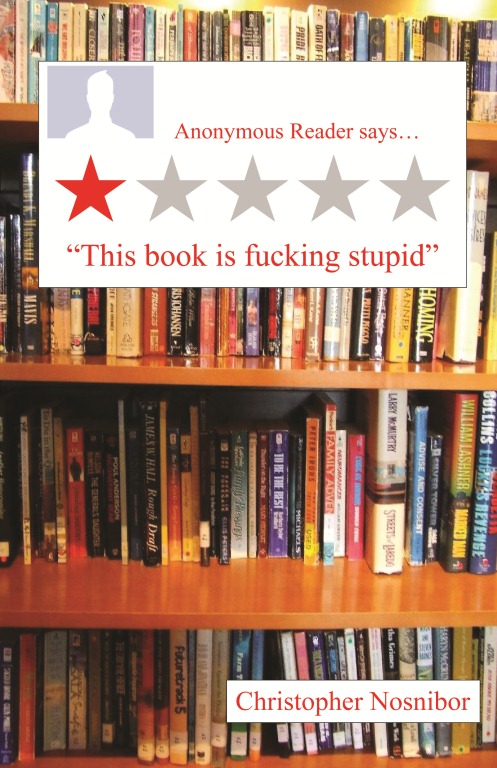
I’m in good company….

The following review is something I found on-line while working on my forthcoming novel., This Book is Fucking Stupid. It’s a review of Hemingway’s classic The Garden of Eden.


I give up.

This book is fucking stupid. There is no story at all. It’s all a bunch of sleeping and eating in France while nothing actually happens. Envy and sex. That’s it. A woman has a mental breakdown and Hemingway obviousy had some rampant sexual fantasies. Now that I know what happens… Catherine loses her mind because she’s jealous of David’s attention to writing…she’s a rich little psycho who wants to be showered in attention constantly. She gets increasingly jealous of his masculinity and she admires it so much that she keeps getting her fucking hair cut more and more and it says online that she even got tailored pants and picked up a chick with whom she had a lesbian affair with. Then she lets David sleep with her too. They’re like some sick happy triangle. Oh my god, really? That’s it? A whole fucking novel for that? My god, the first stage of her psychotic episode seriously took up like a third of the book. Maybe when this was written it was groundbreaking and mind bending so I could be looking at it with completely the wrong mindset and judgmental eyes. I just found it to be such a drag. For me, right now, in 2011 at least. I feel like that was such a waste of life, lol I’m sorry. Wow. Just WOW. Like I said it’s probably a lot more amazing in the context of the time. It took the dude fifteen years to finish. I read the summary on the book and thought it was boring, I should’ve just put it back on the shelf. I guess I wanted a taste of how it was written and how everything played out but I found a lot of babbling, broken scenes with a lot of pointless fluff, a lot of “and”s and a character I really dislike who talks too fucking much and needs counseling. I’m a little disappointed. I should just stick to Poe. There’s always a twist, and if there’s not it at least gets you thinking and stimulates the senses. And Emerson. God, this book made me feel so stir crazy. Crazy. Town. Let me out.


hemingway

Hemingway: Who are you calling stupid?


And if you’re loving my work, there’s more of the same (only different) at Christophernosnibor.co.uk

On a Grohl: The Best of Foo

The Foo Fighters have become something of a recurring theme in my writing, for a number of reasons. I will confess that I did find their debut disappointing, although it’s only as time has passed and their career has progressed that my dislike of the band – Dave Grohl in particular – has really solidified. There was a time in 2005 when it was impossible to escape the strains – and I use the word intentionally and fully aware of all of its connotations – of ‘The Best of You’. Not having a digital radio at the time, I found myself often stuck with Radio 1, where Chris Moyles would play it relentlessly. Fine, he’s a commercial DJ and a slave to the playlist almost as much as to his appetite and ego, which are of comparable size. But at the time, Zane Lowe represented just about the best – by which I suppose I mean the only – real conduit to new alternative music. However, it was around this time that the playlists of the supposedly alternative Lowe, who was growing increasingly irritating in his excessively exuberant links and evermore sycophantic interviews with artists, began to overlap with the mainstream daytime shows to a considerable extent. Were alternative bands taking over the mainstream? No, the alternative being represented was becoming increasingly commercial and narrow in scope.


article-1043198-01D18C39000004B0-695_468x469

Zane Lowe: Bumlicking Cockend

The Foo Fighters – a major force in the charts, especially following ‘The Best of You’ and the attendant album, In Your Honour – were not an alternative act. In fact, the crime was worse than that: they were the acceptable face of rock, the ‘rock’ band it was ok for people who don’t like rock to like. The very worst type of corporate rock is surely the rock the suit digs and references when trying to make like they’re hip. In my own experience, I’ve heard it said on more than one occasion that ‘The Foos Rock’. The line always seems to emit from the mouths of people who wouldn’t know rock if it hit them round the head and knocked them unconscious. Arguably, it’s impossible for any band which has songs converted to ringtones to be alternative, and certainly, if an act’s getting played every morning for a month on Chris Moyles’ breakfast show, it ain’t alternative. While I’ve never actually heard a Foo Fighters ringtone, I’m sure they exist and are favoured by the least ‘rock’ people you’re likely to meet.

Moyles

Chris Moyles: the saviour of Radio 1 or just an egotistical fat cunt who loves the sound of his own voice?

Yet the Foo Fighters retained credibility with the true rock crowd because of Grohl’s credentials in terms of his previous output. Now, as a drummer, I have to confess respect, even admiration, and his contribution to the recordings of other bands is also noteworthy: Killing Joke’s eponymous 2003 album would not have been half the album it was without his powerhouse percussion, for example.

Anyway, while some authors have imbued characters they intend to portray negatively with, for example, physical defects or deformities as a reflection of their defective personalities or deformed morality, I bestow mine with questionable musical tastes – at least as far as I’m concerned. Ben’s liking of the Foo Fighters correspond with his conflicting nature, namely the conformist battling with his rebellious streak. In Ben’s case, it’s a more complex issue than his inner rebel struggling to find an outlet against the conformist he’s become in order to fulfil the function he has assumed. Moreover, he’s a conformist at heart who has a fear of anything that disrupts the comfort of conformity; any rebellion he exhibits is as artificial as the happiness he presents to the outside world, because he knows that a dash of rebellion, of non-conformity, is cool. Fearful of going too far, and not really having a taste for anything too far beyond the ordinary, The Foo Fighters are emblematic of ‘safe’ rebellion, the musical equivalent of, say, a henna tattoo.

23629a

Foo Fighters, with the nicest man in rock, Bee Gee tribute artist Dave Grohl


And if you’re loving my work, there’s more of the same (only different) at Christophernosnibor.co.uk

Who Are You Calling Stupid?

It’s probably fair to say I’m better known as a music reviewer than anything else. That isn’t to say I’m at all ‘well known’, but everything’s relative. The fact is that my ‘bread and butter’ writing emerges in the form of music reviews. This is primarily on account of the fact that I always wanted to be a music journalist and my first published pieces were reviews which appeared in local and regional inkies in the early 90s when I was in my late teens and early twenties and now I’m living the dream of getting more free music than I can listen to. I might not actually be getting paid, but that’s rather beside the point. I’m doing something I enjoy, which is something very few people can say with absolute sincerity, and consequently it seems daft to stop. Nevertheless, I’m also a writer of fiction, and have had stories published here, there and, well, perhaps not everywhere, but I’ve also written a handful of books, to varying degrees of success. Again, success is a most subjective word, and again, everything’s relative.

My current project, which should emerge into the public sphere in the Summer, is entitled This Book is Fucking Stupid. It’s a surefire hit: of that I’m convinced. Of course, I’ve been equally convinced with previous works, but am at the same time aware that none of my work has even the remotest mainstream appeal.

My most successful book to date – by which I mean the one that’s sold the most copies – is THE PLAGIARIST, a book inspired by William S. Burroughs and Kenji Siratori. Sitting somewhere between Nova Express and Blood Electric, the book was billed as ‘a riot of experimentation’ and reflected my preoccupations with time, space, the limitations of conventional linear narrative and issues of ownership, copyright and ‘originality’. These same preoccupations provided the foundations for From Destinations Set, which explored the possibilities of presenting simultaneously occurring events and pushed the formal style of some of John Giorno’s poems to an extreme within a more overtly narrative context.

This left me with the question ‘what next?’ It isn’t that I won’t or don’t ‘do’ linear narrative, because I do, but it’s impossible to shake the feeling that I need to be pushing in new directions and to challenge myself and the conventions of ‘the novel’.

Inspiration hit around Christmas. Stewart Home had just posted a blog on the reader reviews of his books on the Goodreads website. One of the reviews of his novel 69 Things to Do With a Dead Princess proclaimed ‘this book is fucking stupid’. Now, sidestepping the samples of the atrocious fiction this ‘reviewer’ had available, I found myself further considering the difficult space that exists between author and reviewer that not only this review, penned by an ‘author’ highlighted, but which provides a core element of the novel in question. However, before these thoughts had begun to evolve in any tangible sense, I posted a comment that ‘this book is fucking stupid’ would make a great title for a book. Stewart posted a reply in agreement, saying ‘let’s see who can write it first!’

It doesn’t take much to get me going when the planets are correctly aligned, and while this may not have been a genuine challenge, I elected to set the writing of this very book as a challenge to myself, and the idea very soon fell together. I’d already written a novella that was languishing on my hard-drive. Destroying the Balance had been kicked out during an intensive spell immediately after I’d completed THE PLAGIARIST. Having completed it, I had felt it lacked something, being all too conventional, and so shortly after began chopping it up and rewriting the text to produce From Destinations Set, which rendered the positions of the two characters more explicitly separate and distinct. Although I was pleased with the result, if not the reception, which was the review equivalent of tumbleweeds blowing through the last one-horse town before the eternal Nowheresville desert, I felt that there was still something to be done with Destroying the Balance.

Like a number of works written around 2008-2009 – including ‘Corrupted from Memory’ which began life as a novella before being trimmed down to 17,000 words for publication in the Paraphilia Books Dream of Stone anthology late on in 2011 – Destroying the Balance took its title from a Joy Division song, namely ‘Passover’ from the second album Closer. It seemed fitting for a story that was centred around the uptight and carefully managed life of a suburban thirty something on the brink of a premature midlife crisis, given that the full lyric is ‘This is the crisis I knew had to come /Destroying the balance I’d kept’.

So, despite having used the text as the basis of From Destinations Set, I could still see scope for another radical overhaul within the context of what I had in mind, namely a book that was the absolute extreme of postmodern information overload and experimental, but in a different way from the books I had produced previously. After all, it’s very easy to write oneself into a cul-de-sac, and also to become stuck in a rut – not to mention becoming typecast as an author of inaccessible or difficult works of limited appeal. I was therefore conscious of a strong need to reign in the wild experimentalism of THE PLAGIARIST in order to repackage the dilemmas of the Postmodern Condition in a more broadly accessible format.

As with all of my works to date, the result is, in many respects, an abject failure. Yet this failure is equally a measure of success. While segments continue to circulate amongst reviewers and to be touted to periodicals to largely negative responses, the final version of the book continues to expand, and the project’s incorporation of all of the pre-release responses – the more negative the better – means that the book is creating its own anti-cult. This is precisely the inversion of all things – from literary tropes to the commodification of literature – that I had aspired to. Put simply, the whole purpose of This Book was (and I intentionally speak of it in the past tense despite the fact it remains to be completed) one of self-negation.

The premise of the avant-garde was to destroy all that preceded in order to create anew, and subsequently, postmodernism has devoted considerable time and energy proclaiming the death of practically everything. My objective was to create a work that killed postmodernism by beating it at its own game and producing a text that was entirely self-collapsing, and, more importantly, self-contained. Postmodern criticism has (arguably, contentiously) written itself into a self-negating web of endlessly cyclical (self-)analysis, while postmodern novels have taken self-reflexivity to a point that seemingly cannot be exceeded. And that was precisely my plan: This Book needed to not only contain everything that had and could be said about it, but to preemptively comment on it.

This book will eat itself. There really is no success like failure.


And if you’re loving my work, there’s more of the same (only different) at Christophernosnibor.co.uk


The Novel is Under Threat….

For some time now, the status of the novel has been under threat, not just from technological developments like the Kindle, but from self-suffocation and overanalysis. In attempting to break free of the shackles of conventions, authors of contemporary fiction have pushed the novel to breaking point. Readers of modern literary fiction can often find themselves baffled by bewildering texts, devoid of plot or characterization, so-called novels that aren’t really novels and aren’t clear about what they are. Sometimes, it seems as though even the writers don’t know. So desperate are they to create something new and exciting, they’ve lost sight of why most people read books in the first place, and end up creating some weird and horrible mish-mash of documentary and memoir along with social commentary and whatever else comes to hand, all in convoluted plots about writing the book you’re reading that disappear into thin air midway through. These are the most frustrating sorts of books – and they’re not really novels, and to market them as such seems disingenuous.

Book reviewers in the press and on-line tend to be no help, and if anything compound the problem. Most of them are wannabe writers themselves, and use their reviews to show off their writing skills. And of course, they wouldn’t want to lose face by admitting they didn’t like a book that’s supposed to be clever, or, that the unthinkable happened and they didn’t get it. So the parade of books dressed in the emperor’s new clothes continues. For my money, the reviews posted on-line on Amazon and Goodreads by real readers who aren’t pretentious and who don’t have opinions that are clouded by self-interest are far more reliable and more easy to read too.

Then there’s academia. Academic writing makes the guff the reviewers spew out look positively straightforward. The analysis gets so bogged down in theory and the minutiae that all relation to the book that’s under discussion is lost. The prevalent style of academic writing seems designed primarily to obfuscate any trace of logical, linear argument, and for no other reason than to bewilder mere mortals with the density of language that says little more than ‘look how clever I am’. The emperor threw these clothes out a long time ago when they became threadbare and unfashionable. Stuck in its ivory tower with its head up its superior, self-satisfied ass, academia has failed to realise that the game’s up.


It’s for this reason that a recent crop of pseudo-intellectual smart-arse writers who think they’re ahead of the game by combining elements of criticism and commentary within their ‘novels’ – and I use the term loosely given the negligible semblance of plot and the general absence of characters you can believe in, let alone identify with – really are fulfilling their own prophecies regarding the death of the novel by spewing out such atrociously smug, self-indulgent, meaningless drivel. I mean, if you’re going to kill the novel, atrocious dross like these self-referential treatises are bound to do the trick. And, quel surprise, marginal as these authors may be, they’re getting noticed and building up cult followings because the critics are lavishing their abysmal turgid texts with gushing praise and their bands of cronies corralled together via social networking sites – first of all MySpace, and now Facebook – are on hand with sycophantic applause.


Nosnibor’s latest novel – the ironically (or perhaps appropriately) titled This Book is Fucking Stupid – is probably the worst offender of all the books I’ve seen to date. The story is bland and bot very well written with really dull characters who go nowhere, and it’s largely buried beneath endless pages of insertions, including reviews, academic criticism and lengthy passages of pointless commentary from the author. Some of these begin like memoir, and look like they might offer some useful insight into the mind of the writer, but they invariably descend into rants or a platform for something else, and the reader is left none the wiser as to his motivations. Consequently, I ended up with the opinion that the author is even more delusional and moronic than I had thought before, and any interest I may have had in him as a person had completely dissipated. I sincerely hope I never find myself stuck in a lift with this tedious, self-interested egotist who hides having precisely nothing to say behind endless layers of artifice and façade. The most pointless and pathetic attempt at a novel you’re likely to read. If you can honestly say you find something good about this book and can find the ‘point’ to it, you’re smarter than me. Or, more likely, you’re a pretentious asshole and you’re just pretending.


And if you’re loving my work, there’s more of the same (only different) at christophernosnibor.co.uk


The Changing Face of Consumerism IX – Real, Real, Real

Just as the nature of consumerism has changed dramatically during the course of the last decade – not to mention the last half-century – so the nature of industry has also metamorphasised. In so-called ‘developing’ countries (it’s a questionable term. Technological advances could be seen as development, but an exponential increase in fossil fuel consumption and an insatiable need for unsustainable resource is rather akin to ‘developing’ a 40-a-day smoking habit coupled with some heavy drinking), Industrialisation has caught on, dragging them into the global marketplace. By this, of course, it simply means that large corporations can circumvent domestic legislation in favour of giving workers rights and exploit an fiscally impoverished workforce even more ruthlessly. Driving costs down is good for business, as it increases profits, and the shareholders and the City love that.

As more manufacturing has been ‘outsourced’ to developing countries, the nature of employment in the ‘developed’ countries has moved toward tertiary service industries. Collar colours aside, the most fundamental difference between service and manufacturing industries is the tangibility or physicality of the product. The closest you’ll get to seeing or holding your insurance or shares, for example, is in the form of a certificate or other printed document. When you think about it, these objects which represent the thing in itself but are not in actuality the thing in itself – i.e. the signifier to the signified – you’re buying a concept more than an actual product. Of course, this is simply how money works: the ten-pound note in your wallet is not actual money, but a physical symbol of money. The balance in your bank, if you’re fortunate enough to be in the black, does not mean there’s really £500 that you own just sitting there. This is common knowledge, but it’s hard to separate the concept from the reality. You do not have any real money. No-one ever sees ‘the money’. Tom Cruise could yell till he’s blue in the face, he’s never going to be shown the actual money, just more printed paper that promises to pay the bearer a designated sum on demand. But try making that demand and all you’re likely to get another sign or representation.

We live in a virtual world. In his writing on ‘The Political Unconscious’, Frederic Jameson theorises that one feature of postmodernity is a reality that is infinitely deferred. This theory is now the reality as we exist in our virtual worlds projecting ersatz avatar versions of ourselves into the ether. It becomes impossible to distinguish the real from reflection, not only for others, but for ourselves. Do we become the identities we project, or do they become our real-life selves when the layers of the onion that is the multi-faceted personality are peeled back one by one?

On a personal level, my real-life self and virtual self are indeed separate but given to occasional and significant crossover. And so it is that we both like music and books with a passion, but struggle to get to grips with the modern trend for downloading. It’s ok: Deleuze and Guatarri convinced me I’m ok because a schizophrenic mindset is the only sane response to the postmodern, late-capitalist society I find myself in.

Stumbling around the house trying to avoid the partially organised and rather precarious stacks of CDs and books in the office and groaning each time I try to accommodate a new purchase onto the shelf or rack, I can completely understand why people would want to declutter, to reduce their lives. Yet try as I might, I find myself unable to separate the intangible – the music or the words – from the tangible, the physical – the record or CD or the book.

Nevertheless, I like my intangibles to present a physical form. The way I respond as a reader to words contained in the books I read is a complex process, which, while admittedly develop through conditioning and personal experience, is nevertheless intertwined with the act of reading. An audiobook may contain exactly the same words, but will not cause me to react in the same way. On a purely personal feel, the act of reading also entails the turning of the page, the look, feel and smell of the book. The quality of the paper, however poor, the print, the formatting, the cover, while peripheral, are all integral to varying degrees in combining to create the experience as a whole. Even the process of sourcing books is a part of the relationship I have with it: memories are made in the locating of a book in a little secondhand shop while on holiday just as much as they are of recalling where I was when I read the book, and how I was feeling at the time.

The same is true of music and many other objects – objects that now clutter my home, but collectively tell a version of the story of my life. This isn’t to suggest in any way that I am my possessions, or that my possessions own me and not vice versa. Nor would I really describe myself as a materialist in the conventional sense.

Perhaps it’s my age, but I want to feel as though I’m actually buying something when I part with my money. Yes, I know that in reality that it’s the production – the recording, the creative process – that is where the bulk of the cost actually lies. The physical object – the CD or the book – coat pence each to manufacture. A CD may cost in the region of 49 pence to produce, but paying the artist a wage of some descrption, that allows them to eat while they record the album, for which it’s necessary to hire (and pay for) a studio, engineer., etc., soon becomes a substantial expense, and one that must be recouped – usually before the artists gets paid, too. Then there are the designers, the PR people, and all the rest. So, the difference in production cost between a CD and an M3 version of an album comes down to the medium. However, this is only partly true: depending on the size of the manufacturing run, the cost of producing a CD is in fact negligible, and the same is true of a book. Yet as a consumer, I don’t really care about these matters: it feels like the difference is a yawning chasm that spans half the universe.

It’s not just the sound quality (I know the sound of Mp3 files has improved enormously in the last few years, but even if an MP3 isn’t compressed to fuck, it’s still inferior to the digital spectrum we were once sold as being the glory of the CD, which in turn lacked the vibrance and depth of vinyl. Forget clarity, that clinical crispness strips something from the recording that can’t be substituted or compensated, and the MP3 is the CD’s poor cousin, lacking the physical presence and lyric booklet in much the same way that a virtually turning page is not, however hard it might pretend to be, a fair substitute for an actual page.

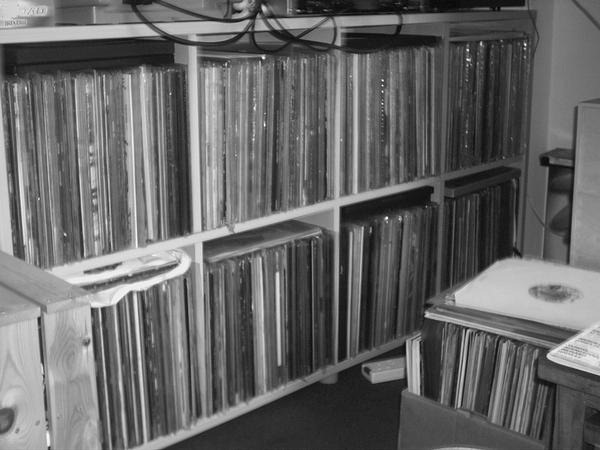
I’m aware of the issues of storage, perhaps more than most. 1,500 or so LPs and 12” singles, 600 7” singles and in excess of 2,000 CDs are a real bastard to house in a two-bed terraced property, and to move when it comes to relocation. But at least I know where my money’s gone and what I need to insure. Picking up a storage device no bigger than an audiocassette knowing that it contains not only my entire music collection, but also music to the value of something in the region of £30,000 is almost inconceivable. The same is true of a virtual library. The fact that a fire tearing through the house would – or could – have the same effect regardless of my choice of ‘file’ type is really beside the point.

It’s curious to note how times have changed: time was when an extensive library of books and an expansive record collection were perceived as accomplishments. They inspired respect, even awe. Now, the owners of large volumes of material possessions are considered to be simply behind the times, information dinosaurs plodding a Luddite land of clutter that’s cumbersome and difficult to navigate. Why would anyone want a 10-volume encyclopaedia when mankind’s entire learnings can be obtained on-line via Wikipedia (or other sites if more specialist knowledge is required, but why would you want that, really, unless you’re a real nerd)? In fact, what’s the point of a space-hogging PC base unit and monitor when you can have everything you need on a tablet? A music collection and library that not only occupies considerable space, but cost a fortune and took a lifetime to accumulate seems entirely redundant beside a small, flat piece of digital kit that costs around £300 and can be transported anywhere. And I suppose if you’re happy or able to accept a life of precarity, instability, endless mobility, that’s fine, but it’s not for me.

In fact, for many, owning music seems superfluous when you can stream it all via Spotify. It frees up funds to purchasing other ephemeralities and experiences. Again, the idea of a life recorded on Facebook is one that doesn’t appeal to me. The public nature of the medium aside, I struggle with the concept of a reliance on something that may disappear at any time. If there’s one thing we’ve learned in our world of rapid development is that technology attains obsolescence at an evermore speedy rate. There was a time, believe it or not, when the 8-track, the cassette and the videotape were all cutting edge. Betamax, laserdisc and minidisc were all the future, yet despite the qualities these media offered, early adopters were left out of pocket and out of style, not to mention out of the technology loop. CD was supposed to supersede both vinyl and the audiocasette – yet strangely, the MP3 killed both CD and tape while vinyl hangs in there, with a whole new wave of audiophiles sustaining a market that previously didn’t exist. I digress: the point is that Facebook could be next year’s MySpace, and a life on line is only a transient representation of real life: it’s a history that can not only be easily misrepresented and misappropriated, but one that could even more easily be erased. Obviously, nothing’s forever, but the physical – especially if backed up, duplicated somehow – has a greater capacity to be futureproof than anything that relies purely on the intangible (but then I find the idea of playing a virtual guitar while playing at being in a virtual band equally abhorrent and not just a little strange Step away from the console, pick up a real instrument, learn to play and form a proper fucking band if you have any interest in Rock Stardom!).

I’m not doing technology down as such – at all, in fact – but can you imagine future generations, instead of looking through albums and biscuit tins of family photos and shoeboxes of postcards and correspondence, gluing themselves to a screen and reminiscing about the day that prompted that romantic email, the wonderful day out to the coast captured magnificently in 6 megapixel digital colour, or even the idea of returning to that book you so loved in college and forwarding your friend or child the Kindle download to read and share the wonder? In all of the streamlining, the decluttering, something has been lost. An on-line playlist is not a direct or equal substitute for a lovingly-compiled mix-tape with lovingly-written, hand-scribbled notes on a piece of paper torn from an exercise book and inserted, tightly-folded, into the plastic case. If, as Marshall McLuhan suggested, the medium is the message, what sort of message is a medium that’s so theoretical say about our times and its users?

The bottom line is that if I’m spending money on something, I want something to show for it. I’m not suggesting that it needs to be big to justify the expense, but in a world where so little is fixed, stable, reliable, there’s a lot to be said for keeping it real as a means of keeping it grounded, and as a way of keeping it accessible in the future.


Vinyl


100_0044


And if you’re loving my work, there’s more of the same (only different) at Christophernosnibor.co.uk.

2011: A Year in Books

When I’m not busy writing, there’s nothing I like more than immersing myself in a good book. In fact, just as I’d describe myself as a compulsive writer, so I’d also describe myself as a compulsive reader. At times, it’s something that can prove to be something of a curse, as I’ll find myself distracted by any text within – or even just beyond – my range of focus. For his reason, rolling news channels can really test me, especially if the screen’s behind the head of someone who’s talking to me.

As a rule, I’m rather a ‘glass half empty’ sort of person, but this year, having found myself required to spend more time travelling to and from places of work (albeit for the same desultory pay-packet), I elected to make the best of a bad situation and use the time in transit to squeeze in a spot of light – and not so light – reading. Here’s a list of the texts I managed to plough through. A handful were re-reads, others were texts I’d stalled on previously and decided to attempt again (successfully this time) and others had been lurking on my shelf for some time. While I enjoyed some more than others, they all had their merits and enriched my life in some way during the last 12 months, and as such, I would happily recommend every last one of them.

Jarrett Kobek – HOE #999

Dennis Lehane – Shutter Island

JG Ballard – The Drowned World

Gary Cummiskey & Eva Kowalska (eds) – Who Was Sinclair Beiles?

James Wells – Hack

Alain Robbe-Grillet – The Erasers

Bill Drummond – $20,000

Chuck Palahniuk – Diary

Frank Kermode – Modern Essays

Mary Beach – Electric Banana

Carl Weissner – The Braille Film

Katrina Palmer – The Dark Object

JG Ballard – High Rise

Stewart Home – Memphis Underground

John Wyndham – The Day of the Triffids

Edward S. Robinson – Shift Linguals: Cut-Up Narratives from William S. Burroughs to the Present

Raymond Chandler – The High Window

Alain Robbe-Grillet – Jealousy

Ed McBain – Sadie When She Died

RG Johnson – American Scrap-Dragon

Mike Meraz – Black-Listed Thoughts

Mark Merlis – American Studies

JG Ballard – The Complete Short Stories Vol. 2

Plato – The Symposium

Roland Barthes – Mythologies

JG Ballard – The Day of Creation

Michel Foucault – Language, Counter-Memory, Practice

Kathy Acker – Bodies of Work

Mark Fisher – Capitalist Realism: Is There No Alternative?

Michel Foucault – The Will To Knowledge 1: The History of Sexuality

JG Ballard – The Atrocity Exhibition

Robert Lort (ed) – Azimute: Critical Essays on Deleuze and Guattari

Chuck Palahniuk – Lullabye

Shakespeare – The Tempest

Stewart Home – Blood Rites of the Bourgeoisie

Nick Kent – The Dark Stuff

Valerie Solanas – S.C.U.M. Manifesto

Ivor Southwood – Non-Stop Inertia


Inertia


And if you’re loving my work, there’s more of the same (only different) at Christophernosnibor.co.uk