Christopher Nosnibor’s Guide to Working as a Music Reviewer – Part One

For those who think that working as a music reviewer is way cool and involves hanging with bands backstage and basking in free stuff and record company promo largesse, the average online music reviewer leads a very different existence. I’m not saying I’m representative of all or even most music reviewers, but as someone who’s been doing this thing for nigh on 20 years off and on, and has consistently turned in over 300 reviews a year since 2009, I do feel I’m at least qualified to report on my own experiences. Will this blog help aspiring reviewers? Probably not. Is it some kind of therapy session? I have no idea. It’s a blog. It is what it is.

When I started writing in earnest for Whisperin’ and Hollerin’ in November of 2008, I was thrilled to receive a Jiffy containing five or six CDs by artists I’d never heard of, and would never hear of again. I was actually off work with ‘flu when they landed, so I say, huddled in a blanket, streaming snot as I shivered and shook my way through a bunch of fairly bland albums, which I dutifully listened to a handful of times and did my best to give them a fair and honest but critically balanced and objective appraisal. It wasn’t easy, at least for all of them.

I started to receive offers of gigs to review in York and Leeds, too, my nominated / designated territory. Keen to get myself on the register, I took the first few that came up regardless. I wanted to prove myself, to get my name out, to show I was eager and willing, and able to critique anything. And so I did. I saw some ok bands, the majority of which I’ve since forgotten. I saw a fair few shit bands, too, but you gotta take the rough with the smooth, I figured.

Being a serious gig veteran (I started watching pub gigs and so on when I was 14 and saw my first big gig proper – The Mission at Sheffield City Hall – when I was 15) I wasn’t the sort to be swept away on the tide of excitement the inexperienced feel when presented with live music. I didn’t think ‘it’s live, therefore it’s amazing’ and was more than capable or retaining my critical faculties – and memory – even after a few pints.

It’s fair to say things rapidly snowballed.

Cut forward from 2008 to 2014 and I’d like to say the hard works paid off. In some respects it has, in that I now receive more free music than I can physically listen to, and manage to score many of the releases I’d have previously paid for for free. Similarly I can pick and choose the live shows I cover, and get to go and see bands I’d have historically paid for – or even missed because I couldn’t afford a tickets, although I still take punts, and I still review acts I’m either unfamiliar with or largely ambivalent to because I think covering them will help raise my profile.

I still don’t get paid for any of this and I still work the 9-5. Trying to do up a house and be a half-decent parent to a 3 year old with a full-time job is enough for most people. They’re pussies, or otherwise lacking ambition.

Tomorrow, I’ll be hauling myself from York to Leeds and out to the Brudenell Social Club after work to cover Black Bananas. I thought their most recent album was middling, a 6/10 but figure they might be entertaining as a live act. I’ll be going on my own, despite being offered a +1. Because I’m popular like that. I won’t hang out with the band. I’ll get back in around 2am and will be up less than five hours later for work. Because. Cool huh?


johnrobbdec

John Robb: music journalist, band front man and cool. The bastard.


And if you’re loving my work, there’s more of the same (only different) at Christophernosnibor.co.uk

Writing about Writing (Again): A Slap of Reality in a World of Fiction

On TV and in films, and even in many novels, writers are often – if not almost always – portrayed as high-profile media types, living the high-life, traversing here and there in sharp suits and fancy dresses, to interviews, readings, launches and high-profile media events. they’re inevitably best-sellers, and vaguely eccentric, and live in nice, even vaguely grand homes or apartments (if they’re American): they get stopped in the street (and, if you’re Castle, at crime scenes) by fans who simply love your books, live and breathe your characters and want to marry you., or at least have an affair.

Now, I’ll be the first to admit that the literary circles I move in are toward the lower end of the industry. By which, of course, I actually mean they exist outside of ‘the industry’. They work regular jobs, have families and chisel out their works in stolen hours late at night and early in the morning. They do it out of compulsion, a need to purge and splurge, rather than for the money. It almost goes without saying I count myself amongst these. Writing isn’t some hobby or light-relief pastime.

The writers I know and associate with are, believe it or not, more representative of writers than the popular portrayals of writers. With a few notable exceptions – Stephen King, JK Rowling, for example – writers tend to be fairly anonymous. Unlike actors, writers don’t get their faces splashed over huge billboards. Writers aren’t usually the most photogenic of people, which is often why they’re writers and not actors. Do you know what E.L. James looks like? Dan Brown? John Grisham? Jodi Picoult? Donna Tartt? Toby Litt? And these are ‘bestseller’ list authors, not the majority of people who constitute the world of publishing in all its guises.

It’s ironic that actors get paid megabucks for playing out the scenes laid out in the pages of books penned by anonymous writers, and earn significantly more for doing so, given that without the writers, the actors would have no scenes to perform. it’s all about having a face and an image that sells. ‘Game of Thrones’ author George R.R. Martin didn’t get rich posting selfies and posing for Vogue.

Fiction is often escapist: it doesn’t have to be fantasy or sci-fi to take the reader beyond the confines of their hum-drum daily existence. And so it may be that even writers who earn royalties of pence and cents may portray high-living celebrity writers in their works. I have no gripe about that, per se, other than the observation that it flies very much in the face of the first principle of writing, which is ‘write what you know.’ This doesn’t mean fantasy and science fiction are out by any stretch, so much as that it pays to at least research scenarios that exist beyond your knowledge, because a savvy reader can spot a bluffer. Research plus imagination is, of course, another matter entirely and can be the very essence of creative genius.

As such, I resist the urge to yell at the TV when ‘celebrity’ writers are portrayed. Of course, my initial thought is ‘when do these people get to do any writing, given the time they spend travelling around to premieres and being famous?’, but the answer is obvious – namely, the rest of the time. Because unlike the writers I know, they don’t work the 9-5, and their maids and the like take care of the kids while they swan round in the name of ‘research’.

Recent research suggests that the prospects of a writing career are pretty dismal if you’re looking to get rich, even if you do achieve a degree of fame: Prospects.ac.uk report that ‘The median earnings for professional writers (those who dedicate more than 50% of their time to writing) was only £11,000 in 2013, and only 11.5% of professional writers earned their incomes solely from writing.’ The Guardian reports that ‘The typical median income of all writers was even less: £4,000 in 2013, compared to £5,012 in real terms in 2005, and £8,810 in 2000.’

This is nowhere near a luxurious salary. It’s not even minimum wage. It’s certainly well below the £16,850 figure the Joseph Rowntree Foundation says is needed to achieve a minimum standard of living. It means that writers don’t live in palatial mansion-type homes, resplendent with antique furniture (unless they’ve inherited it) or plush penthouse apartments. They may have heaps of books on their shelves (the majority likely either purchased second hand or sent to them for review or in trade) but the chances are most writers don’t rise around brunchtime and slip on a silk bathrobe before a serving of eggs Benedict and then chip out a page or so while sipping sherry or 50-year old single malt in their resplendent superbly plush leather-upholstered chair at a Louis XIV desk in the prime spot in a mahogany-panelled library. No, writing is work: hard work, even for ‘successful’ authors. And given that in the region of 99% of all books published sell fewer than 100 copies, what hope is there fore the rest of us to break through to the major league?

The rest of us – the writers who can’t even qualify as ‘professional writers’ and who are obliged to work for a living and write on the side, in their spare time… well, what about us? We may be by and large fringe producers of culture, but collectively account for much of the vital undercurrent that breaks new ground and ultimately inspires the commercial mainstream. We’re the lifeblood. We stay up late, typing with our eye bags instead of our well-manicured fingers, using stolen moments to render those ideas that poke and prod and gnaw at us during the ours of the 9-5 into words that will ultimately purge us of the torment of drudgery.

Some, perhaps maybe many, harbour ambitions of the palatial mansion-type homes or plush penthouse apartment with a capacious library suite and luxurious office. Maybe they’ve bought the fictional representation of the author, like the office temp I worked with once – a guy in his early twenties who was convinced he could pen a novel that would become lauded as a literary masterpiece, after which he would never have to work again. I didn’t delight in shattering his illusions, and equally, I don’t delight in the author’s plight, because it’s my plight as much as the next minor-league author’s. This isn’t about highlighting that plight, either. It’s not a grumble and grouse about how artists don’t reap the rewards they deserve, but a meditation on the vast disparity between the fact and the fiction. And what beggars belief is that the fiction, as presented in the media, of the wealthy, famous and esteemed author, is propagated by authors at all levels. After all, ‘big’ films, TV dramas, series and the like are as likely to be penned by breakthrough authors, who are accustomed to the real world rather than the privileged world of the top flight. Where do they get these ideas from?

Is this the real life? Is this just fantasy? Caught in a landslide, no escape from reality. Open your eyes, look up to the skies and see… Originality is dead. Legend and myth isn’t the life of the author. You’re not Stephen King, you’re not Castle. This is not ‘Murder, She Wrote’. This is life. Now write it.


DSCF9246

Cramped, cluttered and anything but the image of a palatial literary person’s writing space…. the ‘office’ of part-time literary nonentity Christopher Nosnibor, today.


And if you’re loving my work, there’s more of the same (only different) at Christophernosnibor.co.uk.

True Journalistic Integrity: Keeping it Real

Occasional Guardian writer and former Melody Maker journo Everett True says it best on his website profile, which reads as follows:

“My name is Everett True. I am a music critic. This is what I do. I criticise music. The clue is in my job description – music critic. I do not consider myself a journalist, as I do not research or report hard news. I do not consider myself a commentator as I believe that everyone should be a participant. I criticise people and in return I am not surprised if other people criticise me. It is part of the whole deal of being in the public arena. I am Everett True. Believe in me and I have power like a God. Quit believing in me and I no longer exist.”


True

Everett True: the man who ‘discovered’ Nirvana knows how to be critical 


It was reading Melody Maker from around 1987 and onwards through the early 90s that made me want to be a music writer (not a journalist per se, but someone who writes about music)I always preferred MM to the NME because the writing always struck me as being far superior, more intelligent – and when it wasn’t overtly intelligent, its parodic columns and humour amused me no end. I owe a great deal to the paper’s contributors for introducing me to or piquing my interest in so many bands – and also for making me realise just how many ways there were to dismantle a release with an all-guns-blazing slating review.

The first time I tried out as a music reviewer, I submitted a sample piece to the Lincolnshire Echo who were looking for a contributor. A live review of a local band that very weekend, it was pretty brutal. I got a call from the music editor within days. He loved it. I got the ‘job’ (I say ‘job’ because it was unpaid). It was unlike your regular local paper review: it wasn’t pedestrian or polite, and instead took is cues from the national music press, and I’d gone all out to show could write and be critical and creative at the same time. I’d never expected it to land in the public domain, but the editor loved it so much he ran it that very week. For the first time in the paper’s history, a music review received letters of complaint, as well as compliment. Some found my brand of music criticism refreshing. Others thought it was simply horrible and nasty. I was torn between a sense of guilt and gleeful delight. It was awkward and uncomfortable, but I soon came to terms with the fact that what I had written was the review I had wanted to write. There was little point in writing if not to be read, and I’d have to deal with any consequences of that. Besides, it would be shameful hypocrisy to think a critic should be above criticism themselves.

It wasn’t the first time something I had penned had stirred things up. During first year of GCSE studies, I had come up with the idea of writing a gossip column based on my schooling peers: a friend with a computer had helped facilitate the publication, which was distributed by hand to select individuals. The second or third issue of The Parish News was produced during the summer holidays, so I decided to post them to people. Unfortunately, one recipient shared an initial with her mother, who on opening and reading the little zine, took umbrage to references to her daughter’s ‘tight jumpers’ and called the police, who came round to my house to give me a ticking off and insisted I cease publication.

I didn’t, of course. I was simply more careful about my distribution methods from thereon in. it seemed ironic, though, that of all of the things that could have caused offense, what got me into trouble was someone reacting disproportionately to something extremely minor.

And so it’s been throughout my career (such as it is) as a writer, and in particular as a music critic. On one occasion, a ‘find and replace’ typo error on an artist’s name prompted the artist to declare me a ‘moron’ on Twitter and resulted in a deluge of comments from fans decrying my piece ‘the worst review ever written’. I doubt they’d have been quite as bothered if I hadn’t been giving a 5-star review that described the songs as ‘contrived’ and ‘twee’.

Another less than complimentary review of another act provoked a single reader’s one-word comment: ‘cunt’, while parodic pieces penned on the death of Michael Jackson and the evolution of Linkin Park’s sound elicited a tidal wave of declarations of how dumb I was, with the former article bombarded by irate commenters telling me that Michael wasn’t really dead.

But more often than not, as was the case with the ‘contrived’ review, it’s the criticisms of the lesser acts that cause the greatest antagonism. Maybe it’s because in some cases, niche / cult acts have the more ardent fans. In other instances, I can’t help but wonder if it’s the friends and parents of those little bands who can’t believe anyone would have a bad word to say about them.

And so it was when I received an email from a harassed editor, who’d had to fend off some heavy threats from a certain label / management company in light of a less than complimentary review I’d penned of one of their bands’ releases.

I’d said the production was lousy and the songs generic. I’d said they’d be huge, at least for a while. But what sealed it was that I’d referred to them as ‘fuckers’ and ‘dismal twats’. The complainants wanted the review pulled. My editor, thankfully, refused. But what they seemed to object even more than the grim two stars were my chosen descriptors, and they threatened to take the matter further. Needless to say, said review was hurriedly cut and all the rest and a crisis was averted.

I have no difficulty is understanding why they were unhappy with the review, of course. But was a crappy review by a reviewer who very few people pay attention to on a small indie website really likely to damage the band’s sales or reputations? It wasn’t as though I’d written anything genuinely damaging. Their many fans, if any of them bothered to read my review, would likely dismiss me as a grouchy crank.

The heavy-handed threats and forced retraction, then, were tantamount to censorship. And this is where things get difficult. Matters of ‘free speech’ and ‘free press’ are hot topics in the wake of the phone hacking scandal and in light of the recent rise in right-wing extremism and rising tensions amidst religious militants around the globe. I understand that with freedom of speech comes responsibility, and I would never incite hatred or violence, even in jest. To do so would be dangerous and irresponsible. But to slam a band… that’s another matter entirely. By putting their music out there, they’re automatically opening themselves to critical analysis. Let’s also be clear here: they – the band’s ‘people’ who are acting on behalf of the band and therefore represent them and their interests – saw that their music came my way, which is essentially asking for my opinion. And I gave it. This wasn’t some unprovoked attack and it wasn’t exactly ‘personal’ in the true sense. It was just a rather fiery review in which they opinion I gave was negative, i.e. not the one they wanted to hear. While I doubt – or at least like to believe – they wouldn’t have been too affronted by negative comments on a forum posted by the member of the public, as a music critic it’s surely my prerogative to criticise, at least provided I justify my criticism, which I did, with reference to the material and production, amongst other things. So why the furious reaction? It wasn’t as if I’d fallaciously accused them of being Nazi sympathisers or paedophiles. I would challenge them to prove in court that they’re not ‘dismal twats’.

I therefore feel we’re on dangerous ground, not with the ‘free speech’ debate (here, at least, although those who use it as a means of justifying sending threats of death and rape on social networking sites are over the dangerous ground and into the domain of the prosecutable) but in terms of media manipulation through fear. Little zines and zero-budget websites can’t afford lawyers. But if the threat of litigation means it’s possible to ensure only positive reviews are published, what of free speech and journalistic integrity then? Moreover, have we really come to this? Where will it end? I expect if I stick with it long enough, I’ll find out… Meanwhile, whatever happened to simply sending a turd in the mail?


Something Must Break: A Taste

I shall be self-publishing Something Must Break – a long short story, or miscro-novel (7,000+ words) as an e-book via Amazon Kindle soon. With no budget, time or publisher, promotion will be limited. It’s more about putting it out there. ahead f its publication, here’s a taste:


Blood… the roar of blood in my ears. My heart isn’t racing: that connotes an even but rapid pace. Nothing nearly so regular: it heaves, lurches and palpates in my chest. Each beat drives like a hammer, forcing blood in hot, agonized surges through my slowly narrowing veins. My aorta throbs, valves straining and corpuscles pushed to the brink of haemorrhage with every explosive spasm. This is no red mist descending. The mists come in all different hues, dependent on which of the myriad triggers has induced the symptoms on any given occasion. This time, a white haze obfuscates everything, pluming like smoke across all of my receptors.

I inhale slowly, deeply, mindful that I don’t hyperventilate. An oxygen rush would only exacerbate my condition. Which is what? It’s hard to say. But when one of these episodes manifests… it’s not so much that I’m not in control. I’m simply not present, not myself.

My mobile phone vibrates in my shirt pocket and I answer without looking at the display: I can’t focus anyway.

‘Hey, are you ok?’ The voice on the line is Faye, my wife.

My greeting must’ve sounded even worse than I’d thought. ‘Just a bit spaced out,’ I mumble, my voice sounding distant and muffled in my own ears, ‘it’s been a long day.’ She’s aware of these episodes of mine, but I try not to cause her undue worry. I forget the rest of the conversation. I killed the call. My vision was still blurred and my hands were trembling, but otherwise, normality was beginning to return.

I power down the PC, lock up my office and leave.

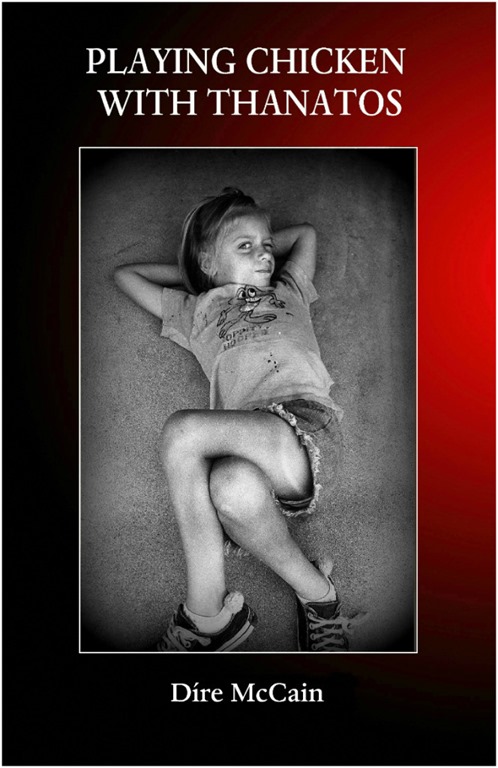
Review: Playing Chicken With Thanatos by Díre McCain (Apophenia Books)

I had the great and rare privilege of reading a manuscript version of this book some time ahead of its final draft and subsequent publication. Then, it had a different working title and a number of changes would follow which made tracing some of the identities of the real-life characters who populate the book rather more difficult. But even in its not-quite complete stage, I was struck by a number of things, not least of all the vibrancy of the narrative, the immediacy of it all, how relatable and accessible the narrator was.

Now, I’ve known the author – virtually, at least, and over Skype – for a number of years: under the auspices of co-founders Díre McCain and D M Mitchell, Paraphilia Magazine generously published my work from the very first issue at a time when no-one else would (a situation that continues, if the truth be known) and have been immensely supportive through the years, long before I clambered aboard as a contributing editor. Díre also graced the Clinical, Brutal anthology I edited for Clinicality Press in 2010 with a piece that was stunning, not to mention truly brutal. So I had an inkling of her abilities as a writer, and indeed of her turbulent formative years. But none of this could have really prepared me for her autobiographical novel.

It’s everything you want from a novel: the narrator drags you along on the journey: at times you sympathise, at others, not so much, but that’s how it is with friends, you take the rough with the smooth. It’s the raw honesty of Díre’s narrative, delivered in a strong, individual voice, that’s so compelling and so human that means you forgive, and you worry about what will happen, you’re there in the moment.

It’s also the fact that however bad things get, however badly she’s treated and however low she sinks, she never plays ‘the victim’, and herein lies the book’s greatest strength: she just tells it straight, and never uses sensationalism to detail sensational events. In this way, Playing Chicken With Thanatos doesn’t sit with the contemporary vogue for memoir, but instead belongs to a strain of classic American autobiographical reportage: Bukowski’s Post Office springs to mind; Jack Black’s You Can’t Win; Burroughs’ Junky, and from over the pond, Colin Wilson’s Adrift in Soho and Terry Taylor’s Baron’s Court, All Change. What all these books share is an episodic approach to storytelling and a lack of pretence.

There are moments that are utterly terrifying, and the happy-go-lucky easy rollin’ of teen experimentation with whatever substances are on offer takes a turn into extremely dark territories, and the later sections of the book are indeed harrowing. But it’s by no means a depressing book: even through the bleakest sections, the way the words simply flow is a joy, and the author’s sharp intellect and extensive vocabulary set Playing Chicken With Thanatos leagues apart from any drug-addled confessional. And, despite placing a clear distance between her past and present, at no point does Playing Chicken With Thanatos become a vehicle for anti-drug rhetoric, high moralisation or preaching: the fact Díre doesn’t insult the reader’s intelligence – or mar the narrative – with such interjections is another aspect of what makes this book such a great read.

It’s from a purely objective mindset that I say that this book is special, bursting with life and emotional resonance and that for these reasons I give it my strongest recommendations. So do as the preface bids: ‘fasten your fucking seatbelt and hold the fuck on….’


PLAYING-CHICKEN-WITH-THANATOS-Cover-664x1024


Link: http://www.paraphiliamagazine.com/diremccain/playing-chicken-with-thanatos/


And if you’re loving my work, there’s more of the same (only different) at Christophernosnibor.co.uk

Blah, Blah, Blah, Blog On…Why I Quit Blogging Part 2

I couldn’t give a shit about your blog. I’d say it’s nothing personal, but in truth that’s exactly what it is, because your blog is you, your life, your innermost thoughts, out there, in the public domain. I should admire your courage, your openness and honesty. Your brutal truth. Your disarming humility, your humanity. The fact you’re so willing to open up and reveal your insecurities, the mechanisms of your daily existence. You’re real, you’re normal: we’re all insecure, we all eat, sleep, dream. I almost feel as though I know you, as if I’m living your life with you, like I’m there, a part of you and your life, your beautiful, brilliant, ordinary life, where I’m sharing your dreams and hopes, your knock-backs, disappointments and failures, the long, hard hours you put into your work, your family, your writing, your emotional release.


Blog3

Do as the sign says and love yourself a bit more


And therein lies the problem. We all do exactly the same, fundamentally, and it’s no secret as to what it is to be human. Get a fucking grip. you’re not special.

Half the people who have blogs harbour ambitions of being a writer. Stop telling me about how you’re so engrossed in mapping the plot, how you’re starting to live and breathe the characters, your creations, your babies and get on and write it. The endless hours spent writing blog posts about your writing process could be spent actually writing something. But then, so could the hours spent arranging flowers (and posting pretty pictures of your arrangements on your blog), baking (and posting semi-pro shots of your magnificent cakes and mouthwatering confectionary), taking coffee with friends, making – and photographing – endless pots of speciality teas in your humble, small but tasteful cottage kitchen. So you like Earl Grey, love brownies and hate confrontation but more than anything you want to write that book and see it published.


Blog1

So many blogs, so little time

Me, I like to keep quiet about my personal life, what I get up to. No-one gives a fuck that I suffer chronic insomnia, woke up at 4:30am in a state of panic and drenched in sweat as I wondered how I’m going to pay he next electricity bill and the rent while reeling amidst tumultuous thoughts whereby my abject failure both as an artist and a human being scream at me until the dawn breaks.

No-one cares that I stumbled downstairs in my dressing gown at half past six with a raging hangover, crazed and delirious from a fitful sleep punctuated by nightmares to make a cup of tea – no-brand with semi-skimmed milk from Asda, five days out of date and on the turn – that went cold while I emptied my bowels, a lose movement with a small trace of blood, before hauling my sorry arse into the spare room where the computer – hopelessly out-of-date and only semi-functional – sits and attempt to hack out some words. You don’t need to know how I pissed away my day in isolation, fielding phone calls from my mother and three different offshore sales departments. How I cooked a bland meal of pasty oven chips and a tepid frozen pizza before vegetating on the sofa in front of some brainrot ‘reality’ TV because there’s nothing else on on a Saturday night. No, you just don’t want to know.

Better just get on with it.


Blog2

You don’t have to have anything (important) to say to blog about it.


And if you’re loving my work, there’s more of the same (only different) at Christophernosnibor.co.uk

Midlife Crisis

I will be 38 very soon. Some might say I look it, others less polite that I don’t, because I look 20 years older. They’re twats, but it doesn’t matter.

When I turned 30, I found I began to care less. That doesn’t mean I stopped caring altogether, or that I stopped experiencing fits of anxiety over various things, but that having realised I was old enough to be taken seriously while being young enough to be up-and-coming, and having been around a while and seen some things, I was beginning to be comfortable (enough) in my skin to not worry about trivial matters such as peer pressure and looking ‘cool’ (and since true cool is about not giving a fuck, my coolness soared by default).

So, being almost 38, I don’t really care that I look like a burned-out trampy mess. I’d rather spend time and money on doing stuff than on clothes and preening in front of the mirror.

Therefore, it may be because of my age or it may be because of the times and the culture, that I’m fed up of emotional depth. Don’t get me wrong, I’m not insensitive, and music and films and writing with emotional depth still move me, when well executed. But I’ve no time for all this heart-on-the-sleeve, bleeding-heart, introspective emotionally-wracked tortured soul crap any more. Artists who feel every heartbeat, and agonise over every exchange between themselves and the many individuals who have a high emotional impact on them, for whom every conversation involves trawling the depths of their souls and agonising over their every move…. I simply haven’t got the time.

Forget this creative soul, artistic genius bollocks and move on. Get a grip and get a life. It’s quite possible to have resonance without picking at the scabs on your navel and sharing with the world at large the minute details of your tempestuous relationships and near-misses and all of the other ephemeral emotional highs and lows that punctuate or even define your otherwise dreary life. Because that isn’t life: it’s five minutes of your life, and no-one else cares. Least of all me.


And if you’re loving my work, there’s more of the same (only different) at Christophernosnibor.co.uk

The Changing Face of Consumerism: Public Opinion, Booze Culture and Bartering

The local newspaper recently ran a front-page headline about proposals to open three new pubs in York’s city centre. Two local breweries – The Leeds Brewery, formed as an offshoot of the York Brewery, and the Ossett Brewery, had submitted plans to take over vacant premises – one a former cafe, the others retail units, previously an estate agent and an army surplus store.

The objectors raised all of the concerns you’d expect them to. Predictably, there was concern about the city centre becoming a mecca for drinkers, that having such a concentration of licensed premises would send a message that York promoted the already endemic booze culture that is, we so often told, a leading problem in Britain that causes the taxpayer billions, and that the opening of these three new hostelries would encourage an even greater influx of stag and hen parties and cause violent, alcohol-fuelled crimes and other such sordid scenes to soar.

But these aren’t the kind of places rowdy stag and hen parties would frequent. we’re talking about traditional ale houses that would also serve traditional pub grub. The kind of places tourists – particularly those from America and Japan – flock to in their thousands in order to experience a slice of culture they simply do not have back home. As a historic city, visitors to York want to see and sample tradition. They also want refreshment.

Other critics argued that it was essential that the city preserve retail premises for retail when conditions improve. Will they ever? This is also the same council that approved another out of town retail park, which objectors – not least of all local business owners – have opposed on the grounds that by taking the retail trade away from the city centre, the place is slowly dying. It’s a complex argument, not least of all because the major chains and small independent stores serve different markets. Nevertheless, they can’t have it both ways, by encouraging more retailers to move out of town and then complain that there is an abundance of vacant premises once occupied by retailers, especially in the middle of a lengthy economic downturn. Remember the words ‘credit crunch’ and ‘recession’? For some reason, people seem to think things are improving just because the FTSE’s up and more houses have sold in the last 6 months – never mind the huge numbers of redundancies announced by large employers like Aviva, Co-op and HSBC.

There is of course another angle to this, namely, if everyone’s redundant, they’ll need nice pubs to sit in and while away the hours as they drink their redundancy pay-offs and dole cheques.

The same day I read the article, I was walking home through the city’s pub-packed centre when I ran into musician, poet, diarist and rambler Mark Wynn, a man who’s inspiring in his complete disregard for any kind of consumer trends or capitalist-led operating models of industry. As ever, he’d been travelling the length and breadth of the city, the county and the country, playing poorly-paid gigs in pubs of the very sort the Leeds and Ossett breweries run and giving away most of his CDs for nothing or in exchange for a beer. It’s something to be applauded. he’ll never be rich, but in sharing his art, he never goes thirsty. Moreover, his approach represents the epitome of the punk ethic: he’s out there doing it himself on zero budget and building a fanbase from a grass roots level. that’s what I call sticking it to the man!

We exchanged pamphlets: I had the very last copy of my Liberate Yourself! pamphlet folded in my bag (there are now 100 copies in circulation, and having been left on trains, in pubs, inside self-help books in WHS and who knows where, their whereabouts and readership I haven’t a clue) while he had a batch of a new A5 publication called Dirty Work containing some selected highlights of his spectacularly off the wall and very funny tour diaries and, stapled inside the back page, a PVC wallet containing his last album. Arguably, I was up on the deal, but these things always balance out over time (some weeks later, Dirty Work 3 would see the light of day, containing more rampant ramblings and a new CD EP by Mr Mark E Wynn with additional text by Sam Forrest of Nine Back Alps and The Sorry Kisses, and myself). The important thing was, we had traded our art with one another, we’d both received something we wanted and what’s more, the cash-free barter had taken place on the street. Retail outlets are just so last year.


Woolworths_-_History_1_JPG_375x238_crop_upscale_q100

Shops? Who needs ‘em?


And if you’re loving my work, The Changing Face Of Consumerism – the book – will be out some time in June.

Criticising the Critics Criticising the Critics: An Exercise in Infinite Reflexivity and Getting Hip

So I recently stumbled upon a piece that was ostensibly a review of a gig I’d attended and reviewed, but with the secondary purpose of dismantling my review.

The writer, one Patrick Lee attacked my write-up from a number of well-considered angles, but it seems that the primarily provocation, to which he took particular exception, was my observation regarding the number of trendy hipster bozos in attendance (in fairness, relatively small) and the fact they talked incessantly (thus more than compensating for their number in terms of volume and level of irritation caused).

What I actually said, in the middle of a glowing review of all 4 acts performing that night, was, “Granted, a band as hot as White Firs are going to attract more than their fare share of hipster hangers-on, and the duffel-coat wearing popped-collar brigade are out in full force tonight, standing right at the front talking loudly and posturing hard. Forget ‘em. it’s all about the music…”

His response – suggesting he didn’t read the entire piece – was to get uppity about the duffel coat diss (I’d add that I was wearing a fleece under a jacket under a leather coat, because it was cold and I need the pockets to carry my pad / camera / beer / ego, but of course, I like to be inconspicuous at gigs and so not only to I keep out of the way but I keep my trap shut) and to defend talking throughout Bull’s set (I wouldn’t know if he jabbered on through the headliners’ set because I moved to get away from the hipster bozos who’d been standing directly in front of me).

He begins by saying ‘I think I might have been (depending on the time of the paragraph taking place) one of the “hipster hangers-on”, and whereas I am, I think, borderline complimented by this, I do take exception to the duffel-coat criticism, wanting to take the chance here to express admiration both for the duffel coat itself, and for those daring enough to wear it inside at a gig as “hot” as the one The White Firs produced.’

I’d also note here that neither of the places which have published Patrick’s piece (in Vibe as ‘Notice the form, or, Looking up at music culture from the underground’ and One&Other under the more descriptive and succinct title ‘Review: White Firs at Nichely Does It’) include links or even proper credits to my own original review which appeared at Whisperin’ and Hollerin’ and this, it has to be said, is poor form. But what’s considered good etiquette clearly isn’t a part of his agenda and may not even feature in his cognisance.

More pertinently, only a narcissist of the highest order would find any way of converting my criticism into a commentary, and then to admit to a) being one of the ‘characters’ so depicted b) being complimented (borderline or otherwise) transcends narcissistic egotism and borders on sociopathy. But then, such is the arrogance of the hipster. Pretentious, moi? I’m so cool, of course he’s writing about me… At this point, Patrick turns my criticism around a full 180 degrees to reveal that in fact, it is I who is in the wrong for being so misguided as to complain about their incessant chatter, writing,

‘to criticise those voicing an opinion during bands like Bull and The White Firs would be an error. Daring to pursue, tackle, render lifeless and then begin a post-mortem on this error is, as noted, daring, as splitting open an ugly error of such bizarre and complex proportions is likely to result in being covered in surgical smelling entrails; but, dragged here as we have been, we might as well cover ourselves in the grizzly innards of the thing, and hopefully be left cathartically and metaphorically cleansed by the end. A crucial question has been left unasked by the typical, cliché-ridden reviewer of music: What do The White Firs do?’

What do White Firs do? I think I covered that, actually, because I make a point of providing objective reviews that actually say what bands sound like and what they ‘do’ on whatever level people who’ve not heard the band may be interested in knowing about. Again, this furthers my theory that Patrick’s protracted exposition was a knee-jerk reaction to the second paragraph, and he was so incensed and overwhelmed he was compelled to spill his effusive verbiage instantaneously without taking the time to read on.

I feel a degree of empathy here. I too sometimes struggle to contain the urge to splurge when it comes to committing words to the (virtual) page, although I do think it’s poor form to dismantle a piece of writing without having read all of it. There’s a grave danger of appearing reactionary and ill-informed, after all. More importantly, my piece doesn’t have any pretence of being anything other than a review. It’s a short article, not a feature. I produce over 400 reviews a year. There isn’t the time to pick apart every fibre of every band’s being, and nor would I wish to even if there were. I don’t care what White Firs ‘do’ in terms of their being some kind of mega-influential cultural phenomenon. Not yet, anyway.

So when I wrote that ‘During their blistering set that ratcheted up both the volume and intensity of the night, they proved themselves to be in a different class altogether. With a rock-solid rhythm section (drummer Jack Holdstock occupied the stool for now-defunct but hotly-tipped garage noisemongers The Federals) providing the pulsating heart of the sound and the essential foundations for the fuzzed-out guitar attacks, they’ve got the swaggering Stooges sound absolutely nailed,’ I think I gave a few hints about what they ‘do’.

In fairness, hipster wordsmith Patrick Lee is writing with a different purpose. His angle, while writing on music and culture, in this piece, is to consider the nature of music reviewing, and there are many who believe that reviewing is a frankly pointless exercise. Fair enough, but in my experience both as a reader and writer of reviews, I’ve found that people come to respect the opinions of certain reviewers, and discover a lot of new bands they otherwise wouldn’t have because of the acts those reviewers provide exposure to.

It’s notable that a number of people have complained that they’ve never heard of any of the bands I review. As far as I’m concerned, that’s precisely the purpose of my reviews. Everyone already has an opinion on U2, Radiohead, Madonna, Coldplay, the household names and acts they have heard of, and there’ll be no short of coverage of their latest album in everything from The Guardian to the NME via The Sun and Q, not to mention every last website you might care to look. I find it much more gratifying – and culturally useful – to put word out about unknown and lesser known bands. And it’s for this reason I place such emphasis on description. Again, by way of example, another excerpt from my review of White Firs.

Danny Barton’s vocals have a nonchalant drawl about them, but still carry a melody and delivery some tidy pop hooks. Meanwhile, brother James churns out thumping basslines as cool as you like, while occasionally throwing in some shouty backing vocals. For all the overdriven noise blasting from the amps and the PA, it’s clear they’ve got a keen ear for a tune, their appreciation of Big Star shining through the squall of feedback.’

I’d also add that I tend to keep my style simple and direct, not because I’m incapable of flourish-filled purple prose, but because, well, who needs it? I love seven-line sentences and paragraphs that extend beyond three pages more than most of my work reveals, but by the same token, I do make every effort not to produce slabs of text so sense with descriptors as to lose even the most articulate of readers – an my own meaning – before the first semicolon. Postmodern society’s alienating enough without needlessly alienating the bulk of any potential readership before you’ve even said anything. Moreover, a good reviewer knows that their job is to convey what’s exciting about the band – and it’s all about the bands, not pushing my own agenda of convincing a publisher that they should indulge my literary aspirations by signing me up for a five-book deal which will see me rubbing shoulders with Martin Amis and Salman Rushdie and other heavyweight purveyors of literary fiction. Again, Lee’s reference points – Hemingway and Brett Easton Ellis – are telling in that they’re suitably literary (by which I mean they’re worthy namedrops for anyone with a casual interest in 20th Century literature) but reveal the author to be lacking in real knowledge of the field (Stewart Home makes for a much more pertinent and credible alternative to Ellis, and Lee could do far worse than acquaint himself with the exploratory prose of my own recent anti-novel, This Book is Fucking Stupid, if only to demonstrate just how firmly he’s got his finger on the pulse of the literary zeitgeist).

I’m practically bawling into my beer when I read his incisive summation of Bull, which pisses all over my my ‘tepid, cliche-ridden’ descriptions (being a typical music reviewer, I’m completely incapable of moving beyond such abysmal prose, while yearning to achieve flourishes comparable to his Paul Morley-esque circumlocution, brimming with esoteric verbosity dressed in endless frills. So when Mr Lee writes of ‘splitting open an ugly error of such bizarre and complex proportions’, it’s worth remembering the context. He’s writing about talking at a gig. And what’s more, he’s trying to defend it by pointing out that he was only saying good things about the bands. Good, clever things, too, unlike my simplistic, witless cliché things – which I at least had the decency to keep to myself until I’d left the venue. Put simply, Lee is making a pathetic and utterly misguided attempt to excuse the inexcusable and defend the indefensible by means of absurdly overinflated and exhausting prolix.

Of course, it all amounts to no more than pleonastic posturing. Fair enough. But please, next time you’re watching bands play, just shut the fuck up.


hipster1

A hipster at a gig, minus duffel coat. He’s so cool he’s hot and doesn’t need any tepid descriptions, dude.


Patrick Lee is a graduate from Goldsmiths College, University of London. He has written for Mint Magazine, International Relations, The Vibe and continues to write and edit fiction for Shabby Doll House. He enjoys music and film, and reading contemporary fiction, non-fiction and philosophy.

His profile pic features him, with a chick – thus illustrating his popularity and appeal to the opposite sex – with a paper or polystyrene beaker held in his mouth. What a bozo.


Christopher Nosnibor is a writing machine. He doesn’t feel the need to justify his existence by including his superior educational background in his biography and has written for more publications than her can be bothered to list.

He doesn’t have a profile picture, so no-one can identify him and beat the crap out of him when he’s dished out one of his more critical music reviews.


And if you’re loving my work, there’s more of the same (only different) at Christophernosnibor.co.uk

Redressing the Balance: This Book Isn’t Nearly as Stupid as the Title Suggests… Or Is It?

For all of the claims made by myself and my publisher for the audacious anti-literary bent that drives my latest novel, This Book is Fucking Stupid, the fact that the core thread – the story itself – is essentially a straightforward piece of contemporary literary fiction is something that’s been very much underplayed.

As the paperback edition is out today, I thought it would be an idea to post an excerpt from one of the more conventional narrative passages, if only to prove to the world that as a writer I am capable of ‘normal’ things like plot and character development (after a fashion) and not only about text that function on a theoretical level…. Ok, well I half mean it…


from This Book is Fucking Stupid


It was just another day at the office, the same as any other. Ben sat at his desk. He had spent the last three hours trying desperately to compile his latest report based on a series of site visits to out-of-town shopping developments ahead of Friday’s deadline, but it was proving nigh on impossible. For a start, the buildings were in a poor state of repair: his surveys had uncovered a number of significant structural flaws which were bad news all round. The trouble was, he found these modern prefabricated monstrosities composed of concrete and corrugated iron the most uninspiring of all buildings to assess, and while he had most of the information he required to hand, some of his notes were a little patchy regarding some of the sites, as he had been tired, bored and hungover while conducting the surveys. That said, he didn’t really find buildings in themselves all that inspiring. Surveying hadn’t been a calling for him, but then, for whom is surveying a calling, a passion? Surveying was a job, which required an even and pragmatic approach to factual data and a grasp of figures and certain scientific concepts regarding the deterioration of concrete, the weakening of iron girders, the flammability of certain materials and so on.
    The appreciation of architecture was not a prerequisite for becoming a government inspector of commercial property. Yes, a civil servant. But the modern out-of-town retail park developments were still the worst: once you had seen one, you had seen them all. But feeling tired and grotty made any report on such buildings even more wearisome, and with a tight deadline looming, even more troublesome to a man who was not a big fan of typing long reports, preferring, if possible, to keep communications down to brief notes and bullet-points. Equally troublesome, his phones – landline and mobile – kept ringing, interfering with his train of thought. No sooner had he regained his flow and begun formulating a coherent sentence detailing the defects in the roofing structures or damp coursing than another call would demand his attention and haul him away from the job at hand for just long enough for him to forget exactly what it was he had been about to write next.
    Ben sat and rubbed his eyes with his thumb and forefinger. His skin felt rough and dry, his eyes sensitive and watery. He had been staring at the screen for what felt like hours. How long it had really been, he was uncertain. The text was beginning to drift before his eyes as he read it again and again. The text was beginning to drift before his eyes as he read it again and again. He was exhausted, and this was reflected in his sallow appearance. He had spent the last week and a half driving long-distance between the sites he was surveying for this report – Wednesday last, Southampton, Thursday last Birmingham, Friday last Nottingham, followed by Bath on Monday, Stoke on Tuesday, Newcastle on Wednesday and Norwich this morning – before returning to the office with a sheaf of scribbled notes, digital camera shots, notes recorded on a Dictaphone while on the tops of various buildings, muffled and inaudible due to high winds blasting across the mic as he had mumbled tiredly and unenthusiastically about various joists and joints. He rubbed his eyes again and returned his bleary eyes to the screen. He rubbed his eyes again and returned his bleary pupils to the screen. He needed a break. Needed to clear his head, to regain his focus. Yes, he had a deadline looming, but he’d never make it like this, he simply couldn’t focus his mind.
    The Foo Fighters’ track ‘The Best of You’ rattled from his pocket for the umpteenth time that day. He loved that song – it rocked – but he was beginning to tire of its polyphonic yet stunted ring-tone version intruding into his life every five minutes. He was also weary of his works mobile. Why they wouldn’t upgrade to something more contemporary and functional like an iPhone or a Blackberry, he had no idea.
    It wasn’t that Ben was a he fan of the iPhone, although he did rather like its multimedia functionality, and its now classic design. He liked its dimensions, a cozy yet suitably chunky 115.5mm x 62.1mm 12.3 and comforting 133g weight. He also had an appreciation for its TFT capacitive touchscreen, even if its sleek surface, with its with its scratch-resistant oleophobic coating, became a slick of greasy thumb-prints within seconds, even while in the pocket, and these obscured the screen, despite its presenting a respectable 320×480 pixel 3.5” view at a density of 165 pixels per inch. Similarly, the Blackberry was a classic example of contemporary design. The Curve 8900 had real appeal. Despite the rather fiddly QWERTY keypad, it was practically a mobile office that would fit in the pocket, and with its 256MB ROM memory, 250ppi display, albeit at a smaller 2.5” – a whole inch smaller than that of the iPhone – its 65K colours made it suitable for checking out pics emailed from different sites while on the move, and then there was the card slot with a reader that could handle an SD card of up to 32GB. It also had the better camera. Still, neither the iPhone nor the Blackberry had a battery life worth writing home about, while the clunky piece of Nokia crap work had provided him with only needed charging once a week.
    He checked the name on the incoming call. It was Ruth, his ‘better half.’ They had been together almost eight years now – long enough for him to have known almost instinctively that it would have been her ringing.
    “Hi, Ru,” he said, half sighing, half croaking, his voice cracked with fatigue.
    “Hey,” she chirruped back.
    A slight pause – as was customary. He never liked to jump in and ask why she was phoning this time – it sounded tetchy, and she was the sensitive type – but she never came straight out with anything either, hence the waggledance of telephonic etiquette each time they spoke, even after all this time. Particularly after all this time: it had become habit, and he knew it. He knew not, however, of a way to break it, or even if there was any point in doing so – or even if he wanted to do so. It was harmless, but did take seconds out of his busy day. Seconds that could have been spent on other matters. He fought this involuntary irritation that he felt – that he had been feeling for the past few weeks, or possibly longer, he’s not been paying that much attention as he’d had a lot going on – and reminded himself that Ruth didn’t actually do anything to annoy him and that his tiredness was simply making him irrationally irritable. It wasn’t his fault he was tired and stressed. It wasn’t her fault he was tired and stressed. He just was.
    “Hey,” he echoed back, as he commonly did. It bought time, breathing space, signalled to her that he was listening, like a call-and-response of ‘Copy,’ ‘Roger.’
    “I was just wondering what time you’d be home for tea tonight,” she said in her usual even, gentle tone.
    He sighed and rubbed his tired, itchy eyes again. Ruth liked her routine. Daily, she called around 3.30 or 4pm to enquire when he’d be home, although he was rarely able to give a specific answer. There were invariably deadlines to be met, which frequently entailed working later than anticipated, however he budgeted his time, however hard he worked, and however closely he worked to the premise that however long one anticipates something taking, double it and add ten per cent to get a more accurate estimate. Then there was the matter of the drive home. On a good day – or a weekend – it would be a 40-minute drive. But on a weekday, during the rush two hours, it could be anything up to an hour and a half, and that was provided there were no accidents, freak storms or other unusual circumstances which may extend the journey time still further. Ben enjoyed driving, but did not enjoy being stuck in slow-moving traffic for hours on end on the same stretches of rode night after night. Open country roads with the windows down, the wind in his hair, shades on and the stereo up loud and his foot the the floor, that was his idea of driving. It was to liberating, that sense of freedom, the idea he could go anywhere he wanted, and fast. It was the precise opposite of being hemmed in between the mushroom walls of the office in which he worked, with its Jacobs Twist Axminster carpet in a fetching shade of blue-grey by the name of Fen and regimented rows of desks, each with identical Dell base units and monitors, accompanied by ergonomic keyboards and mice and standard-issue high-backed office chairs without arms.
    “I dunno,” he replied after a pause. “I’ve got a lot on at the moment.” “Ok, do you think you’ll be home before eight-ahuh?” she asked, her voice rising at the end and a small not-quite-laugh following the last syllable. He pictured her, smiling as she did, her nose wrinkled a little and her eyes half-closed, an endearing expression which he had been fond of from the outset when they had met some seven years ago. How time flew! He had been in his early twenties then, and having recently relocated following the securing of a decent job in Sheffield, Ben had been on the brink of embarkation on his career proper.
    “I don’t know,” he reiterated. “I hope so, but I wouldn’t like to say for definite.”
    “Ok, well I thought we might have chops tonight and they grill in no time, so I shall wait until you get in before starting the tea.”
    “Fine.”
    “Call me when you’re leaving work?”
    “Sure.”
    “Ok, I’ll speak to you later, bye.”
    “Yeah, bye.”
He couldn’t help it, he knew he sounded ‘off.’ The simple fact was that he had been feeling decidedly fractious lately, and it was difficult to pinpoint the exact reasons why. And because he didn’t know, he felt he couldn’t really talk about it with Ruth – what was there to say? It was his problem, and he didn’t want to push it onto her. She had her own things going on, namely the fact that she would soon be unemployed – again. After a succession of unappealing and unsatisfactory temporary jobs, mostly in big corporate offices, the type of place she hated – so many people, so many awful people, the sort she’d not have given a moment of her time to through choice – she had landed herself a fantastic job on a medieval library archiving project. Only now the project was almost done and the funding had run dry and so her contract was to be terminated in a couple of weeks. Ruth’s unemployment, or otherwise low wages did place a strain on things for them financially. Again, Ben never liked to make an issue of it, because to do so would be unfair. He accepted, and in some ways, thrived on fulfilling his role as the dominant male, the breadwinner. He’d always been ambitious, and while he’d never been certain as to what career he wished to pursue, he’d always been ambitious to earn. A good income, a nice house, a fast car…. It’s what every man wants, and it had always been his dream to live the life, to work hard and to reap the rewards, and to spend those rewards in such a way that everyone who saw him knew it, that he was a successful person.
    But right now he didn’t feel successful, and he was struggling to put his finger on exactly what the root of his niggling discontent was. But he had realised that he was not content, and despite his reasonable income – £42K pa plus car plus mobile phone, etc., was a fair salary, he knew that, although after tax there was little benefit, he felt, to earning £42K over earning £25K. He knew he wasn’t like those he left behind in school, those whose profiles he had read on Friends Reunited….

One Star


And if you’re loving my work, please buy a book. This Book is available in print from Clinicality Press and as an e-book through Amazon.co.uk and Amazon.com.