Things That the Everyday Folk Leave Behind

So I’ve had a pretty busy time of late, what with a couple of interviews I’ve conducted and am conducting for various publications, not to mention interviews and promo bits and pieces for From Destinations Set which is out on the 28th, and a spate of gigs and a tidal wave of new releases to review (90 reviews this year to date), and as a consequence, the blog’s something I’ve let slide a bit (again).

With so much to do, places to go and people to see, I find I spend all of my waking hours rushing about, and my non-waking hours spent with my mind churning through all of the things I’ve done and have got to do and should have done but haven’t yet. To an extent, that’s pretty normal for me, but lately I’ve been so preoccupied and absorbed in all of this activity that I noticed that I’ve stopped noticing things. This concerns me. I’ve always maintained that being attuned to one’s surroundings is the key to being a writer of merit (and while my merits as a writer won’t ultimately be determined by me, it’s something I like to feel I at least aspire to). Besides, it’s not something that’s entirely optional: drawing on the details and minutia of the everyday is a compulsion, it’s something I can’t help, at least under normal circumstances. Observation, those details of life and snippets of overheard dialogue have long provided me with an abundance of material for my writing, be it fiction or blogs or whatever, Absorbing information from the world around me is integral not only to my work, but who I am. Small wonder I was beginning to feel that the workload was swallowing my life: I was beginning to lose myself.

As a consequence, I resolved to pull myself back to life, and I’ve begun to try to observe my surroundings again. I have no idea why I was remotely surprised by the sensory overload this retuning induced, given that I find the wealth of extraneous information dizzying the majority of the time, but having effectively shut down for a period of time, engaging once again with my environment proved to be an immediate culture shock.

So on leaving the house this morning, I was elated to note that day was breaking. It was the first time in months I had hit the pavement in daylight. The air was cold but still. Birds were singing – something quite uncommon given the density of the housing, the lack of gardens and trees and the large number of brutal cats in the neighbourhood. On arrival at the bus stop, I was amused – and also bemused – to see that on one of the seats moulded into the shelter was a handbag. Abandoned, forgotten. Beside the handbag, stretched and strewn across the next two seats, a pair of tights. I wondered if the tights and bag had the same (former) owner. Must’ve been one hell of a night.

It’s not just physical objects that are discarded at random. Conversations, sounds, ideas, all contribute to the flotsam and jetsam. Before long, I’m on the bus, surrounded by blank individuals. The journey is soundtracked by the album The Disaster of Imagination by Sense of Scenery. It doesn’t entirely drown the chatter of the other passengers. I’m reading $20,000 by Bill Drummond. The sensory overload I’m accustomed to is back. Snippets of dialogue filter into my consciousness, on the bus, at the office. Most of it mere babble, some of it so inane it’s beyond belief. ‘Is she still Spanish?’

I’m being flooded with material, more material in a day than I can use in a lifetime. I pick them all up, all of the bits and pieces, and stow them, ready for when I need them. I never know when I might need that discarded handbag, the left-behind tights, the fragments of dialogue, the half light and the birdsong. I’m living the experience that I was supposed to be creating to an amplified degree in THE PLAGIARIST. It’s not funny any more. This is the world.

I’m back and I’m firing on all cylinders….

And if you’re loving my work, there’s more of the same (only different) at Christophernosnibor.co.uk
Spin on this! When the Machines Take Over

So things are starting to happen where the publication of the paperback edition of my novel, From Destinations Set is concerned. The publisher have the first batch in hand – I’ve seen one, and they look great – and are starting to mail out review copies. They’re circulating press releases, too, and from what I can tell, these are beginning to generate traffic already.

Stuart at Clinicality Press has penned some very nice press releases and made use of the rather tidy synopsis / blurb he did for the book. I was amused, then, to find a version of the press release that didn’t remotely resemble those Clinicality have issued, not least of all because one of the threads of James Well’s book, Hack, that Clinicaliy will be putting out later in the year, is concerned with word-spinning.

Unsure of precisely what this entailed, I conducted a spot of research, to learn the following:

Article spinning is a search engine optimization technique by which blog or website owners attempt to manipulate their rank on Google and other search engines. It works by rewriting existing articles, or parts of articles, and replacing elements to avoid being penalized in the Search Engine Results pages (SERP) for using duplicate content. The original articles are often plagiarized from other websites and can often also be copyright infringements if the original article was used without the copyright owner’s permission.

Website owners may pay writers to perform spinning manually, rewriting all or parts of articles. Writers also spin their own articles, manually or automatically, allowing them to sell the same articles with slight variations to a number of clients or to use the article for multiple purposes, for example as content and also for article marketing. There are a number of software applications which will automatically replace words or phrases in articles. Automatic rewriting can change the meaning of a sentence through the use of words with similar but subtly different meaning to the original. For example, the word “picture” could be replaced by the word “image” or “photo”. Thousands of word-for-word combinations are stored in either a text file or database thesaurus to draw from. This ensures that a large percentage of words are different from the original article.

The spun version of Stuart’s press release is a brilliant example of automated article-spinning 9and why it doesn’t work). The words substituted so inappropriately that much of the initial meaning is lost. Nevertheless, it’s highly amusing, and while it’s great to see my work continually cropping up in unusual and unexpected places, I very much doubt that this piece will do much for the sales of From Destinations Set. Ah well….  http://42.cm/clinicality-press-push-the-boundaries-with-a-book-of-two-halves-coming-march-28th/

Notes From a Mountain: Annual Coleridge Kick, 2011

My annual Coleridge Kick began in 1987. My father had a Winter Fell-walking trip booked with a friend of his who dropped out, so I took his place and I got a real taste for experiencing the great outdoors in the kind of conditions that keep most people sheltering indoors or heading off to sunnier climes. I’ve always been a fairly solitary individual, so the idea of spending a whole day out there without seeing a soul was part of the appeal and the excitement.

It wasn’t called the Coleridge Kick back then, of course: that came much later. Although Wordsworth’s association with the Lake District is stronger and more widely known, Coleridge also spent significant periods of time there, and I find Coleridge far more interesting, both as a poet and a character. Despite being one of, if not the first to record an ascent of Scafell Pike, England’s highest peak, Coleridge’s importance in the history of Fell walking is spectacularly eclipsed by Wainright, but Coleridge’s relationship with the mountains has long fascinated me, and I consider the darker, deeper shades of his verse to correspond and resonate with my experiences of the mountains far more vividly than Wordsworth’s.

In the intervening times since that first excursion during the February half-term week, I’ve missed a few years here and there, but have been making the trip each year since the new millennium. It’s pretty much the only time I can truly empty my mind and find a moment of inner peace, and in that sense, it’s become a sort of pilgrimage, a duty I undertake for my own mental health. Immense physical exertion, coupled with a need to concentrate on staying on the mountain while battling with snow, ice, high winds and difficult terrain requires focus, and the mind tends not to wander into the domains of fretting about one’s bank balance or getting churned up over how much you hate your job. Recording my walking experiences directly has never really been of interest to me in the past. I much prefer to absorb the atmosphere and draw on it – or otherwise escape there in my mind – when required. This year, however, I decided that I would record a few notes, not on the summits as Coleridge (supposedly) did, but each evening, at the end of the walk when I would reflect on the day’s walking.

Having been pretty busy over the last few months, I was keen to get out in the open air. The absence of snow or true winter conditions wasn’t going to impinge on my enjoyment or appreciation of the time out. No internet, no television, only sporadic mobile phone signal while on the fells and none whatsoever in the hotel nestled in the Borrowdale valley, it’s like stepping out of the century.


Day 1: 25th January 2011

The Langdale Pikes. 3 summits, relatively low – Pike o’ Stickle, Harrison Stickle, Pavey Ark. Total distance a little over 6 miles. On paper, a veritable piece of piss. In practice, rather different. The simple facts – even considering an extended distance, including a double-back detour, totaling 7.8 miles and a total ascent / descent of a fraction over 3,400ft – don’t convey any of the other factors: high wind, low cloud, rain, wind-chill, terrain that all contribute to the fatigue such an excursion can cause. Having started rather late – a little before midday – and lost time to an unplanned detour, the light was beginning to fade on the final descent from Pavey Ark. The atrociously-pitched path down didn’t help, either.

As the daylight began to fade, I felt myself growing anxious. My ever-present internal monologue, usually a reasonable travelling companion who keeps quieter when hard concentration is required, begins to take over. Today, it makes a fairly rapid transition from a calm but endless narrative to a manic scream as darkness descends. Toward the bottom, I manage to lose my footing on a stone, landing with my right leg halfway underneath my body. I bounce back in an instant and it doesn’t hurt much, and within another few minutes, I’m back at the Dungeon Gill car park, relieved to be down and uninjured, and to have made it before it became properly dark. It’s not that I’m afraid of the dark, I’m just fearful of being on a mountain in the dark. Having emerged from my state of high anxiety, I’m beginning to realize that I really do need to take more steps to address my stress levels. More headspace is clearly required, starting with a few pints, a decent meal and a hot bath.


Day 2: 26th January 2011

Skiddaw via the Edges ostensibly represents a single-summit ridge-walk on the face of it. But this nevertheless comprises lesser peaks en route – Ullock Pike, Little Man and Blakestall. The continuous, straight and clearly-marked ridge path which is, in most places, broad and not too severe in terms of gradient generally makes for comparatively easy walking (although these things are all relative), with the valleys unfolding below from the top of Ullock Pike. There are, however, steeper sections, notably toward the summit. That the ground was frozen solid on this section was frozen solid, thus rendering a purchase rather difficult, was cause for panic and it did extend the ascent time by some minutes, which felt like an eternity as I scrambled, slipped, puffed panted and panicked my way from one moment of paralysing fear to the next. Once over this short steep stretch, I found I was able to feel the joy and elation of being out there once again. I was doing this! It felt good to be alive.

Again, the headline statistics don’t account for elevation – 4,600 of ascent in total, a distance of 9.2 miles and a temperature just below freezing on the summit, reduced dramatically by a steady 35-40 mph wind. It was enough to freeze my beard, with crystals forming on my eyelashes too. Views from the summit were limited by the cloud, but dropping down below the cloud level toward Dash Falls, and sheltered from the winds, the air felt balmy and the grass looked right and fresh.

Back at the hotel with a bottle of Conniston Bluebird by the roaring log fire, having made it down well before dark, I had a sense of well-being. My mind and limbs, too weary for activity, soaked in the warmth and the alcohol. I was in bed by 10pm, although again my sleep was rent with disorienting dreams. It usually takes me a night or two to adjust to a different bed, but the focus and effort of the walking on these trips tend to override that. Clearly, I needed more walking, more focus, more beer, more time in front of the fire.


Day 3: 27th January 2011

The Coledale Round: a pleasant ride-walk punctuated by some dramatic undulations. 9.4 miles, 4063 feet of ascent in total, taking in 6 peaks. Ascending to Grisedale Pike via Kinn is a steady climb until the final section toward the summit of the Pike, when it becomes steep and rocky, and can be particularly challenging in high winds or icy conditions. Today, there were neither, but I still found it hard work. Unaccustomed to walking with a pole, I found the instrument an encumbrance, worsened by the knee injury I sustained on the descent from Pavey Ark two days previous flaring up at possibly the most inconvenient time.

It was cold and windy on the top of Grisedale Pike, but the views – Scotland was clearly visible, including the Robin Rigg off-shore wind-farm in the Solway Firth – more than compensated. This is precisely what I do this for. It’s hard to describe the exhilaration and the ‘top of the world’ feeling such vistas inspire, but it’s a sensation that fills every corner and weaves through every fibre of one’s being.

A brief saunter across to Hopegill head yielded more rewarding views as the sun began to break through, making the relatively easy-going stretch to Crag Hill via Sand Hill all the more enjoyable.  The subsequent summits were equally a joy, until it came to the descent from Sale, when my knee became unbearable and my pace slowed to an agonizing crawl only matched by the searing pain in my joint that rendered flexing my right leg – or putting any weight on it – almost impossible.

This dictated the adherence to the formal route, rather than the preferred extended version that takes in Causey Pike. Stepping cautiously, and, for the most part-sideways and using my pole as a walking stick certainly took the joy out of what should have been a downhill yomp to the finish. Still, I felt I’d earned my pint, and made myself comfortable in the Dog & Gun, Keswick for a while.


Day 4: 28th January 2011

My walking companions took pity on me with my painful and rather swollen knee, and so the planned ascent of Great Gable for the final day was shelved. Instead, leaving the car at the hotel once we’d checked out, we headed over from Rosthwaite to Watendlath, then round Watendlath Tarn, up to Dock Tarn and down through woodland back to the start – a mere 5 miles with around 2,000 feet of ascent in total. Even then, I found some of the going tough, especially on the downward sections, but a perfect blue sky and glorious golden sun on the frosted grass and frozen tarns had an undeniable capacity to lift the spirits.

I hadn’t really given Coleridge much thought over the course of the four days away. I hadn’t tried any insane descents via climbers’ routes using only my bare hands, preferring instead to keep to less risky routes. I might not have composed any great poems, and I’d barely made any notes, but I had managed to squeeze in a fair bit of reading for pleasure – a rare luxury – during the evenings. Returning home meant reconnecting with the things I enjoy about my home life, but also rejoining the world: very much a two-edged sword. I missed the Internet and wanted to escape it in equal measure. Nine-mile excursions followed by local ales and hearty grub, a spot of reading and an early night for a long sleep may be the perfect antidote to modern living, but in or out of the rat-race, life goes on. I’ve got some catching up to do…

And if you’re loving my work, there’s more of the same (only different) at Christophernosnibor.co.uk 

I’m Not Afraid Any More….

I’m generally too busy writing to look for reviews of my work. In fact, half the time I’m not even sure what’s been published or when, although since I decided to cut back and focus on some longer works in 2010, it has been a little easier to keep tabs on things (besides music reviews, that is). Having had 370 of the things appear last year, and having got off to a busy start in January (42 reviews so far), it’s fair to say that the short fiction has taken a bit of a back seat.

I daresay I will find the time and motivation again once my current, longer projects are done and dusted.

Anyway, the tail-end of 2010 saw a piece I’d been thinking about for an age but hadn’t got around to writing finally chiselled into shape and published in the second issue of the rather excellent northeastern zine I’m Afraid of Everyone. From what I can tell, it’s being well-received, and I was particularly heartened to find this review (and it’s nice to see that Ian Chung @ The Cadaverine is loving my work, too): http://www.thecadaverine.com/?p=2111


And if you’re loving my work, there’s more of the same (only different) at Christophernosnibor.co.uk.

No Success Like Failure: How Things Never Go To Plan

As a rule, I avoid making New Year’s resolutions. They’re usually impossible o keep and I get sick of people going on endlessly about how they’re going to go the gym or whatever, only to moan six weeks later that their plans went out the window before they’d even started. Me, if I’m going to do something, I’ll do it when I’m read and when the time is right. New Year is a bad time to start anything, on a number of levels. Moreover, if I’m going to do something, rather than making a big song and dance about it, I just shut up and get on with it. Then, if I don’t achieve my objective, no-one’s any the wiser and I save myself shame and embarrassment.

Next month sees the publication of issue 2 of I’m Afraid of Everyone, a cool, no-budget old-school zine.  The brainchild of a collective who go under the banner of King Ink, Issue 1 was dark, yet also darkly comical, a proper photocopy and staple job that goes against the tide of the slick digital publications and all the better for it. Issue 2 will feature a new piece of mine, entitled ‘Blaming Bukowski.’ Alongside this, I was asked for a few words abut what I’m afraid of. After some thought, I realised that my biggest fear is of failure. And yet I have failed. I fail often, an this year has been one endless failure for me.

Back in January, I vowed to publish less, even to blog less, and concentrate on longer pieces. As it’s nigh on impossible to write something substantial and maintain a level of output in the public domain at the same time, the plan was to sacrifice the latter in favour of the former. After I’d done the Clinical, Brutal thing, that was.

So January saw the publication of Clinical, Brutal… An Anthology of Writing With Guts, which has been doing pretty well. To promote the book, I conducted interviews with a number of the contributing authors. It was time-consuming but immensely rewarding. It also meant that articles with my name on kept appearing for the next two months.

While I may have continued into the summer without much by way of new fiction, I was kicking out music reviews like it was my day-job, and have now written and published some 325 of the things, while also blogging on MySpace most weeks and throwing the occasional article out in various other directions on-line. Some of those pieces have been requoted elsewhere, and done my profile no harm whatsoever, other than further spoil my plan to disappear for a while

In the last couple of months, after I stepped down from working for them for the foreseeable future, Clinicality Press have seen fit to publish my novella, From Destinations Set and a new collection of short stories, The Gimp. Ok, so they’ve emerged and remained under the radar for most so far, but that’s fine. I’m just happy they’re out there.

However, in a final self-defeating twist, I have recently begun to assail open mic nights and other such events with my presence and brief performances. Turns out I’m not terrible at it, but given my objective to operate as an ‘invisible’ author, I’m painfully aware that I’m breaking all of my own rules by doing this. I’ll be doing it again on December 10th. I’m Afraid of Everyone will be holding a launch night event for issue 2 at the Python Gallery in Middlesborough, and reading a selection of my latest writing. It’s good for business, and perhaps the heaviest promotion I’ve ever done, but given my aims for 2010, the price of any perceived success this may equate to is without doubt absolute failure.

I’m Afraid of Everyone’s on-line base is here: http://imafraidofeveryonemh.blogspot.com/

And if you’re loving my work, there’s more of the same (only different) at Christphernosnibor.co.uk.

WordPressing Issues: New Blog Location and Other Changes

Having previously devoted some time to to finding a blogging platform that offered reasonable visibility, extreme ease of use and could be readily – and again, easily, given my limited technical skills – fed into my website, I’ve spent the last year or more augmenting my MySpace blog with pieces posted on my Windows Live blog. It wasn’t great and the limitations on comments were frustrating, (i.e. you need an account to comment, and I learned that much of my traffic is ‘casual’ rather than ‘networked’ or repeat visitors), but it did the job.

LiveSpaces are to be shut down early in 2011: they’re merging with (or, more specifically, being replaced by) WordPress. That’s cool, not least of all because WordPress offers a much greater and more flexible functionality, and during the period in the run-up to the end of LiveSpaces, the option to migrate existing Live blogs onto WordPress blogs has made the transition relatively smooth.

I say relatively, because a lot of the formatting has been screwed up in the process: line spacing, font colour, font types… the old blog is now here on WordPress, and while the contents has made it unscathed, aesthetically, it’s a bit of a mess. It’s something I will be attending to, in due course. However, it’s not a top priority at this moment in time, and I need to get myself acquainted with the workings of WordPress, which may take some time and could well result in things looking worse before they look better.

Hey ho. I’m here, and if you’re reading this, so are you. Thanks for stopping by: please com again. And remember, there’s always more of the same (only different) at Christophernosnibor.co.uk.

Anti-Everything: A Blogger’s Dilemma

I greatly admire Kathy Acker’s writing, and I greatly admire the attitudes she espoused. I admire her writing because it’s exciting and unconventional and bursting with ideas. I admire her attitudes because she was antagonistic, awkward, challenging and non-conformist. Acceptance for Acker was extremely hard-won. I recently revisited an interview with her, in which she explained her early motivation:

“I took a lot of writing courses when I was in college… They were just torture… I reacted in this kind of this radical anti-authority stance, anti-right rules of writing. I started off by saying ‘no’ to everything. My whole identity as a writer was in saying ‘no’, in reacting. So in my first books I refused to rewrite. I wrote as fast as possible. I refused to have any consideration for proper grammar or proper syntax.”

It’s possible to react without being ‘reactionary,’ and Acker’s opposition to all things ‘establishment’, all things ‘conventional’ is something I’ve long been able to identify with. The establishment and the conventional frustrates me. The world frustrates me. I abhor the herd mentality, the misguided and broadly accepted notion that something must be good because it’s popular, the fact that so much ‘culture’ and so many ‘norms’ are simply accepted because that’s what the masses get fed by the various agents of dissemination. Our education system is flawed because it teaches people what to think, rather than how to think for themselves. Or, as Acker contended, “universities have peculiar transmission problems: they transmit stupidity.” It’s a pretty radical view, but it’s not difficult to see what she was driving at. 

As I’ve grown older, my views haven’t softened: I’ve simply found more evidence to substantiate them, and more cogent ways to articulate them. I’m frustrated at every turn, and as such, my writing, in all its forms, is writing of protest, it’s anti-something, if not absolutely anti-everything. Am I a nihilist? No, because I think that such negativity can be channelled for positive ends.

To return to a favourite analogy of mine, that of literature being the new rock ‘n’ roll, I find it irritating (you’ll probably be seeing the pattern by now) when bands plead with the audience to buy their CD at the merch stall between every song. Sure, plug it by all means, but ramming it down people’s throats is bad form. It’s overkill. It stops the set being about the music, and becomes a sales pitch. The set is an advertisement for the CD in itself. Do writers give readings and break after every page to ask the audience to please please please buy their book so they can get the bus home? Well, perhaps, but it’s rare in the extreme.

Writers do tend to be a lot less shameless by nature, to the extent that many come across as being quite apologetic. This can be similarly frustrating for audiences and people who meet them, for they seem shy, nervous or aloof. In the main, I’m no exception to this rule although I do try to speak confidently when reading in public.

This isn’t something I’ve done a great deal of. I have, so far, based a career on upping the anti, so to speak (yes, that’s wordplay, creative misprision, not a sign of limited literacy). I’ve refrained from using any mugshots on any social networking sites, and divulge very few personal details. I guard my privacy fiercely. I like to think it adds to the mystique, but it’s also a deliberate strategy. On one hand, it means my personal life remains just that, and on the other, it means I’m able to create a persona based around the invisible author. I’m the anti-author, if you like. I’ve done the anti-novel, in the form of THE PLAGIARIST, which is also a statement against originality, authorship and copyright. While producing music reviews ahead of release date, I’ve also written articles against music reviewing, and promoted the concept of retrospective reviewing as a means of combating the popular hyping processes. I’m against organised religion, I’m against CCTV and the countless infringements on personal freedoms. I’m against large corporations taking over the world and I’m against idiots cycling on the pavement. Yes, I’m pretty much anti-everything, to the extent that I’m quite averse to endlessly plugging my writing. Being anti-everything, I’m operating a strategy of anti-promotion.

After years of refusing to give public readings, I recently took a slot at an open mic night and read a couple of short stories, in the interests of (self) promotion. Only, I couldn’t bring myself to reiterate my name at the end of my performance, and I didn’t plug any of my books. Needless to say, I didn’t sell any.

Is this strategy of anti-promotion self-defeating? Perhaps. The trouble is, I get fed up of writers who post three blogs a week about their books, but never actually give anything away. Now, I have posted the odd snippet and link to my published works, but work on the premise that my blogs are separate from my fiction and other writing, and live in the hope that the blogs will pique the interest of readers sufficiently that they might feel compelled to investigate further. It works to an extent, but perhaps not as well as I would like. I’m so averse to plugging my work that many occasional readers probably won’t even realise I have books in print.

So, to redress this, for those who don’t know, I have a number of books out. Earlier this year, I edited Clinical, Brutal… An Anthology of Writing with Guts. It’s choc-full of brilliant works by some truly outstanding contemporary authors. A couple of months ago, Clinicality Press published my novella, From Destinations Set and a booklet, The Gimp. The former is conceivably one of the most progressive and innovative works of the last decade, while the latter is pure, unadulterated in your face (anti)literary filth. They’re all available from Clinicality Press at http://clinicalitypress.co.uk. Go buy ‘em.

(And yes, the title is a Mansun reference…)

And if you’re loving my work, there’s more of the same (only different) at Christophernosnibor.co.uk.

Less is More: Judging a Book By Its Cover

From Destinations Set was a bitch to write. I set out to tackle the problem of presenting two separate yet interweaving simultaneous plots. It was something I had touched on before, in ‘Heading South’ and A Call for Submission. You could say that I was obsessed with simultaneity and pushing the limits of the dual narrative technique for a good year or more. I came up with the idea for From Destinations Set in the summer of 2007 as a submission to Bookworks’ Semina series, and knocked out around twenty pages and roughly planned the rest.

It made the 2008 shortlist in the Spring of that year. Realising that to produce anything like a complete working manuscript would take a lot of time and effort, I pushed on with putting some meat on the bones of the remainder. In the end it wasn’t commissioned (I can’t really grumble: the books that did come out are brilliant), but I was committed to seeing the project to completion. It was seriously hard work. Not so much the contents – although some of that was also extremely challenging – but the formatting. Having previously only produced short bursts of simultaneous narrative, inserted within the main body of the text within text boxes, for some reason I thought it would be a good idea to use the columns setting in Word (and I’m still running 97).

Given that the two stories were to run continuously in left and right columns, it meant I had to write both stories at the same time, and any additions / deletions in one narrative meant I had to match them, almost character for character, in the other.

I was explaining the arduous nature of the process to a friend over a few pints the other week, who asked why I’d not just written the stories separately and then pasted them into two columns in Excel. Now why didn’t I think of that?

So, having completed the manuscript, I touted it round a few publishers who looked like they might take such a brain-bendingly unconventional book, but without success. And so the manuscript languished: I had no desire – nor the technical know-how – to reformat it, and assumed that was that, until Stuart at Clinicality, who I’d mailed a copy of the story to, said he’d cracked it and wanted to publish.

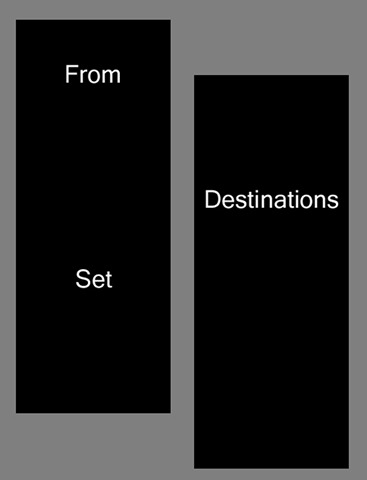
The cover design looks unlike anything my earlier work has been wrapped in, but I do rather like it. While I’m less than keen on minimalist art, as a cover design it’s undeniably striking, and also appropriate, not only to the contradictions of the narratives inside (penned in places in a rather minimalist style, while in others more expansively, and not necessarily confining either style to only one of the two stories), but also the challenges the visual aspects of the text present to the reader. The bold rectangles are very literal representations of the twin columns of the text, and serve as a reminder that Destinations is a very visual text. The placement of the words invites alternative readings: from set destinations, for example. How should the reader approach the physical task of reading the text? One story at a time, a page at a time, cross-column to create a real-time cut-up in the mind? Any and all of these are quite viable options. There are more than simply two stories, and more than two readings here.

To further the sense of variability, the pages in the printed version are unnumbered. As such, the text is complex enough, without the need for a busy or complex cover. Moreover, ‘modernism’ and ‘futurism’ are now historical, and the cover lends it something of a ‘vintage’ feel (I’m personally reminded of Breakthrough by Konstantin Raudive, published in 1971, a remarkable book in every way: http://www.colinsmythe.co.uk/books/brere.htm). Given that Destinations is in many ways concerned with he ‘future’ of narrative and issues of (dis)location in time / space, a cover that drew inspiration from retro representation of futures now past, seemed particularly appropriate. The book is both retro and of the future, and therefore not of any one time, or of any time other than that of its own making.

And in case you’re wondering, the title is a line from the song ‘Double Dare’ by Bauhaus, which is fitting not only because of the ‘double’ narrative, but because a key element of the stories is the sense of the characters’ actions being ‘steered.’ Ostensibly, someone else is writing – and rewriting – their scripts. As such, the writing process is a part of the story: but who is writing the writer? ‘Don’t back away just yet / From destinations set.’ As if they had any choice in the matter.

From Destinations Set is out on Clinicality Press on Monday 2nd August. Here are the opening pages by way of a taster:

http://christophernosnibor.co.uk/Documents/From%20Destinations%20Set%20-%20Section%201.pdf


The Pleasure of Pain of Being Chronically Misunderstood

Do you ever feel as though you’re gravely misunderstood by the majority? Feel frustrated by the complete inability of the everyday person to get even the smallest grasp on what you’re on about what you’re about? Of course you do: these feelings are common to most people at some time, ad is one of the reasons people who share not only opinions but levels of intellect gravitate toward one another in the main. It’s how society works.

As a writer, I experience these feelings of disconnection quite acutely. I tend to submit work to zines and publishers in waves, and as a consequence tend to receive rejections in waves, which punctuate the steady trickle. It doesn’t bother me per se: after all, it’s all material for my book of rejections that I will one day undoubtedly publish.

Some of the rejections I receive are quite nice: well-written and considered. One that landed with me a few weeks back suggested that the paragraphs were disproportionately long for the story. Ok… it also criticised the fact that ‘the story has to rely far too much on the reflections of the narrator.’ Given that that was the point of the piece, I found this a rather odd criticism, but at least it showed that they’d read it. On the other hand, the ‘not what we’re looking for’ and ‘sorry not for us’ rejections aren’t simply impersonal and generic, but strike me as being pointless and lazy. I know these people are busy, but really… again, the problem I find is that too few publishers – even of free e-zines – are willing to take risks, and many are excessively prescriptive in what they are ‘looking for.’

No, this isn’t a sour-grapes rant about the volume of rejections I get in a competitive market. The point is that I write the kind of stuff I like to read, largely because too few publishers are putting out the kind of stuff I like to read, and I’m quite sure my tastes aren’t so niche that I’m a market unto myself. Moreover, I suspect that a lot of the things I do intentionally are often misconstrued, and perceived as ‘errors’ or shortcomings rather than virtues.

Returning to my point about gravitating toward the like-minded, it’s fair to say valuable lessons can be learned from spending time out of one’s selected circle, however (even if it’s only to be reminded why you gravitate toward the people you do). As such, it’s worth taking the risk of being misunderstood from time to time. By posting my Michael Jackson conspiracy piece in a place where it would be read by those unfamiliar with my work, I’ve been able to infiltrate a new audience. Have I gained a new readership? Doubtful, but I’ve succeeded in winding a few people up and derived much amusement from the fact that they clearly can’t tell that I’m taking the piss.

So to pre-empt any criticisms that may be levelled at my short film ‘Into the Earth’ I should perhaps state here and now that yes, the sound quality is supposed to be a little shaky, degraded-sounding, semi-mechanised and in places lacking clarity. It’s intended to create some distance between myself and the piece, and, more importantly, to echo the themes of decay and degradation in the story itself (which, incidentally, has been rejected by the half-dozen places I’ve tried it so far, although no-one’s been more specific than that it’s not for them). And yes, the footage is supposed to be repetitious: that’s the whole point. It wasn’t that I only had a couple of minutes of footage and was feeling lazy.

Enjoy!


Spreading the Virus: World Domination via a Circuitous Route

I know it goes against all the rules of promotion to openly admit when a release hasn’t exactly been flying off the shelves, and that the way to generate buzz is to spread the word that the initial run has almost sold out and that those who’ve been hanging back need to buy now or miss out, or, worse still, be derided by their peers for living in a cultural vacuum. But I can’t be the only contrary consumer who reacts negatively to such hyp, and will automatically give up hope of obtaining a copy and claim that my avoidance of the latest trend is a mark of protest and a sign of virtue. Anyway, I’ve still got a fair pile of copies of ‘Lust for Death’ sitting here in the office (which is quite an achievement considering that there were only 25 to begin with). Pah, we’re in the middle of a global financial meltdown and I’m not the world’s most commercial writer.

I’ve written a fair few blogs in the past – and have a fair few more articles in the pipeline – that reflect my obsession with the economics of art in the 21st century. Without retreading old ground (or spoiling the surprise concerning the contents of the future pieces on the subject), my basic argument is that it’s nigh on impossible to make a living exclusively from art – be it writing, music or whatever – in the current society. I don’t blame the Internet. I just don’t think we’ve adjusted to it yet.

My initial strategy was to produce so much content that it would prove almost impossible to key anything into a search engine without stumbling across something I’d written. Now, I still maintain that content is king, and that the way to bring traffic to a site is by having as many words as possible that may show in a search as is humanly possible, but have come to realise that quality is still as important as quantity when it comes to building a fanbase. And what’s more, I’m also finding that there are other obstacles, namely publishers – but also time. I simply don’t have the time to try out countless publishers only to be told ‘not quite what we’re after.’ And I get that a lot.

Even for a writing machine, the endless stream of rejections gets to be a grind. So, at least for a short time, I intend to cut back a little on my output. Less is more, and all that. Rather than endlessly blogging and publishing on-line, I plan to spend a few months completing as many of the half-finished stories and articles I have kicking about as possible, and trying to find them homes by selectively targeting potential outlets.

The pamphlet series I began on March 31st with ‘Lust for Death’ will still happen as planned, with a new pamphlet at the end of every quarter. # 2, ‘Before the Flood’ is already written and the cover art almost there, and # 3, as yet untitled, is coming along nicely, and will be in the bag well before it’s due to be published at the end of September.

I will also be continuing with the music reviews. Since I began contributing to ‘Whisperin & Hollerin’’ back in November, I’ve added 37 reviews (and counting). It’s a good gig for me, as I get CDs in the mail and have to listen to bands I’d otherwise have avoided or simply never heard of in the name of ‘work,’ and even the occasional free entry to gigs. And I’m also noticing my reviews cropping up in all sorts of unusual places: a few of the bands I’ve reviewed have quoted from them on their websites and on CD Baby, and I even saw one of my lines in a mailing list mail-out from a label I particularly admire in the last couple of days. Is it shifting books or building my reputation? Not yet, but it’s gratifying to see that there are other routes to ubiquity. Watch this space: 2010 could yet bring me world domination…